
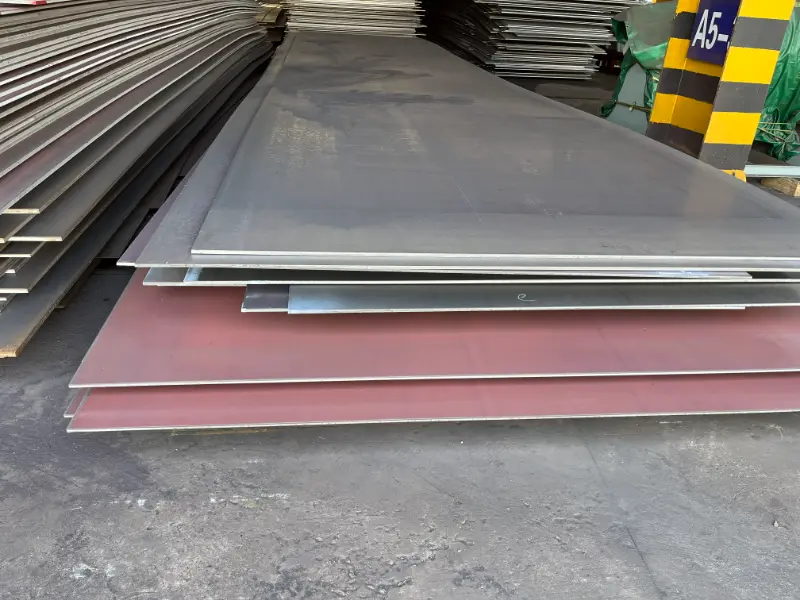
S355J2WP Weather Resistant Steel
S355J2WP Weather Resistant Steel: EN 10155 Grade, Properties & Global Equivalents
Explore S355J2WP atmospheric corrosion-resistant structural steel according to EN 10155 (EN 10025-5). Detailed data on chemical composition, mechanical properties, thermal physics, equivalent grades, and applications.
Hot rolling, cold forming, welding, machining, cutting
- Phone : +8618037372205
- Email : [email protected]
- WhatsApp: Contact via Whtsapp
- WeChat: +8618037372205
S355J2WP Weather Resistant Steel Introduction
S355J2WP is a structural weathering steel specified in EN 10155 (now superseded by EN 10025-5). It is designed for exposed steel structures where enhanced atmospheric corrosion resistance is required, often eliminating the need for protective painting. The steel achieves its weathering capability through controlled additions of phosphorus, copper, chromium and nickel, which form a dense, adherent patina that slows further corrosion.
- Strength: minimum yield strength of 355 MPa in the thinnest sections, suitable for load-bearing applications.
- Toughness: guaranteed impact energy of 27 J at -20°C (J2 quality), ensuring reliable performance in cold climates.
- Workability: good weldability and cold forming properties for efficient fabrication.
- Durability: long service life with minimal maintenance in most atmospheric environments.
Typical delivery condition is hot rolled, normalized, or thermomechanically rolled. The steel is widely used in bridges, container structures, architectural facades, and railway vehicles.
S355J2WP Weather Resistant Steel Chemical Composition
The weathering properties of S355J2WP derive from phosphorus, copper, chromium and nickel. Phosphorus, in particular, is intentionally maintained in the range 0.06–0.15% to promote protective rust formation. The limits listed below comply with EN 10025-5:2004. Microalloying elements such as niobium, vanadium, or titanium may be present by agreement for grain refinement, but are not mandatory in the standard.
| Chemical Element | Standard Value (wt%) | Remarks |
|---|---|---|
| Carbon (C) | ≤ 0.12 | Maximum |
| Silicon (Si) | ≤ 0.75 | Maximum |
| Manganese (Mn) | ≤ 1.00 | Maximum |
| Phosphorus (P) | 0.06 – 0.15 | Key weathering element; upper limit control |
| Sulfur (S) | ≤ 0.030 | Maximum |
| Chromium (Cr) | 0.30 – 1.25 | Enhances patina formation and strength |
| Copper (Cu) | 0.25 – 0.55 | Essential for atmospheric corrosion resistance |
| Nickel (Ni) | ≤ 0.65 | Maximum; improves toughness and corrosion resistance |
| Other alloying | Niobium, Vanadium, Titanium may be added by agreement | Grain refinement; if added, content limits apply per standard |
S355J2WP Weather Resistant Steel Thermal and Electrical Physical Properties
The physical properties listed below are typical for S355J2WP as a low-alloy structural steel. These values are not mandatory in the product standard but are essential for design calculations involving thermal expansion, heat transfer, and structural dynamics. Slight variations may occur depending on exact chemical composition and heat treatment condition.
| Physical Property | Typical Value | Unit | Test Condition / Reference |
|---|---|---|---|
| Density (ρ) | 7850 | kg/m³ | At 20°C |
| Modulus of Elasticity (E) | 200 – 210 | GPa | At 20°C, tension |
| Shear Modulus (G) | ≈ 80 | GPa | At 20°C, calculated from E and ν |
| Poisson's Ratio (ν) | 0.3 | dimensionless | At 20°C, elastic range |
| Thermal Expansion Coefficient (α) | 12.0 × 10⁻⁶ | K⁻¹ | Between 20°C and 100°C |
| Thermal Conductivity (λ) | 25 – 35 | W/(m·K) | At 20°C |
| Specific Heat Capacity (c) | ≈ 460 | J/(kg·K) | At 20°C |
| Electrical Resistivity (ρ_e) | 0.13 – 0.20 | μΩ·m | At 20°C |
S355J2WP Weather Resistant Steel Mechanical Properties
The mechanical properties are specified for longitudinal test pieces in the hot-rolled or normalized condition. Yield strength (ReH) decreases with increasing product thickness. Impact energy (KV) is guaranteed at -20°C for J2 quality. Elongation (A) requirements also vary with thickness. These values conform to EN 10025-5 and represent minimum requirements unless a range is given.
| Property | Standard Required Value | Unit | Test Condition / Thickness (mm) |
|---|---|---|---|
| Yield Strength (ReH) | ≥ 355 | MPa | t ≤ 16 |
| Yield Strength (ReH) | ≥ 345 | MPa | 16 < t ≤ 40 |
| Yield Strength (ReH) | ≥ 335 | MPa | 40 < t ≤ 63 |
| Yield Strength (ReH) | ≥ 325 | MPa | 63 < t ≤ 80 |
| Yield Strength (ReH) | ≥ 315 | MPa | 80 < t ≤ 100 |
| Yield Strength (ReH) | ≥ 295 | MPa | 100 < t ≤ 150 |
| Tensile Strength (Rm) | 470 – 630 | MPa | t ≤ 100 |
| Tensile Strength (Rm) | 450 – 600 | MPa | 100 < t ≤ 150 |
| Elongation (A) | ≥ 22 | % | t ≤ 40 (longitudinal) |
| Elongation (A) | ≥ 21 | % | 40 < t ≤ 63 (longitudinal) |
| Elongation (A) | ≥ 20 | % | 63 < t ≤ 100 (longitudinal) |
| Elongation (A) | ≥ 18 | % | 100 < t ≤ 150 (longitudinal) |
| Impact Energy (KV, -20°C) | ≥ 27 | J | Longitudinal, standard specimen |
S355J2WP Weather Resistant Steel Completely Equivalent Material Standards & Substitute Grades
| Country/Region | Standard | Grade | Remarks |
|---|---|---|---|
| Europe | EN 10025-5:2004 | S355J2WP | Full equivalence; supersedes EN 10155 designation |
| Europe | EN 10155:1993 | S355J2WP | Original standard; often still referenced in specifications |
S355J2WP Weather Resistant Steel Application Introduction
S355J2WP is engineered for long-term outdoor exposure with minimal painting. Its self-protecting oxide layer (patina) develops over time under wet-dry cycling, reducing corrosion rates to around 0.01–0.02 mm/year. The steel is fully weldable with appropriate consumables and can be cold formed into complex shapes.
- Design note: Provide drainage to avoid water stagnation; avoid contact with de-icing salts.
- Fabrication: Use weathering steel electrodes/wires for welding; post-weld cleaning is usually unnecessary.
Product Applications: Road and pedestrian bridges, Steel-framed buildings with exposed steel elements, Weathering steel facades and cladding, Freight containers and intermodal chassis, Railway wagons and locomotive body panels, High-voltage transmission towers, Signage structures and lighting columns, Outdoor storage tanks and silos, Architectural sculptures and landscape features
Processed into products: Bridge girders, box sections, and stiffeners, Structural columns and beams in building frames, Welded hollow sections for architectural trusses, Container corner posts and side rails, Railcar underframes and side walls, Tower legs and cross arms for power lines, Formed and welded brackets for outdoor equipment, Corrugated sheets for roofing and siding
Application industries: Construction and Civil Engineering, Bridge Building, Architectural & Façade Design, Container Manufacturing, Railway Industry, Power Transmission (Towers & Poles), Offshore & Coastal Structures (with care), Agricultural Equipment, Art & Sculpture
S355J2WP Weather Resistant Steel Similar / Alternative Materials with Comparable Weathering Behavior
| Country/Region | Standard | Grade | Remarks |
|---|---|---|---|
| USA | ASTM A588 / A588M | Grade A | Yield ≥345 MPa; higher Mn, lower P; similar corrosion index but not identical |
| China | GB/T 4171 | Q355NH | Yield ≥355 MPa; impact at 20°C or 0°C; weathering composition resembles S355J2W |
| Japan | JIS G3114 | SMA490AW | Yield ≥365 MPa; weathering steel for welded structures; P content lower |
| International | ISO 4952:2003 | S355W | Chemical composition allows phosphorus-based or Cr-based weathering; verify P range |
Notes:
For welding, low-hydrogen processes are recommended. Matching weathering consumables (e.g., AWS E7018-W) ensure uniform corrosion protection at welds. Despite its corrosion resistance, the steel is not suitable for continuously submerged or aggressive chemical environments. In chloride-rich coastal areas, more frequent inspection and controlled washing may be needed to maintain the patina. Always consult the full EN 10025-5 standard and relevant national annexes before use in structural design.
- Share



