
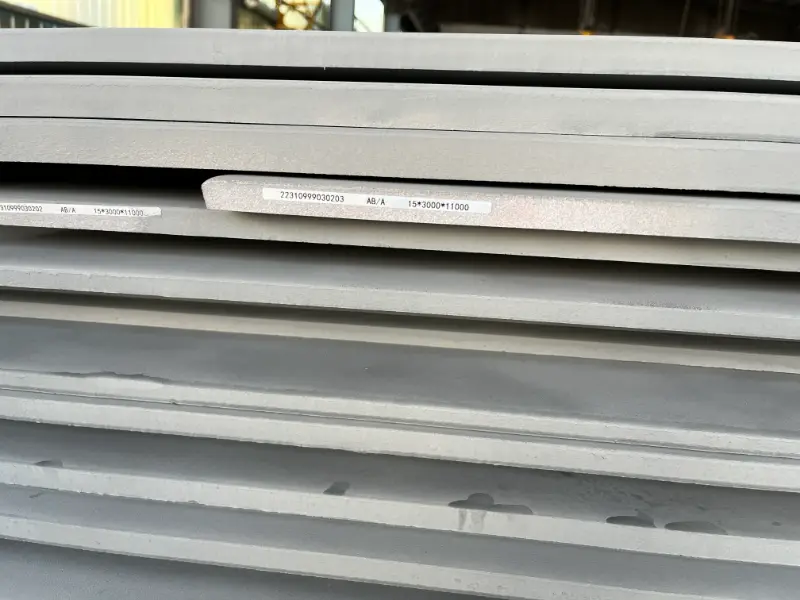
DNV Grade A40 Shipbuilding Steel Plate
DNV Grade A40 Shipbuilding Steel Plate - High Strength Marine Structural Steel
Detailed material data for DNV Grade A40 shipbuilding steel plate: chemical composition, mechanical properties, physical characteristics, equivalent grades, and application guidance for marine and offshore structures.
Hot rolling, controlled rolling, normalizing, thermo‑mechanical control process (TMCP), quenching and tempering (for thicker sections when agreed)
- Phone : +8618037372205
- Email : [email protected]
- WhatsApp: Contact via Whtsapp
- WeChat: +8618037372205
DNV Grade A40 Shipbuilding Steel Plate Introduction
DNV Grade A40 is a high-strength hull structural steel specified by the Det Norske Veritas classification society (now DNV GL). It belongs to the series of normalized or thermo-mechanically controlled rolled (TMCP) steels used in ship and offshore construction. With a minimum yield strength of 390 MPa, A40 provides an excellent balance of strength, weldability, and toughness at 0°C impact temperature. Typical thicknesses range up to 50 mm, with deliveries in normalized or TMCP condition. Its chemical composition is tightly controlled to ensure good weldability and resistance to brittle fracture, making it suitable for critical hull components such as decks, shells, and longitudinal stiffeners. The grade is widely accepted by major classification societies and can be substituted with equivalent designations like ABS AH40 or LR AH40. The steel exhibits typical physical properties of carbon‑manganese steels, including a density of 7.85 g/cm³ and an elastic modulus of about 205 GPa.
DNV Grade A40 Shipbuilding Steel Plate Chemical Composition
The chemical composition meets the requirements of DNV GL rules for grade A40. Microalloying elements (Nb, V, Ti) may be added singly or in combination to achieve grain refinement and precipitation strengthening. The total aluminium content ensures full deoxidation. Carbon equivalent (CEV) is usually controlled to guarantee weldability and is typically ≤0.38% for this strength level.
| Element | Content (%) | Remarks |
|---|---|---|
| Carbon (C) | ≤0.18 | |
| Manganese (Mn) | 0.90–1.60 | |
| Silicon (Si) | ≤0.50 | |
| Phosphorus (P) | ≤0.025 | |
| Sulfur (S) | ≤0.025 | |
| Aluminium (Al total) | ≥0.020 | Acid soluble Al ≥0.015%; for fully killed steel |
| Niobium (Nb) | 0.02–0.05 | If added alone or in combination |
| Vanadium (V) | 0.05–0.10 | If added alone or in combination |
| Titanium (Ti) | 0.007–0.05 | If added; often used for grain refinement |
| Nitrogen (N) | ≤0.012 | Unless bound by sufficient Al, Ti, etc. |
DNV Grade A40 Shipbuilding Steel Plate Thermal and Electrical Physical Properties
Physical properties are typical for hot‑rolled carbon‑manganese structural steel and are not part of DNV acceptance criteria. They are provided for design calculations such as heat transfer, thermal expansion, and electrical resistivity. Values may vary slightly depending on exact composition and processing.
| Property | Typical Value | Unit | Remarks |
|---|---|---|---|
| Density (ρ) | 7.85 | g/cm³ | At 20°C |
| Elastic Modulus (E) | 205–210 | GPa | At 20°C |
| Shear Modulus (G) | ~80 | GPa | Estimated from E and Poisson's ratio |
| Poisson's Ratio (ν) | 0.3 | — | At 20°C |
| Thermal Expansion Coefficient (α) | 11.5 (20–100°C); 12.5 (20–200°C) | 10⁻⁶/K | Average linear coefficient |
| Thermal Conductivity (λ) | ~50 (at 20°C) | W/(m·K) | Decreases with increasing temperature |
| Specific Heat Capacity (Cp) | 460–500 | J/(kg·K) | Room temperature to 100°C |
| Electrical Resistivity (ρ_e) | ~0.20 | μΩ·m | At 20°C |
DNV Grade A40 Shipbuilding Steel Plate Mechanical Properties
The following tensile, impact and bending properties are required by DNV GL rules for grade A40 plates ≤50 mm thickness. Test specimens are generally taken in the transverse direction for tensile tests and longitudinal for impact, unless otherwise specified. Impact testing is performed at 0°C using Charpy V‑notch specimens. Results are the minimum average of three specimens and individual minimum.
| Property | Specified Value | Unit | Test Condition |
|---|---|---|---|
| Yield Strength (ReH) | ≥390 | MPa | Transverse, thickness ≤50 mm, ambient |
| Tensile Strength (Rm) | 510–650 | MPa | Transverse, thickness ≤50 mm, ambient |
| Elongation (A5) | ≥20 | % | Longitudinal, gauge length 5.65√So, thickness ≤50 mm |
| Bending Test | No cracks at 180° bending | — | Former diameter d = 3a (a = plate thickness), ambient temperature |
| Impact Energy (KV2, longitudinal) | ≥27 | J | At 0°C, Charpy V‑notch, average of three |
| Impact Energy (KV2, transverse) | ≥20 | J | At 0°C, Charpy V‑notch, average of three |
DNV Grade A40 Shipbuilding Steel Plate Fully Equivalent Material Standards and Substitute Designations
| Country/Region | Standard / Society | Designation | Remarks |
|---|---|---|---|
| USA | American Bureau of Shipping (ABS) | AH40 | Same yield strength (390 MPa min) and impact temperature (0°C) |
| UK | Lloyd's Register (LR) | AH40 | Equivalent in all respects |
| France | Bureau Veritas (BV) | AH40 | Equivalent |
| China | China Classification Society (CCS) | AH40 | Equivalent |
| Japan | Nippon Kaiji Kyokai (NK/ClassNK) | AH40 | Equivalent |
| South Korea | Korean Register (KR) | AH40 | Equivalent |
| Italy | Registro Italiano Navale (RINA) | AH40 | Equivalent |
| Russia | Russian Maritime Register of Shipping (RS) | AH40 | Equivalent |
| India | Indian Register of Shipping (IRS) | AH40 | Equivalent |
| International (ASTM) | ASTM A131/A131M | AH40 | Equivalent shipbuilding steel |
DNV Grade A40 Shipbuilding Steel Plate Application Introduction
DNV Grade A40 is extensively used in the marine and offshore industry where high strength and moderate low‑temperature toughness are required. Its excellent weldability allows efficient fabrication of complex structures. Typical applications are listed below.
Product Applications: Hull structural plates (bottom, side, deck), Bulkheads and longitudinal/transverse web frames, Stiffeners (flat bars, bulb profiles, angles), Deck plating and hatch coamings, Offshore platform decks and module support structures, Monopile and transition piece components for wind turbines, Bridge girders and box sections
Processed into products: Bottom shell plates and keel plates, Side shell strakes, Main deck and strength deck plating, Longitudinal stiffeners and stringers, Transverse floor plates and brackets, Bulkhead stiffeners and primary support members, Hatch coaming stays and crane pedestals, Bitts, chocks and fairleads foundation plates
Application industries: Shipbuilding (commercial vessels, naval ships), Offshore Engineering (oil & gas platforms, wind turbine foundations), Marine & Harbor Construction, Bridge Building, Heavy Machinery & Crane Manufacturing, Pressure Vessel & Boiler (where approved)
DNV Grade A40 Shipbuilding Steel Plate Similar or Closely Related Grades
| Country/Region | Standard / Grade | Designation | Remarks |
|---|---|---|---|
| Norway (DNV) | DNV Rules | DH40 | Higher toughness: impact at -20°C, same strength level |
| Norway (DNV) | DNV Rules | EH40 | Very high toughness: impact at -40°C, same strength |
| Norway (DNV) | DNV Rules | AH36 | Lower strength (355 MPa min), same impact temperature |
| European (EN) | EN 10025-4 | S420ML/S420MLO | Thermo‑mechanically rolled, min yield 420 MPa, impact at -50°C, comparable in strength |
| International (ISO) | ISO 4950-3 | E420 | High yield strength steel for structural purposes, similar tensile properties |
Notes:
Welding and Fabrication: DNV A40 steel exhibits good weldability with low carbon equivalent (CEV typically ≤0.38%). Preheating is generally not required for plate thicknesses up to 30 mm at ambient temperatures (>5°C); for thicker sections or low‑temperature conditions, a preheat of 50–100°C may be recommended. Common welding processes (SMAW, SAW, FCAW, GMAW) with matching or slightly overmatching consumables are suitable. Post‑weld heat treatment is normally not required, but if applied, it must respect DNV guidelines to avoid degradation of mechanical properties. The material is supplied with certificates in accordance with EN 10204 Type 3.1 or 3.2, and additional testing (ultrasonic, through‑thickness properties) can be ordered.
- Share



