
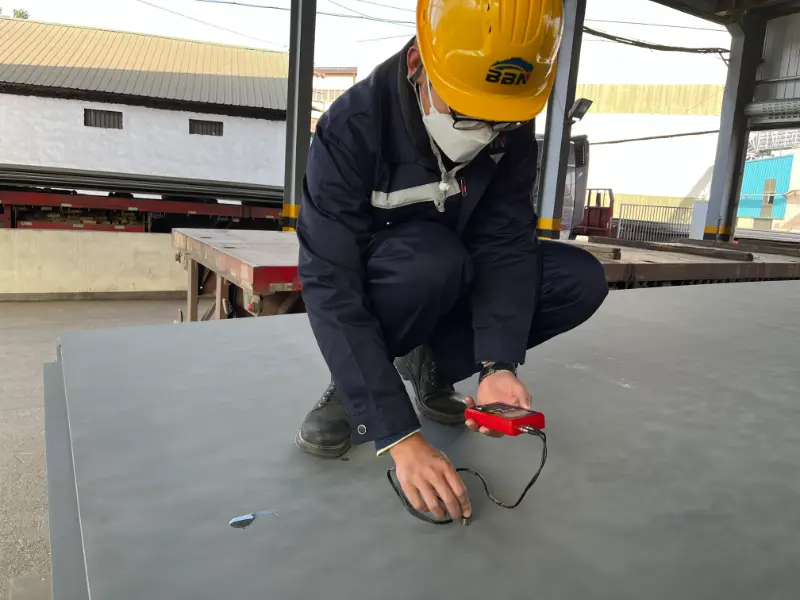
ABS Grade FQ70 Shipbuilding Steel Plate
ABS Grade FQ70: High-Strength Quenched & Tempered Steel for Offshore & Marine Structures
ABS FQ70 is a high-strength quenched and tempered steel plate with a minimum yield strength of 690 MPa, designed for demanding offshore and marine constructions. It offers excellent weldability, low-temperature toughness, and resistance to harsh environments.
Hot rolling, quenching and tempering, cold forming, welding, machining
- Phone : +8618037372205
- Email : [email protected]
- WhatsApp: Contact via Whtsapp
- WeChat: +8618037372205
ABS Grade FQ70 Shipbuilding Steel Plate Introduction
ABS Grade FQ70 is a high-strength structural steel plate classified under the American Bureau of Shipping (ABS) Rules for Materials and Welding. It undergoes quenching and tempering (Q&T) to achieve a minimum yield strength of 690 MPa, making it suitable for heavy-load offshore platforms, ship hulls, and critical structural components. The material provides excellent low-temperature impact toughness (tested at -60°C), good weldability when proper procedures are followed, and high resistance to fatigue and brittle fracture. FQ70 is part of the ABS Extra High Strength Steel category, meeting rigorous requirements for chemical composition and mechanical properties, and is widely used in
- jack-up rig legs
- heavy-lift crane booms
- pressure vessel shells
.
ABS Grade FQ70 Shipbuilding Steel Plate Chemical Composition
The chemical composition respects the limits specified in ABS Rules. Micro-alloying elements like Nb, V, and Ti ensure grain refinement and precipitation strengthening while maintaining weldability. Carbon equivalent (CEV) is typically controlled to match mechanical performance.
| Element | Standard Value (max) | Comment |
|---|---|---|
| Carbon (C) | 0.20 | Max |
| Silicon (Si) | 0.10 – 0.55 | Range |
| Manganese (Mn) | 0.90 – 1.60 | Range |
| Phosphorus (P) | 0.025 | Max |
| Sulfur (S) | 0.025 | Max |
| Chromium (Cr) | 0.25 | Max |
| Nickel (Ni) | 0.40 | Max |
| Molybdenum (Mo) | 0.08 | Max |
| Copper (Cu) | 0.35 | Max |
| Niobium (Nb) | 0.02 – 0.05 | Range |
| Vanadium (V) | 0.05 – 0.10 | Range |
| Titanium (Ti) | 0.02 | Max |
| Aluminum (Al, total) | 0.015 min | Min, grain refining |
| Boron (B) | 0.0005 – 0.005 | Optional micro-alloy, if agreed |
ABS Grade FQ70 Shipbuilding Steel Plate Thermal & Electrical Physical Properties
Physical values are typical for quenched and tempered high‑strength structural steel. They are not mandatory in ABS rules but useful for design. Properties may vary slightly depending on exact chemical composition and heat treatment.
| Property | Typical Value | Unit | Test Condition |
|---|---|---|---|
| Density (ρ) | 7.85 | g/cm³ | 20 °C |
| Modulus of elasticity (E) | 205 | GPa | 20 °C |
| Shear modulus (G) | 80 | GPa | 20 °C |
| Poisson's ratio (ν) | 0.3 | — | 20 °C |
| Coefficient of thermal expansion (α) | 11.5 × 10⁻⁶ | 1/K | 20 – 100 °C |
| Coefficient of thermal expansion (α) | 12.0 × 10⁻⁶ | 1/K | 20 – 200 °C |
| Coefficient of thermal expansion (α) | 12.8 × 10⁻⁶ | 1/K | 20 – 400 °C |
| Thermal conductivity (λ) | 45 | W/(m·K) | 20 °C |
| Thermal conductivity (λ) | 40 | W/(m·K) | 200 °C |
| Specific heat capacity (cp) | 460 | J/(kg·K) | 20 °C |
| Electrical resistivity (ρₑ) | 0.25 × 10⁻⁶ | Ω·m | 20 °C |
ABS Grade FQ70 Shipbuilding Steel Plate Mechanical Properties
The following values apply for plates in the quenched and tempered condition, tested in accordance with ABS requirements. Both longitudinal and transverse properties are defined; values shown are typical minimums for longitudinal specimens unless noted otherwise.
| Property | Standard Requirement | Unit | Test Condition |
|---|---|---|---|
| Yield strength (ReH) | 690 min | MPa | Room temperature, longitudinal |
| Tensile strength (Rm) | 770 – 940 | MPa | Room temperature, longitudinal |
| Elongation (A5) | 14 min | % | Gauge length 5.65√Sₒ, longitudinal |
| Bend test (bending angle 180°) | D=3a | — | Mandrel diameter (a = plate thickness), crack-free |
| Impact energy (KV₂) | 69 min (average) / 52 min (single) | J | -60 °C, longitudinal |
| Impact energy (KV₂) | 50 min (average) / 38 min (single) | J | -60 °C, transverse (if agreed) |
ABS Grade FQ70 Shipbuilding Steel Plate Fully Equivalent Material Standards & Substitute Grades
| Country/Region | Standard | Grade | Remarks |
|---|---|---|---|
| Europe | EN 10025-6 | S690QL | Yield 690 MPa, Q&T, -60°C impact option |
| International (offshore) | API 2W | Grade 60 (690 MPa class) | Similar low-temperature toughness requirements |
| France | NF A 36-231 | L690QL | Equivalent to EN S690QL |
| China | GB/T 16270 | Q690D/E | When low-temperature impact is agreed (E: -40°C; additional requirements for -60°C may be negotiated) |
ABS Grade FQ70 Shipbuilding Steel Plate Application Introduction
ABS FQ70 is designed for critical structural applications requiring high strength, weight savings, and reliable performance in extreme cold. Main uses include
- offshore and marine structures
- heavy lifting equipment
- pressure vessels
. It is supplied as quenched and tempered plate, ready for fabrication. Post-weld heat treatment is generally avoided unless thoroughly qualified.
Product Applications: Jack-up rig legs and spudcans, Offshore platform decks and nodes, Ship hulls for ice-class vessels, Heavy-lift crane booms and structures, Hydropower penstocks and spiral cases, Armor plate and security barriers, Pile-driving hammers and components
Processed into products: Welded structural beams and columns, Flanges and rolled cylinder sections, Transition pieces for offshore wind turbines, Padeyes, lifting brackets, Fatigue-critical joints, Cutter heads for dredging equipment
Application industries: Shipbuilding and marine engineering, Offshore oil & gas platforms (jack-ups, semi-submersibles), Renewable energy (offshore wind turbine foundations), Heavy equipment manufacturing (cranes, mining trucks), Pressure vessel and boiler construction
ABS Grade FQ70 Shipbuilding Steel Plate Close / Similar Alternative Materials
| Country/Region | Standard | Grade | Remarks |
|---|---|---|---|
| USA | ASTM A514/A517 | Grade Q | Yield 690 MPa, quenched & tempered, similar chemistry but with specific alloy limits; verify toughness at -60°C |
| Norway/Germany | DNV/GL | NV F690 | 690 MPa yield, offshore grade, -60°C impact, widely accepted |
| International | Lloyd's Register | LR FH690 | 690 MPa Q&T offshore steel, -60°C Charpy, fully substitutable |
| Japan | JIS G 3128 | SHY685NS | Quenched & tempered, 685 N/mm² tensile class; check elongation and toughness to match FQ70 |
Notes:
Welding: Preheating and interpass temperature control are required according to the carbon equivalent value; typically preheat above 100 °C. Low-hydrogen consumables must be used. Forming: Cold forming to minimum bending radii; hot forming above 600 °C is permissible if followed by re‑quenching and tempering. Corrosion protection: Coatings or cathodic protection are recommended in marine environments. The material is not intended for prolonged service above 250 °C as mechanical properties may degrade.
- Share



