
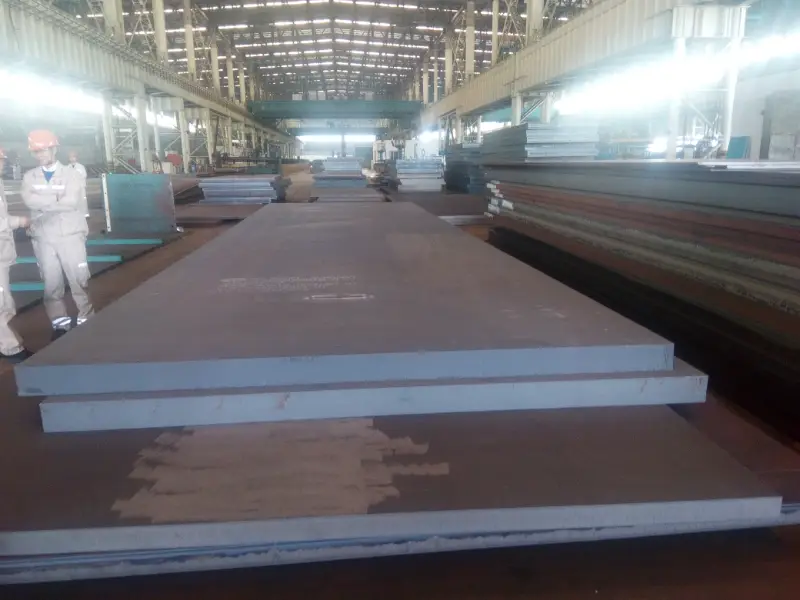
ABS Grade EQ70
ABS Grade EQ70 - High-Strength Quenched and Tempered Steel for Ship and Offshore Structures
Detailed material data for ABS Grade EQ70, a high-strength structural steel for marine and offshore applications. Includes chemical composition, mechanical, thermal properties, and equivalent grades.
Thermal cutting, cold forming, machining, welding (with recommended preheat and low-hydrogen procedures); cold bending should be restricted to avoid cracking in the Q&T condition.
- Phone : +8618037372205
- Email : [email protected]
- WhatsApp: Contact via Whtsapp
- WeChat: +8618037372205
ABS Grade EQ70 Introduction
ABS Grade EQ70 is a high-strength quenched and tempered steel specified under the American Bureau of Shipping (ABS) Rules for Materials and Welding. It provides a minimum yield strength of 620 MPa (90 ksi) and is designed for demanding marine and offshore environments where weight reduction and high load capacity are critical. The "E" suffix indicates an impact test temperature of -40°C, ensuring excellent notch toughness in cold climates. Key characteristics include:
- High yield and tensile strength, allowing lighter structural designs.
- Excellent low-temperature toughness through controlled chemistry and Q&T processing.
- Good weldability when proper preheat and consumables are used.
- Compliance with ABS weldability and lamellar tearing requirements.
ABS Grade EQ70 Chemical Composition
The chemical composition of ABS EQ70 is tightly controlled to achieve the required strength and toughness after quenching and tempering. Carbon equivalent (CEV) is usually limited to ≤0.52–0.55% to ensure sufficient weldability. Micro-alloying elements (Nb, V, Ti, Al) promote grain refinement and precipitation strengthening. Phosphorus and sulfur are kept low for cleanliness and ductility.
| Element | Content (%) | Remarks |
|---|---|---|
| Carbon (C) | ≤0.20 | Typical range 0.12–0.18 for optimum strength/toughness balance |
| Silicon (Si) | ≤0.55 | Deoxidizer; higher values increase strength marginally |
| Manganese (Mn) | ≤1.70 | Key contributor to hardenability and strength |
| Phosphorus (P) | ≤0.025 | Controlled for improved toughness and weldability |
| Sulfur (S) | ≤0.025 | Kept low to avoid hot cracking and lamellar tearing |
| Chromium (Cr) | ≤1.50 | Increases hardenability and corrosion resistance |
| Nickel (Ni) | ≤2.00 | Enhances low-temperature toughness and hardenability |
| Molybdenum (Mo) | ≤0.70 | Hardenability agent, reduces temper embrittlement |
| Copper (Cu) | ≤0.50 | Added for weather resistance; sometimes present as residual |
| Vanadium (V) | ≤0.10 | Grain refiner and precipitation strengthener |
| Niobium (Nb) | ≤0.06 | Strong grain refiner and precipitation hardener |
| Titanium (Ti) | ≤0.05 | Grain refinement and nitrogen scavenger |
| Aluminum (Al) | ≥0.015 total | Deoxidizer and grain refiner; acid-soluble Al is specified |
| Nitrogen (N) | ≤0.020 | Controlled to avoid strain aging and maintain toughness |
| Boron (B) | ≤0.005 | Optional; can enhance hardenability in heavy sections |
| Carbon Equivalent (CEV) | Typically ≤0.52–0.55 | Calculated as C + Mn/6 + (Cr+Mo+V)/5 + (Ni+Cu)/15 |
ABS Grade EQ70 Thermal and Electrical Physical Properties
These physical properties are representative for a low-alloy quenched and tempered steel with similar composition. Slight variations may occur depending on exact tempering temperature and section size. Values are provided for engineering calculations and should be verified against specific mill certificates when necessary. The density is based on an iron-based alloy; elastic modulus is typical for structural steel.
| Property | Typical Value | Unit | Test Condition |
|---|---|---|---|
| Density (ρ) | 7.85 | g/cm³ | Room temperature |
| Elastic Modulus (E) | 205 | GPa | Room temperature, tension |
| Shear Modulus (G) | 80 | GPa | Calculated from E and ν |
| Poisson's Ratio (ν) | 0.3 | - | Elastic range |
| Thermal Expansion Coefficient (α) | 12.1 × 10⁻⁶ | K⁻¹ | 20 – 100 °C |
| Thermal Expansion Coefficient (α) | 13.6 × 10⁻⁶ | K⁻¹ | 20 – 400 °C |
| Thermal Conductivity (λ) | 42 | W/(m·K) | At 20°C |
| Thermal Conductivity (λ) | 39 | W/(m·K) | At 300°C |
| Specific Heat Capacity (cp) | 475 | J/(kg·K) | Room temperature |
| Electrical Resistivity (ρ_e) | 0.15 × 10⁻⁶ | Ω·m | At 20°C (approx. 15 µΩ·cm) |
ABS Grade EQ70 Mechanical Properties
The mechanical properties below are extracted from ABS Rules for Materials and Welding (2023) for Grade EQ70. Strength values depend on plate thickness – the minimum yield strength decreases as thickness increases above 50 mm. Charpy V-notch impact tests are performed on longitudinal and transverse specimens at -40°C. The average absorbed energy must meet the specified minimum, with individual values ≥70% of the average. Bend test is carried out with a mandrel diameter of 3 times the specimen thickness (3a) and 180° bending without cracking.
| Property | Required Value | Unit | Test Condition |
|---|---|---|---|
| Yield Strength (ReH) | ≥620 | MPa | t ≤ 50 mm |
| Yield Strength (ReH) | ≥580 | MPa | 50 mm < t ≤ 70 mm |
| Yield Strength (ReH) | ≥550 | MPa | 70 mm < t ≤ 100 mm |
| Yield Strength (ReH) | ≥550 | MPa | 100 mm < t ≤ 150 mm |
| Tensile Strength (Rm) | 720 – 890 | MPa | All thicknesses |
| Elongation (A5.65) | ≥15 | % | Longitudinal, gauge length L0 = 5.65√So |
| Elongation (A5.65) | ≥14 | % | Transverse, gauge length L0 = 5.65√So (for guidance) |
| Bend Test | No cracks after 180° bend | - | Mandrel diameter = 3a (a = specimen thickness) |
| Charpy Impact (KV2) at -40°C (Longitudinal) | ≥34 (average) | J | Full-size specimen (10×10 mm) |
| Charpy Impact (KV2) at -40°C (Transverse) | ≥24 (average) | J | Full-size specimen (10×10 mm) |
ABS Grade EQ70 Fully Equivalent Material Standards and Substitution Grades
| Country / Region | Standard | Grade | Remarks |
|---|---|---|---|
| Europe | EN 10025-6 (2019) | S620Q (with -40°C impact option) | Identical strength class and QT condition; verify toughness option (class L = -40°C) |
| Norway (DNV) | DNV Rules for Ships / OS-B101 | NV E620 | Direct equivalent for ship and offshore; Q&T; -40°C Charpy |
| China (CCS) | CCS Materials & Welding Rules | A620Q / D620Q / E620Q | EH620Q matches EQ70; specify -40°C and Q&T |
| Japan (NK) | NK Rules Part K | KE620 | Equivalent with longitudinal KV ≥ 34J at -40°C; Q&T delivery |
| France (BV) | BV Rules M7-6 | E620 | Same minimum yield and impact requirements; HT (Q&T) condition |
| UK (LR) | Lloyd's Register Rules | LR SH62 QT | LR S620Q is the designation; confirm -40°C notch toughness |
| International (ISO) | ISO 17684 Ships & Marine Technology | ISO E620 | Harmonized standard; essentially identical in chemistry and properties |
ABS Grade EQ70 Application Introduction
ABS EQ70 is engineered for heavy-load-bearing welded structures that require an excellent strength-to-weight ratio and reliable low-temperature toughness. Due to its hardening tendency from alloy content and carbon equivalent, special attention must be paid to welding procedures (preheat, interpass temperature, post-weld heat treatment) and forming limits. Preferred stock size availability and delivery condition (Q&T) should be aligned with fabrication capabilities.
Product Applications: Hull plates for high-stress zones in large container ships (sheer strakes, bilge strakes), Leg chords and rack plates of self-elevating drilling units, Deck plates and bulkheads in FPSO and offshore platforms, Boom and jib sections for heavy-lift crawler cranes, Transition pieces and anchor frames for wind turbine foundations, High-pressure piping and manifold blocks (with suitable supplementary requirements)
Processed into products: Stiffeners, girders, and beams in primary hull support structures, Padeyes and lifting lugs subject to high dynamic loads, Bolted/riveted connection plates in modular offshore structures, Reinforcement collars and doubler plates around mooring points, Cut-outs and inserts where local stress concentrations demand high strength
Application industries: Shipbuilding (container ships, LNG carriers, ice-class vessels), Offshore Oil & Gas (jack-up rigs, semi-submersibles, production platforms), Heavy Engineering (crane structures, excavator booms, piling equipment), Bridge Construction (orthotropic decks, truss members), Pressure Vessels and Boilers (where ASME compatibility is verified), Naval and Defense (surface combatant hulls, submarine frames)
ABS Grade EQ70 Similar or Alternative High-Strength Steels for Reference
| Country / Region | Standard | Grade | Remarks |
|---|---|---|---|
| United States (ABS) | ABS Rules | EQ63 | Lower yield strength (min 550 MPa) but same toughness class – cost-effective alternative when full 620 MPa not needed |
| United States (ASTM) | ASTM A514/A517 | Grade Q (S690Q equivalent) | Higher minimum yield (690 MPa); requires suitable welding procedures and may be overstrength for some designs |
| Europe | EN 10025-6 | S690Q (-40°C) | Widely available Q&T grade; higher strength than EQ70, but can be substituted with re-evaluation of design safety factors |
| Japan | JIS G 3128 | SHY 685NS | Similar strength level (Y.S. 685 MPa); commonly used in heavy machinery; check impact temperature |
| China | GB/T 16270 | Q550D/Q690D | Q550D has lower strength; Q690D is higher; must select appropriate thickness and impact class |
| Russia | GOST 19281 | 09G2S (historical) | Lower strength (YS ~345 MPa) – not a direct substitute, but used in comparable shipbuilding applications |
Notes:
- Welding: Use low-hydrogen process (SMAW, GMAW, SAW) with appropriate preheat (typically 100–150°C for thicknesses up to 50 mm; higher for thicker sections). Heat input and interpass temperature must be controlled to preserve mechanical properties.
- Forming: Cold forming radius should not be less than 3× thickness to avoid cracking; hot forming may degrade Q&T properties – re-tempering may be required.
- Heat treatment: The material is delivered in Q&T condition; flame-cutting edges may require light grinding or temper bead technique to remove hardened zones.
- Certification: ABS inspection and stamping are mandatory; test certificates must include chemical analysis, tensile, impact and bend tests as per ABS Part 2.
- Lamellar Tearing: When through-thickness loading is expected, steel with guaranteed Z-direction properties (e.g., Z25, Z35 according to EN 10164) should be specified.
- Share



