
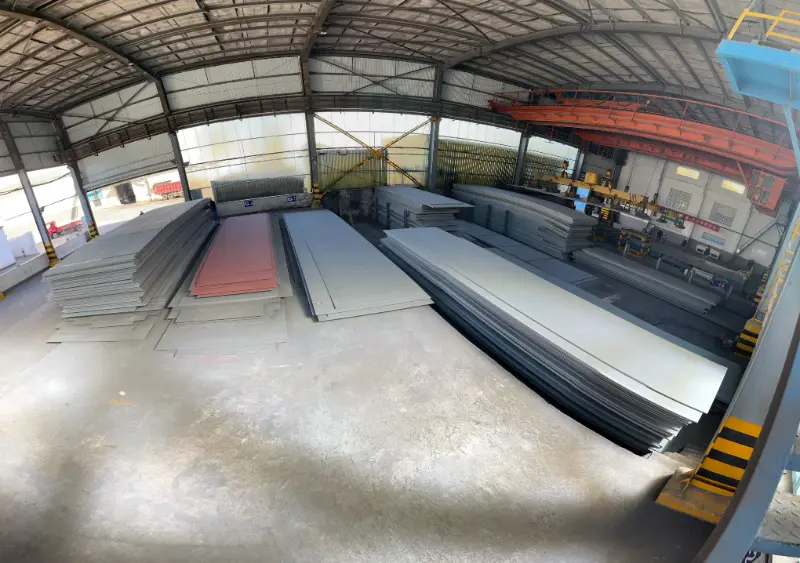
ASTM A131 Grade EH32 Shipbuilding Steel Plate
ASTM A131 Grade EH32 High-Strength Shipbuilding Steel Plate Data & Equivalents
Complete technical data for ASTM A131 Grade EH32 steel plate: chemical composition, mechanical properties, thermal and electrical physical properties, international equivalents, and application guidance for ship and offshore structures.
Hot rolling, normalizing, thermo-mechanical control process (TMCP), quenching + tempering (optional for improved toughness), welding, cutting, forming, machining
- Phone : +8618037372205
- Email : [email protected]
- WhatsApp: Contact via Whtsapp
- WeChat: +8618037372205
ASTM A131 Grade EH32 Shipbuilding Steel Plate Introduction
ASTM A131 Grade EH32 is a high-strength hull structural steel specified under ASTM A131/A131M. It is intended for use in the construction of ships and marine equipment that require superior weldability and low-temperature toughness. The grade is primarily supplied in normalized or thermo-mechanically controlled processed (TMCP) condition to achieve a minimum yield strength of 315 MPa, excellent ductility, and guaranteed impact energy at -40 °C. Typical delivery shapes include plates, sheets, and cut-to-length pieces.
- Minimum yield strength: 315 MPa
- Tensile strength range: 440–590 MPa
- Charpy V-notch impact: ≥ 34 J at -40 °C (longitudinal)
- Good resistance to brittle fracture in Arctic/navigating environments
ASTM A131 Grade EH32 Shipbuilding Steel Plate Chemical Composition
The chemical composition of ASTM A131 Grade EH32 is designed to provide a balance of strength, ductility, and weldability while ensuring adequate low-temperature toughness. Carbon equivalent (CEV) is controlled to facilitate welding. The standard also permits the addition of grain-refining elements such as niobium, vanadium, and titanium, provided the specified limits are observed. Acid-soluble aluminium is mandatory for fine grain practice.
- All values are maximum unless a range is indicated.
- CEV ≈ C + Mn/6 + (Cr+Mo+V)/5 + (Ni+Cu)/15 typically limited to ≤0.38 for good weldability.
| Element | Specified Value (max, or range) | Remarks |
|---|---|---|
| Carbon (C) | 0.18 | Ladle analysis |
| Manganese (Mn) | 0.90 – 1.60 | For thickness >25.4 mm, lower Mn may be agreed; actual range depends on manufacturing route |
| Silicon (Si) | 0.10 – 0.50 | Killed steel; Si contributes to deoxidation |
| Phosphorus (P) | 0.035 | Lower values achieved in modern steelmaking |
| Sulfur (S) | 0.035 | Low sulfur improves through-thickness properties |
| Aluminium (acid-soluble) | ≥0.015 | Mandatory for fine-grain practice |
| Niobium (Nb) | 0.02 – 0.05 (optional) | Grain refining; may be used alone or with V, Ti |
| Vanadium (V) | 0.05 – 0.10 (optional) | Grain refining and precipitation strengthening |
| Titanium (Ti) | ≤0.02 (optional) | Grain refining; may be used in combination |
| Copper (Cu) | ≤0.35 (if specified) | Residual element; may be added for corrosion resistance |
| Chromium (Cr) | ≤0.20 (residual) | Not intentionally added |
| Nickel (Ni) | ≤0.40 (residual) | Residual element |
| Molybdenum (Mo) | ≤0.08 (residual) | Not intentionally added |
| Nitrogen (N) | ≤0.012 (if specified) | Usually controlled for fine-grain steels |
ASTM A131 Grade EH32 Shipbuilding Steel Plate Thermal and Electrical Physical Properties
The following physical properties are representative of carbon-manganese hull structural steels. They are not specified in ASTM A131 and are provided for design guidance only. Values correspond to room temperature unless otherwise noted.
- Density may slightly vary depending on alloy content.
- Thermal expansion coefficient refers to the range 20–100 °C for these steels.
- Electrical resistivity is for annealed condition at 20 °C.
| Property | Typical Value | Unit | Test Condition / Remarks |
|---|---|---|---|
| Density (ρ) | 7.85 | g/cm³ | 20 °C |
| Modulus of Elasticity (E) | 205 – 210 | GPa | Room temperature, static |
| Shear Modulus (G) | 80 | GPa | Calculated from E and Poisson's ratio |
| Poisson's Ratio (ν) | 0.29 – 0.30 | – | Elastic range |
| Thermal Expansion Coefficient (α) | 11.7 – 12.2 | 10⁻⁶/K | 20 to 100 °C |
| Thermal Expansion Coefficient (α) | 12.8 – 13.2 | 10⁻⁶/K | 20 to 200 °C |
| Thermal Conductivity (λ) | 48 – 52 | W/(m·K) | 20 °C |
| Specific Heat Capacity (cₚ) | 460 – 500 | J/(kg·K) | 20 °C |
| Electrical Resistivity (ρₑ) | 0.16 – 0.22 | µΩ·m | 20 °C, annealed |
| Melting Range | 1460 – 1520 | °C | Approximate solidus–liquidus |
ASTM A131 Grade EH32 Shipbuilding Steel Plate Mechanical Properties
Tensile and impact tests are performed on test pieces taken in the transverse or longitudinal direction as per ASTM A370. The yield and tensile values apply to plates of thickness ≤100 mm. For thicker sections, properties may be agreed. Impact testing is mandatory at -40 °C for E-grade. Bending test uses a former diameter of 3 times the specimen thickness (3a) for 180° bend.
- ReH = upper yield strength or 0.2% proof strength if yield is not pronounced.
- Rm = tensile strength.
- A = elongation on a gauge length of 200 mm (50 mm for thinner plates).
- KV = average absorbed energy on three full-size 10×10 mm Charpy V-notch specimens.
| Property | Specified Requirement | Unit | Test Condition |
|---|---|---|---|
| Yield Strength (ReH) | ≥ 315 | MPa | Thickness ≤ 50 mm, transverse |
| Yield Strength (ReH) | ≥ 315 | MPa | Thickness > 50 to ≤ 70 mm, transverse |
| Yield Strength (ReH) | ≥ 315 | MPa | Thickness > 70 to ≤ 100 mm, transverse |
| Tensile Strength (Rm) | 440 – 590 | MPa | Thickness ≤ 100 mm, transverse |
| Elongation (A, 200 mm gauge) | ≥ 22 | % | Thickness ≤ 50 mm, longitudinal |
| Elongation (A, 200 mm gauge) | ≥ 21 | % | Thickness > 50 to ≤ 70 mm, longitudinal |
| Elongation (A, 200 mm gauge) | ≥ 20 | % | Thickness > 70 to ≤ 100 mm, longitudinal |
| Bend Test (180° bend, d=3a) | No cracks | – | Nominal thickness ≤ 100 mm |
| Charpy V-Notch Impact (KV) | ≥ 34 (longitudinal) | J | -40 °C, full-size specimen |
| Charpy V-Notch Impact (KV) | ≥ 27 (transverse) | J | -40 °C, full-size specimen |
ASTM A131 Grade EH32 Shipbuilding Steel Plate Fully Equivalent Material Standards and Substitutable Grades
| Country/Region | Standard | Grade/Designation | Remarks |
|---|---|---|---|
| International | IACS UR W11 | EH32 | Unified Requirement for Normal and Higher Strength Hull Structural Steel |
| China | GB 712 | EH32 | Technical requirements and chemical composition nearly identical |
| Norway/Germany | DNV Rules | E/ EH32 | Classification society equivalent, impact at -40 °C |
| UK | LR Rules | EH32 | Lloyd's Register equivalent |
| USA | ABS Rules | EQ/EH32 | American Bureau of Shipping equivalent |
| France | BV Rules | EH32 | Bureau Veritas equivalent |
| Italy | RINA Rules | EH32 | Registro Italiano Navale equivalent |
| Japan | NK Rules | KEH32 | ClassNK equivalent |
| Korea | KR Rules | REH32 | Korean Register equivalent |
| EU / EN | EN 10025-4 | S355ML (non-marine specific, but comparable) | Requires verification for marine application; similar strength and toughness |
ASTM A131 Grade EH32 Shipbuilding Steel Plate Application Introduction
ASTM A131 Grade EH32 is engineered for critical structural members in ships and offshore installations that operate in cold climates or ice-covered waters. Its guaranteed low-temperature toughness ensures resistance to brittle fracture under dynamic loading and low ambient temperatures.
- Design considerations: The steel is normally delivered in normalized or TMCP condition, which provides fine grain size and eliminates the need for post-weld heat treatment in many applications.
- Fabrication: EH32 exhibits good weldability with appropriate preheat and low-hydrogen procedures typically applied for thicker sections. Cutting, cold forming, and bending can be performed according to the shipyard's standard practices.
- Fracture control: The -40 °C Charpy requirement makes it suitable for ice-class vessels and Arctic service routes.
Product Applications: Hull plates (bottom, side, deck, bulkhead, inner bottom), Stiffeners (longitudinals, frames, girders) constructed from plate strips, Superstructure shells and panels, Sea chests and sea water piping supports, Helideck supports, Mooring equipment foundation plates, Deck houses and accommodation module structural plating
Processed into products: Shell plating (ice-strengthened waterlines), Deck stringer plates, Bilge keels and brackets, Transverse web frames, Hatch coamings and covers, Rudder horns and rudder plates, Bossings and stern frames, Windlass and winch foundations, Bollard and fairlead foundations
Application industries: Shipbuilding industry (commercial and naval vessels), Offshore oil & gas (jack-up rigs, semisubmersibles, FPSO hull structures), Marine engineering (icebreakers, polar supply vessels, wind turbine installation vessels), Port and harbor construction (sheet piles, fender systems), Bridge construction (floating bridges, marine approaches)
ASTM A131 Grade EH32 Shipbuilding Steel Plate Materials with Similar Performance
| Country/Region | Standard | Grade | Remarks |
|---|---|---|---|
| China | GB/T 1591 | Q345D / Q345E | Comparable yield and tensile strength; Q345E also has -40 °C impact test, but not specifically for ship classification |
| EU | EN 10025-2 | S355J2 / S355K2 | S355J2 has 27J at -20 °C; S355K2 has 40J at -20 °C, lower than EH32 -40 °C requirement. Suitable for less severe conditions. |
| EU | EN 10025-4 | S355ML | Thermomechanical rolled fine-grain steel; -50 °C impact available; close but needs classification society approval for marine use. |
| USA | ASTM A572/A572M | Grade 50 (Type 1) | Yield 345 MPa, but Charpy requirements differ; not specifically a shipbuilding grade. |
| USA | ASTM A709/A709M | Grade 50W / HPS 50W | Bridge structural steel, similar strength, some grades have toughness, but not optimized for marine environment. |
| Japan | JIS G 3106 | SM490YA / SM490YB | Welding structural steel; requires supplementary impact agreement to match -40 °C. |
Notes:
- All values in the chemical composition table are based on ladle analysis; product analysis may have permissible deviations as per ASTM A131/A131M, Table 3.
- When plates are ordered with through-thickness (Z-direction) properties, additional sulfur reduction and calcium treatment may be required; such requirements shall be agreed upon at the time of enquiry and order.
- The provided thermal and electrical properties are typical for rolled carbon-manganese steels and may vary with manufacturing process, plate orientation, and temperature. They should be verified for critical design calculations.
- For specific classification society endorsement (e.g., ABS, DNV, LR), the mill test certificate must reference both ASTM A131 and the corresponding society rule notation.
- The data contained herein is for informational purposes only and does not constitute an official mill specification. Always refer to the latest edition of the relevant standard for compliance.
- Share



