
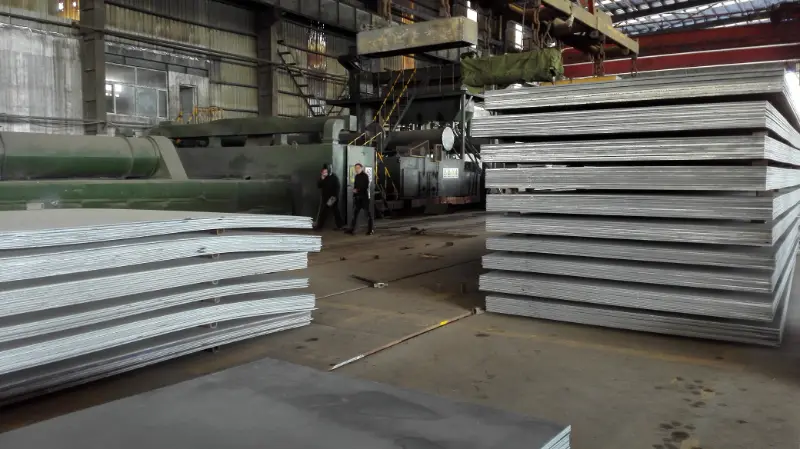
ABS Grade A Shipbuilding Steel Plate
ABS Grade A Shipbuilding Steel Plate - Composition, Properties, and Equivalents
Comprehensive data for ABS Grade A shipbuilding steel plate including chemical composition, mechanical and physical properties, international equivalents, and application guide.
Hot rolling, normalizing (as required), welding, cutting, forming
- Phone : +8618037372205
- Email : [email protected]
- WhatsApp: Contact via Whtsapp
- WeChat: +8618037372205
ABS Grade A Shipbuilding Steel Plate Introduction
ABS Grade A is a common strength hot-rolled shipbuilding structural steel plate approved by the American Bureau of Shipping (ABS). It is designed for use in the construction of hulls, marine structures, and offshore platforms where high reliability and weldability are required. The steel offers a minimum yield strength of 235 MPa and good notch toughness at ambient temperatures. The delivery condition is typically normalized or as-rolled, depending on thickness and customer specification. This grade exhibits excellent formability and can be readily welded using standard shipyard procedures. It is supplied in thicknesses up to 100 mm and is widely used in merchant ships, barges, and coastal vessels. The material conforms to the chemical composition and mechanical property requirements of ABS Rules for Materials and Welding, Part 2.
ABS Grade A Shipbuilding Steel Plate Chemical Composition
The chemical composition of ABS Grade A is controlled to ensure good weldability and toughness. The maximum carbon content is limited to 0.21%, and manganese is required at a minimum of 2.5 times the carbon content to provide adequate strength. Residual elements like sulfur and phosphorus are kept low to improve ductility and resistance to brittle fracture. Supplementary alloying elements may be present but are not specified.
| Element | Standard Value | Remarks |
|---|---|---|
| C (Carbon) | ≤ 0.21% | Ladle analysis; minimum 2.5 × C% Mn is required when thickness ≤ 12.5 mm |
| Mn (Manganese) | ≥ 2.5 × C% (typically 0.60 – 1.10%) | Exact range not strictly codified, but 2.5×C minimum is mandatory; for thicker plates Mn can be on the higher side |
| Si (Silicon) | 0.10 – 0.35% | Killed steel practice required |
| P (Phosphorus) | ≤ 0.035% | |
| S (Sulfur) | ≤ 0.035% | |
| Al (Aluminum) | ≥ 0.020% (acid-soluble) | Required for fine grain practice when impact tested |
| Cr (Chromium) | ≤ 0.20% | Residual element, not intentionally added |
| Ni (Nickel) | ≤ 0.40% | Residual element |
| Mo (Molybdenum) | ≤ 0.08% | Residual element |
| Cu (Copper) | ≤ 0.35% | Residual element |
| Nb (Niobium) | ≤ 0.05% | May be present as grain refiner |
| V (Vanadium) | ≤ 0.10% | May be present as grain refiner |
| Ti (Titanium) | ≤ 0.05% | May be present as grain refiner |
ABS Grade A Shipbuilding Steel Plate Thermal and Electrical Physical Properties
The following physical properties are typical for mild steel grades similar to ABS Grade A and may be used for engineering calculations. These values are not part of the ABS material certification but are derived from standard references for low-carbon structural steel.
| Property | Typical Value | Unit | Conditions / Remarks |
|---|---|---|---|
| Density (ρ) | 7.85 | g/cm³ | At 20°C |
| Elastic Modulus (E) | 210 | GPa | At room temperature |
| Shear Modulus (G) | 81 | GPa | Calculated from E and Poisson's ratio |
| Poisson's Ratio (ν) | 0.3 | - | In elastic range |
| Thermal Expansion Coefficient (α) | 11.7 × 10⁻⁶ | K⁻¹ | Average for 20 – 100°C |
| Thermal Expansion Coefficient (α) | 12.5 × 10⁻⁶ | K⁻¹ | Average for 20 – 200°C |
| Thermal Expansion Coefficient (α) | 13.6 × 10⁻⁶ | K⁻¹ | Average for 20 – 400°C |
| Thermal Conductivity (λ) | 51.9 | W/(m·K) | At 20°C |
| Specific Heat Capacity | 486 | J/(kg·K) | At 20°C |
| Electrical Resistivity (ρ_e) | 0.15 – 0.20 | Ω·mm²/m | At 20°C |
ABS Grade A Shipbuilding Steel Plate Mechanical Properties
The specified mechanical properties of ABS Grade A are determined by the product thickness and testing direction. The minimum yield strength is 235 MPa for all thicknesses. Tensile strength is between 400 and 520 MPa. Elongation requirements depend on the specimen gauge length; the value for a gauge length of 5.65√So is 22% for thicknesses ≤ 50 mm. Impact testing is performed at 0°C (longitudinal) with a minimum average absorbed energy of 27 J. Bending tests require a former diameter of 3t (t = plate thickness) for 180° bending.
| Property | Minimum/Maximum Value | Unit | Test Conditions |
|---|---|---|---|
| Yield Strength (ReH) | ≥ 235 | MPa | All thicknesses; transverse or longitudinal (see product specification) |
| Tensile Strength (Rm) | 400 – 520 | MPa | All thicknesses |
| Elongation (A) | ≥ 22 | % | Gauge length: 5.65√So (ISO 6892-1); for thickness ≤ 50 mm |
| Elongation (A) | ≥ 21 | % | Gauge length: 5.65√So; for thickness > 50 mm up to 70 mm |
| Elongation (A) | ≥ 20 | % | Gauge length: 5.65√So; for thickness > 70 mm up to 100 mm |
| Charpy Impact Energy (KV) | ≥ 27 (average) | J | Longitudinal; at 0°C; specimen size 10×10 mm; minimum single value 20 J |
| Bend Test | 180° bend over former of 3t | - | t = plate thickness; specimen width 30 mm; no cracks allowed |
ABS Grade A Shipbuilding Steel Plate Full Equivalent Material Standards and Substitute Grades
| Country / Region | Standard | Grade | Remarks |
|---|---|---|---|
| International (IACS) | Lloyd's Register Rules | Lloyd's Grade A | Identical chemical and mechanical requirements |
| Norway / Germany | DNV Rules | DNV Grade A (NV A) | Identical; formerly NV A |
| France | Bureau Veritas Rules | BV Grade A | Same property limits |
| Italy | RINA Rules | RINA Grade A | Equivalent |
| China | CCS Rules | CCS Grade A | Equivalent to ABS Grade A |
| Japan | ClassNK Rules | NK Grade A (KA) | Equivalent |
| Korea | KR Rules | KR Grade A | Equivalent |
| Russia | RMRS Rules | RS Grade A | Equivalent to common strength A |
ABS Grade A Shipbuilding Steel Plate Application Introduction
ABS Grade A is primarily designed for marine and offshore structural applications. Its good weldability, moderate strength, and reliable notch toughness make it the workhorse grade for ship hulls and other marine constructions. It can be processed by all standard methods such as cutting, forming, machining, and welding. The steel is often used in the as-rolled or normalized condition, depending on thickness. For critical parts subject to high stress or low temperature, higher toughness grades (AH32, AH36) may be specified.
Product Applications: Hull plates for vessels (bulk carriers, tankers, container ships), Deck plating and superstructures, Marine hatch covers, Offshore platform topside modules and jackets, Sea fastening structures (temporary and permanent), Barge and pontoon shells and internal framing, Caissons and breakwater elements (steel portions)
Processed into products: Ship hull shell and bottom plates, Longitudinal and transverse stiffeners and girders, Bulkhead plates, Deck stringers and plating, Web frames and brackets, Rudder horns and stern frames (non-critical parts), Foundation plates for machinery and equipment, Pipe stanchions and support bases
Application industries: Shipbuilding and Ship Repair, Offshore Oil & Gas Platform Construction, Marine Engineering, Port & Harbor Infrastructure, Dredging Equipment, Barge and Pontoon Manufacturing, Naval Architecture
ABS Grade A Shipbuilding Steel Plate Similar or Alternative Materials
| Country / Region | Standard | Grade | Remarks |
|---|---|---|---|
| United States | ASTM A36 / A36M | A36 | Yield 250 MPa, tensile 400-550 MPa; not impact tested at 0°C; used in general construction, not certified for ship hulls |
| European Union | EN 10025-2 | S235JR | Yield ≥235 MPa, tensile 360-510 MPa; impact at +20°C (27J); non-marine, structural steel |
| China | GB/T 700 | Q235B | Similar yield and tensile; impact requirements differ; not directly substitutable for marine classification |
| Japan | JIS G 3101 | SS400 | Yield ≥245 MPa (t≤16 mm), tensile 400-510 MPa; no mandatory impact test; general structural |
Notes:
- Thickness tolerances and flatness are governed by ABS Rules and the respective product standard (e.g., ASTM A6/A6M or EN 10029).
- When ordering, the purchaser must specify the required impact test temperature (if any), dimension, and supplementary requirements.
- For structural applications subject to fatigue or high restraint, careful attention to weld details and NDT is recommended.
- The steel is suitable for hot-dip galvanizing and coating systems commonly used in marine environments.
- Share



