
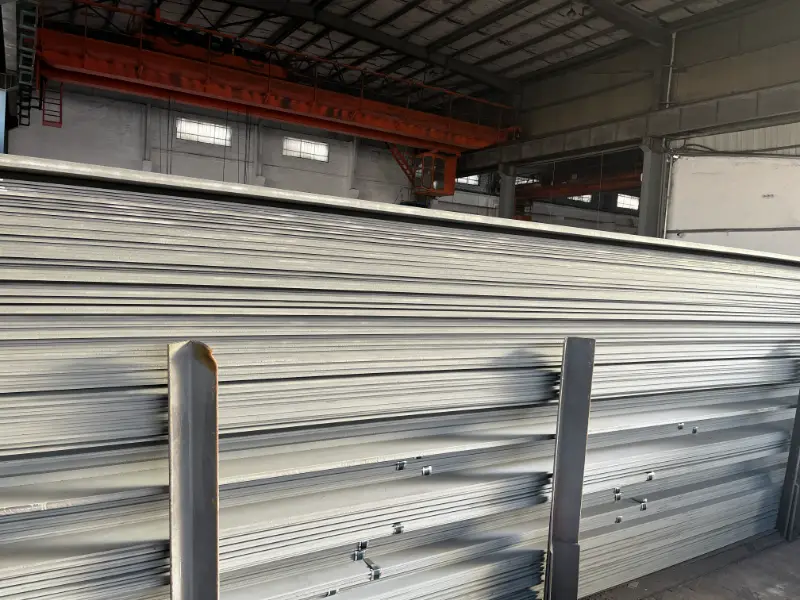
CCS Grade FQ63 Steel
CCS Grade FQ63 Steel: High-Strength Quenched & Tempered Shipbuilding Plate for Offshore Engineering
Comprehensive datasheet for CCS Grade FQ63 shipbuilding steel plate under China Classification Society rules. Includes chemical composition, mechanical properties, physical characteristics, international equivalents, and application guide.
Cutting, bending, welding, machining; preheating recommended before welding due to high hardenability
- Phone : +8618037372205
- Email : [email protected]
- WhatsApp: Contact via Whtsapp
- WeChat: +8618037372205
CCS Grade FQ63 Steel Introduction
CCS Grade FQ63 is a high-strength quenched and tempered (Q&T) steel plate intended for ship and offshore structures, governed by the China Classification Society (CCS) Rules for Materials and Welding. With a minimum yield strength of 620 MPa, it belongs to the family of extra-high-strength structural steels designed for critical load-bearing applications in harsh marine environments.
Key characteristics:
- Excellent combination of high tensile strength and good toughness at low temperatures (-20°C).
- Precipitation-hardened alloy design with controlled carbon equivalent to ensure weldability.
- Available in thicknesses up to 150 mm, delivered in quenched and tempered condition.
- Used extensively in hull structures, offshore platforms, and heavy-lift components.
- Meets strict CCRS requirements for chemical composition, mechanical properties, and internal soundness.
CCS Grade FQ63 Steel Chemical Composition
The chemical composition of CCS Grade FQ63 as specified in the CCS Rules. Maximum and minimum limits are given. The carbon equivalent (Ceq) is controlled to ensure weldability. All values are percent by weight unless otherwise noted.
| Element | Standard Value | Remarks |
|---|---|---|
| Carbon (C) | ≤0.20 | max |
| Silicon (Si) | ≤0.55 | max |
| Manganese (Mn) | ≤1.70 | max |
| Phosphorus (P) | ≤0.025 | max |
| Sulfur (S) | ≤0.025 | max |
| Chromium (Cr) | ≤2.00 | max |
| Nickel (Ni) | ≤2.00 | max |
| Molybdenum (Mo) | ≤0.70 | max |
| Copper (Cu) | ≤0.50 | max |
| Vanadium (V) | ≤0.10 | max |
| Titanium (Ti) | ≤0.05 | max |
| Niobium (Nb) | ≤0.05 | max |
| Nitrogen (N) | ≤0.020 | max |
| Aluminum (Al) | ≥0.015 | min, acid-soluble |
| Carbon Equivalent (Ceq) | ≤0.49–0.55* | depending on thickness; formula: Ceq = C + Mn/6 + (Cr+Mo+V)/5 + (Ni+Cu)/15 |
CCS Grade FQ63 Steel Thermal and Electrical Physical Properties
Typical physical properties for quenched and tempered low-alloy steels similar to CCS FQ63. These values are indicative and not part of the CCS specification. They may vary slightly depending on exact composition and heat treatment.
| Property | Typical Value | Unit | Condition / Temperature |
|---|---|---|---|
| Density (ρ) | 7.85 | g/cm³ | at 20°C |
| Modulus of Elasticity (E) | 205 | GPa | at 20°C |
| Shear Modulus (G) | 79.3 | GPa | at 20°C |
| Poisson's Ratio (ν) | 0.30 | – | at 20°C |
| Thermal Expansion Coefficient (α) | 11.5 | 10⁻⁶/K | 20–100°C |
| Thermal Expansion Coefficient (α) | 12.3 | 10⁻⁶/K | 20–200°C |
| Thermal Expansion Coefficient (α) | 13.0 | 10⁻⁶/K | 20–300°C |
| Thermal Conductivity (λ) | 42 | W/(m·K) | at 20°C |
| Specific Heat Capacity (c) | 460 | J/(kg·K) | at 20°C |
| Electrical Resistivity (ρ_e) | 0.25 | ×10⁻⁶ Ω·m | at 20°C |
CCS Grade FQ63 Steel Mechanical Properties
Mechanical properties for CCS FQ63 plates in transverse direction (unless otherwise noted). Values depend on plate thickness. Charpy V-notch impact test temperature is -20°C for Grade F. Properties are valid for quenched and tempered condition.
| Property | Required Value | Unit | Test Condition |
|---|---|---|---|
| Yield Strength (ReH) (thickness ≤50 mm) | ≥620 | MPa | transverse |
| Yield Strength (ReH) (50 < thickness ≤100 mm) | ≥600 | MPa | transverse |
| Yield Strength (ReH) (100 < thickness ≤150 mm) | ≥580 | MPa | transverse |
| Tensile Strength (Rm) | 720–890 | MPa | transverse |
| Elongation (A5) (thickness ≤50 mm) | ≥15 | % | transverse gauge length 5.65√So |
| Elongation (A5) (50 < thickness ≤100 mm) | ≥14 | % | transverse gauge length 5.65√So |
| Elongation (A5) (100 < thickness ≤150 mm) | ≥13 | % | transverse gauge length 5.65√So |
| Impact Energy (KV2) longitudinal | ≥41 (min individual 28) | J | -20°C, Charpy V-notch |
| Impact Energy (KV2) transverse | ≥27 (min individual 19) | J | -20°C, Charpy V-notch |
| Bend Test (d = mandrel diameter, a = thickness) | No cracks | Bend angle 180° for t≤12.5mm (d=3a); 180° for t>12.5–25mm (d=4a); 120° for t>25–50mm (d=4a); 120° for t>50–100mm (d=5a); 90° for t>100–150mm (d=6a). Test on transverse specimens. |
CCS Grade FQ63 Steel Fully Equivalent Materials – International Classification Society Grades
| Classification Society | Standard | Grade | Remarks |
|---|---|---|---|
| American Bureau of Shipping | ABS Rules | FQ63 | Identical mechanical requirements and chemistry envelope |
| DNV (Det Norske Veritas) | DNV GL Rules | FQ63 | Quenched and tempered high-strength steel |
| Lloyd's Register | LR Rules | FQ63 | Equivalent grade for ship and offshore applications |
| Bureau Veritas | BV Rules | FQ63 | Same yield/tensile/impact requirements |
| Nippon Kaiji Kyokai (ClassNK) | NK Rules | FQ63 | Fully compatible in design and fabrication |
| Registro Italiano Navale | RINA Rules | FQ63 | Approved for welded structural use |
| Korean Register | KR Rules | FQ63 | Interchangeable with CCS FQ63 |
CCS Grade FQ63 Steel Application Introduction
CCS Grade FQ63 is engineered for extreme loading conditions in marine and offshore environments. It is suitable for welded structures requiring high strength, excellent toughness, and good fatigue resistance. Typical applications include:
Product Applications: Deck plates and shell plates for ultra-large container ships, Legs and spudcans of self-elevating (jack-up) drilling units, Node cans and braces for fixed offshore platforms, Wind turbine monopile and jacket foundations, Heavy-lift crane booms and lattice structures, Armour plates and blast-resistant structural components
Processed into products: Hull stiffeners and brackets, Welded beam and column joints, Thick-walled tubular joints, Gusset plates and doubler plates, Machinery foundations and bearing housings, High-strength bolted connections and fittings
Application industries: Shipbuilding and marine (military and commercial), Offshore oil & gas (platforms, jackets, modules), Renewable energy (offshore wind turbine foundations, transition pieces), Heavy civil engineering (bridges, large-span structures), Mining and materials handling (heavy-duty excavator booms, dump truck bodies), Pressure vessel and boiler construction (where applicable codes accept CCS grades)
CCS Grade FQ63 Steel Similar / Closest Alternative Materials
| Standard | Grade / Designation | Remarks |
|---|---|---|
| CCS Rules | FQ70 | Higher strength grade (yield ≥690 MPa, tensile 770–940 MPa), same low-temperature toughness, may be used when higher strength is needed |
| EN 10025-6 | S620Q (1.8914) / S620QL (1.8916) | European quenched and tempered structural steel with nominal yield 620 MPa; not automatically ship-certified but mechanically very similar |
| ASTM A514 / A517 | Grade S (yield ≥690 MPa) | Higher yield strength Q&T steel for pressure vessels and structural use; can be considered if design allows higher strength |
| ASTM A709 | Grade HPS 70W (yield 485 MPa) | Lower strength structural steel but with excellent atmospheric corrosion resistance; not a direct substitute for strength-critical applications |
| JIS G 3128 | SHY 685 (yield ≥685 MPa) | Japanese high yield strength steel for welded structures, slightly higher strength level, requires procedure qualification |
Notes:
Welding precautions: Due to the high carbon equivalent (Ceq up to 0.55) when approaching maximum thickness, preheating and controlled interpass temperatures are essential to avoid hydrogen-induced cracking (HIC). A minimum preheat of 100–150°C is commonly recommended. Low-hydrogen electrodes and heat input control are mandatory. Post-weld heat treatment (PWHT) is generally not required unless specified by the construction code, but it may be applied at 550–600°C for stress relief if needed.
Certification: All plates must be stamped with the CCS mark, heat number, and grade identification. Material test certificates (3.1 or 3.2 as per EN 10204) are typically provided, including chemical, tensile, impact, and non-destructive testing results.
NDE: Plates are usually ultrasonically tested in accordance with EN 10160 Class S1/E1 or equivalent to ensure internal soundness.
- Share



