
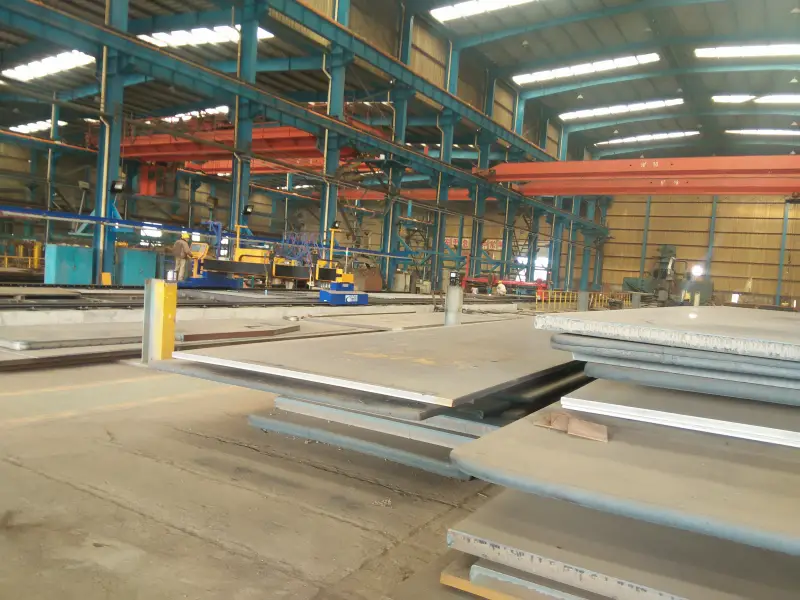
ASTM A131 Grade A Shipbuilding Steel Plate
ASTM A131 Grade A Shipbuilding Steel Plate – Properties, Equivalents & Applications
Complete data sheet for ASTM A131 Grade A shipbuilding steel plate: chemical composition, mechanical and physical properties, international equivalents, and typical applications in marine structures.
Hot rolling, controlled rolling, normalizing, welding, cutting, forming
- Phone : +8618037372205
- Email : [email protected]
- WhatsApp: Contact via Whtsapp
- WeChat: +8618037372205
ASTM A131 Grade A Shipbuilding Steel Plate Introduction
ASTM A131 Grade A is a hot-rolled structural steel plate primarily intended for shipbuilding and marine applications. Classified under the ordinary-strength category of the ASTM A131/A131M standard, this grade offers a minimum yield strength of 235 MPa and reliable weldability.
- Designed for hulls and primary structures of ships, barges, and offshore equipment.
- Typically supplied in normalized or as-rolled condition, with optional impact testing when specified by the purchaser.
- Provides a balanced combination of strength, ductility, and corrosion resistance in marine environments.
- Widely recognized by major classification societies under equivalent designations such as ABS Grade A and LR Grade A.
ASTM A131 Grade A Shipbuilding Steel Plate Chemical Composition
Typical heat analysis limits for ASTM A131 Grade A according to ASTM A131/A131M. The steel is fully killed and fine-grained practice using aluminum or other grain-refining elements. Residual elements are kept within specified maxima to ensure weldability and toughness.
| Element | Standard Value | Remarks |
|---|---|---|
| Carbon (C) | ≤ 0.21 | Max limit, ensures weldability |
| Silicon (Si) | 0.10 – 0.35 | Typical range for deoxidation |
| Manganese (Mn) | ≥ 2.5 × C (min 0.80 typical) | Usually supplied as 0.80 – 1.10; grain refinement |
| Phosphorus (P) | ≤ 0.035 | Max for ductility |
| Sulfur (S) | ≤ 0.035 | Max for toughness |
| Chromium (Cr) | ≤ 0.25 | Residual element, max limit |
| Nickel (Ni) | ≤ 0.40 | Residual element, max limit |
| Copper (Cu) | ≤ 0.35 | Residual element, max limit |
| Molybdenum (Mo) | ≤ 0.08 | Residual element, max limit |
| Aluminum (Al) | ≥ 0.020 (acid soluble) | Grain refining, fully killed requirement |
| Sum of residual elements (Cr+Ni+Cu+Mo) | ≤ 0.70 | Total residual limit |
ASTM A131 Grade A Shipbuilding Steel Plate Thermal and Electrical Physical Properties
Typical physical properties for ASTM A131 Grade A carbon-manganese steel at ambient temperature. These values are indicative and may vary slightly with processing. Used for design calculations in marine structures.
| Property | Typical Value | Unit | Test Condition / Remarks |
|---|---|---|---|
| Density (ρ) | 7.85 | g/cm³ | At 20°C |
| Modulus of Elasticity (E) | 205 | GPa | Room temperature |
| Shear Modulus (G) | 80 | GPa | Room temperature |
| Poisson's Ratio (ν) | 0.30 | — | Within elastic range |
| Coefficient of Thermal Expansion (α) | 12.0 | 10⁻⁶/K | Between 20°C and 100°C |
| Thermal Conductivity (λ) | 50 | W/(m·K) | At 20°C |
| Specific Heat Capacity (cp) | 460 | J/(kg·K) | At 20°C |
| Electrical Resistivity (ρe) | 0.15 | μΩ·m (10⁻⁶ Ω·m) | At 20°C |
ASTM A131 Grade A Shipbuilding Steel Plate Mechanical Properties
Minimum required mechanical properties for ASTM A131 Grade A plates as per ASTM A131/A131M. Tensile testing is performed at room temperature. Impact testing is not mandatory unless specified in the purchase order (optional supplementary requirement). Bend test is performed on all plates.
| Property | Standard Requirement | Unit | Test Condition / Thickness |
|---|---|---|---|
| Yield Strength (ReH) | ≥ 235 | MPa | Thickness ≤ 50 mm (72.5 ksi equivalent) |
| Tensile Strength (Rm) | 400 – 520 | MPa | Thickness ≤ 50 mm (58 – 75 ksi) |
| Elongation (A) – 200 mm gauge | ≥ 21 | % | Thickness ≤ 50 mm |
| Elongation (A) – 50 mm gauge | ≥ 24 | % | Thickness ≤ 50 mm |
| Bend Test (180° bend) | D = 2t (t ≤ 25 mm) | — | No cracks on outer surface; D = bend diameter, t = thickness |
| Bend Test (180° bend) | D = 2.5t (t > 25 mm) | — | For thickness over 25 mm |
| Impact Energy (KV) – Optional | ≥ 27 (longitudinal or transverse) | J | At +20°C, 0°C or -20°C when specified (e.g., Supplementary Requirement S5) |
ASTM A131 Grade A Shipbuilding Steel Plate Exact Equivalent Standards and Replaceable Grades
| Country/Region | Standard / Classification Society | Grade | Remarks |
|---|---|---|---|
| International | IACS (Unified Requirement W11) | Grade A | Common baseline for all major classification societies |
| USA | ABS (American Bureau of Shipping) | Grade A | Fully equivalent; issued under ABS Rules |
| UK | LR (Lloyd's Register) | Grade A | Identical mechanical and chemical requirements |
| Norway | DNV (Det Norske Veritas) | Grade A | Equivalent in DNV rules |
| France | BV (Bureau Veritas) | Grade A | Equivalent marine steel |
| China | CCS (China Classification Society) | Grade A | Chinese recognized equivalent |
| Japan | NK (ClassNK) | KA | Grade A equivalent in NK notation |
| South Korea | KR (Korean Register) | Grade A | Equivalent |
| Italy | RINA (Registro Italiano Navale) | Grade A | Equivalent |
ASTM A131 Grade A Shipbuilding Steel Plate Application Introduction
ASTM A131 Grade A is extensively employed in the construction of seagoing vessels and inland waterway equipment where good weldability and moderate strength are sufficient. It serves as a primary structural material for hull envelopes and internal members. Due to its established track record and acceptance by all major classification societies, it is the baseline choice for ordinary-strength shipbuilding.
Product Applications: Oil tankers, bulk carriers, container ships, Passenger ferries and Ro-Ro vessels, Floating docks and pontoons, Offshore platform modules and living quarters, Barges and floating cranes
Processed into products: Shell plates (side, bottom, deck), Longitudinal and transverse bulkheads, Web frames and stiffeners, Keels and floors, Deck plating and hatch coamings, Rudder horn plates (in some designs), Mild steel fastening parts (brackets, collars)
Application industries: Shipbuilding and marine engineering, Offshore oil and gas (platforms, FPSO), Barge and tugboat construction, Dredging equipment, Port and harbor machinery
ASTM A131 Grade A Shipbuilding Steel Plate Similar / Comparable Substitute Materials
| Country/Region | Standard | Grade | Remarks |
|---|---|---|---|
| USA | ASTM A36/A36M | A36 | General structural steel; yield 250 MPa, tensile 400–550 MPa. Not certified for shipbuilding unless approved by classification society; lacks mandatory grain refining. |
| EU | EN 10025-2 | S235JR (1.0038) | Structural steel with min yield 235 MPa. Similar strength level, but additional notch toughness tests required for ship use. |
| Japan | JIS G3101 | SS400 | Rolled steel for general structure; tensile 400–510 MPa. Not specifically treated for marine toughness. |
| China | GB/T 700 | Q235B | Carbon structural steel; comparable strength, but impact test and fine-grain practice may differ. |
Notes:
- Optional impact testing: when notch toughness is required, purchasers must specify test temperature and energy values (e.g., 27 J at 0°C) in accordance with supplementary requirements.
- Plates can be normalized to meet stricter ductility or grain refinement demands. Normalizing heat treatment is mandatory for Grade A plates over 50 mm thickness unless otherwise agreed.
- Always consult the latest issue of ASTM A131/A131M and relevant classification society rules for precise acceptance criteria and testing procedures.
- Share



