
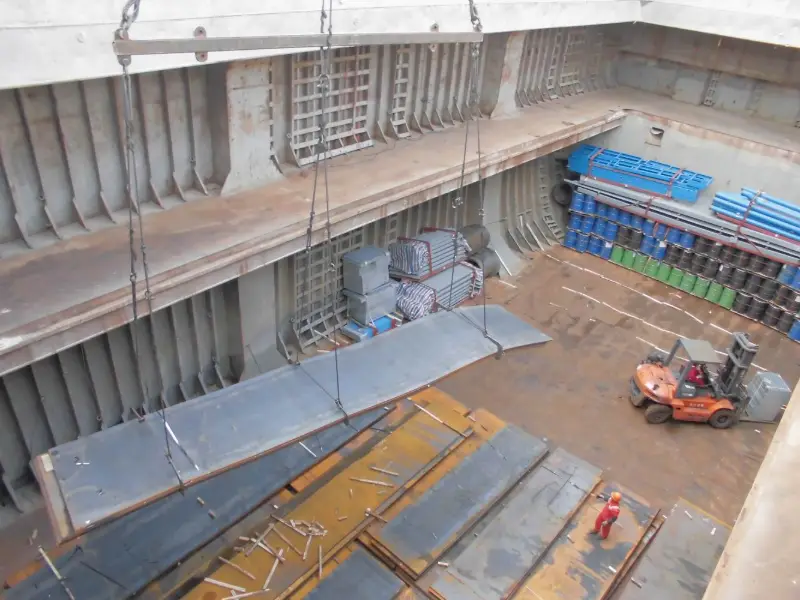
ABS Grade EQ51 Shipbuilding Steel Plate
ABS Grade EQ51 Shipbuilding Steel Plate – High-Strength Quenched & Tempered Offshore Steel
Complete data sheet for ABS Grade EQ51 shipbuilding steel plate: chemical composition, mechanical properties, thermal and electrical performance, equivalent international standards, and application guidance for offshore and marine construction.
Cutting, welding, cold forming, hot forming (with proper temperature control), machining
- Phone : +8618037372205
- Email : [email protected]
- WhatsApp: Contact via Whtsapp
- WeChat: +8618037372205
ABS Grade EQ51 Shipbuilding Steel Plate Introduction
ABS Grade EQ51 is a high-strength, quenched and tempered shipbuilding and offshore structural steel plate under the rules of the American Bureau of Shipping. With a minimum yield strength of 450 MPa, it delivers exceptional toughness at temperatures down to -40°C, making it ideal for critical components exposed to harsh marine environments. As part of the EQ series, EQ51 combines high strength with good weldability and reliable resistance to brittle fracture. Plates are typically supplied in the quenched and tempered condition up to 100 mm thickness. Primary applications include offshore platform legs, heavy ship frames, icebreaker hulls, and other structural members requiring both high load-bearing capacity and low-temperature service performance.
ABS Grade EQ51 Shipbuilding Steel Plate Chemical Composition
The chemical composition of ABS Grade EQ51 is controlled to meet strict limits on carbon equivalent and impurities to ensure high strength, good weldability, and reliable low-temperature toughness. Typical ladle analysis ranges are shown below. Note: Ceq = C + Mn/6 + (Cr+Mo+V)/5 + (Ni+Cu)/15 must not exceed 0.43% for plate thickness ≤50 mm or as agreed for greater thicknesses.
| Element | Standard Value (wt %) | Remarks |
|---|---|---|
| Carbon (C) | ≤ 0.20 | Ladle analysis |
| Silicon (Si) | 0.10 – 0.55 | Ladle analysis |
| Manganese (Mn) | 0.70 – 1.70 | Ladle analysis |
| Phosphorus (P) | ≤ 0.025 | Ladle analysis |
| Sulfur (S) | ≤ 0.025 | Ladle analysis |
| Chromium (Cr) | ≤ 0.25 | Ladle analysis |
| Nickel (Ni) | ≤ 0.40 | Ladle analysis |
| Molybdenum (Mo) | ≤ 0.08 | Ladle analysis |
| Copper (Cu) | ≤ 0.30 | Ladle analysis |
| Niobium (Nb) | 0.02 – 0.05 | Ladle analysis |
| Vanadium (V) | 0.05 – 0.10 | Ladle analysis |
| Titanium (Ti) | 0.007 – 0.05 | Ladle analysis |
| Aluminium (Als) | ≥ 0.015 | Acid soluble aluminium |
| Nitrogen (N) | ≤ 0.009 | Ladle analysis |
ABS Grade EQ51 Shipbuilding Steel Plate Thermal and Electrical Physical Properties
The physical properties given below are typical for high-strength low-alloy quenched and tempered steels and represent values at room temperature unless otherwise indicated. They are suitable for engineering calculations but are not mandatory specification requirements. Note: Thermal conductivity decreases with increasing temperature; expansion coefficient increases slightly.
| Property | Typical Value | Unit | Test Condition / Remarks |
|---|---|---|---|
| Density (ρ) | 7.85 | g/cm³ (7850 kg/m³) | At 20°C |
| Modulus of Elasticity (E) | 205 | GPa | At 20°C, tension/compression |
| Shear Modulus (G) | 80 | GPa | At 20°C |
| Poisson's Ratio (ν) | 0.3 | – | At 20°C |
| Mean Coefficient of Thermal Expansion (α) | 12.5 | 10⁻⁶/K | Between 20°C and 100°C |
| Mean Coefficient of Thermal Expansion (α) | 13.5 | 10⁻⁶/K | Between 20°C and 200°C |
| Thermal Conductivity (λ) | 48 | W/(m·K) | At 20°C |
| Thermal Conductivity (λ) | 45 | W/(m·K) | At 100°C |
| Specific Heat Capacity | 460 | J/(kg·K) | At 20°C |
| Electrical Resistivity (ρe) | 0.20 – 0.25 | 10⁻⁶ Ω·m (μΩ·m) | At 20°C |
ABS Grade EQ51 Shipbuilding Steel Plate Mechanical Properties
Mechanical tests are performed on quenched and tempered specimens in accordance with ABS Rules. Properties are guaranteed for plate thickness up to 100 mm unless otherwise stated. Impact tests are conducted at -40°C on Charpy-V notch specimens. Note: Elongation values apply to gauge length of 5.65√S0 (proportional test piece).
| Property | Specified Value | Unit | Test Condition / Remarks |
|---|---|---|---|
| Yield Strength (ReH) | ≥ 450 | MPa | Transverse, thickness ≤ 100 mm |
| Tensile Strength (Rm) | 570 – 720 | MPa | Transverse, thickness ≤ 100 mm |
| Elongation after Fracture (A) | ≥ 17 | % | Longitudinal, gauge length 5.65√S0 |
| Bend Test (180°) | d = 3a (no cracks) | – | Bend diameter, thickness a ≤ 50 mm |
| Impact Energy (KV2) at -40°C | ≥ 50 (average) | J | Transverse, standard Charpy-V |
| Impact Energy (KV2) at -40°C (single min) | ≥ 35 | J | Transverse, standard Charpy-V |
| Impact Energy (KV2) at -40°C | ≥ 34 (average) | J | Longitudinal, standard Charpy-V |
| Impact Energy (KV2) at -40°C (single min) | ≥ 24 | J | Longitudinal, standard Charpy-V |
ABS Grade EQ51 Shipbuilding Steel Plate Fully Equivalent Standards and Recommended Substitution Grades
| Country/Region | Standard | Grade Designation | Remarks |
|---|---|---|---|
| International (IACS) | DNVGL-OS-B101 / Rules | E550 | Quenched and tempered offshore structural steel, min. yield 450 MPa, -40°C impact |
| France (Bureau Veritas) | BV Rules for Materials | E550 | Equivalent offshore steel grade, similar chemistry and mechanical requirements |
| UK (Lloyd's Register) | LR Rules for Materials | E550 | Marine steel with 450 MPa min. yield, matching toughness class |
| Japan (ClassNK) | NK Rules & Guidance | E550 (KE550) | Same strength level and low-temperature impact properties |
| Korea (Korean Register) | KR Rules | E550 | Identical in performance to ABS EQ51 |
| Italy (RINA) | RINA Rules | E550 | Fully interchangeable for ship and offshore structures |
| China (CCS) | CCS Rules | E550 | Quenched and tempered hull structural steel, direct equivalent |
| Europe (CEN) | EN 10225:2009 | G3 450EMZ | Weldable structural steel for offshore structures, supplementary option for -40°C |
ABS Grade EQ51 Shipbuilding Steel Plate Application Introduction
ABS Grade EQ51 is engineered for demanding marine and offshore constructions where high strength and reliable toughness at sub-zero temperatures are essential. Its quenched and tempered condition provides a balanced combination of weldability and structural integrity. Typical fields of use:
Product Applications: Hull plates, deck plates, and keel plates, Offshore platform legs and jack-up rig components, Crane booms and heavy-lift equipment, Icebreaker and Arctic vessel structures, Subsea structural members (e.g., brace nodes, pile sleeves)
Processed into products: Rudder horns, stern frames, and propeller brackets, Heavy stiffeners, girders, and web frames, Connection brackets and nodes in tubular offshore structures, Bulkhead plates and collision barriers, Foundation plates for deck machinery and winches
Application industries: Shipbuilding (including ice-class vessels and military ships), Offshore oil and gas exploration and production, Renewable marine energy (offshore wind turbine foundations), Heavy marine engineering and port structures, Pressure vessel and storage tank manufacturing for marine environment
ABS Grade EQ51 Shipbuilding Steel Plate Similar / Comparable Alternative Materials
| Country/Region | Standard | Grade Designation | Remarks / Comparison |
|---|---|---|---|
| USA | API 2W / API 2Y | Grade 50 | Offshore structural steel plate, similar strength but may have different notch toughness requirements; verify impact temperature. |
| USA | ASTM A514 / A514M | Grade H | High-strength quenched and tempered alloy steel plate for structural applications; limited thickness (≤50 mm) and impact test temperature (-45°C) may differ. |
| Europe | EN 10025-6 | S460Q / S460QL | Structural steel with 450 MPa min. yield; Q variant with -20°C impact, QL with -40°C; not specifically marine-certified but often accepted for less critical offshore components. |
| Japan | JIS G 3128 | SHY685 | High yield strength steel for welded structures, strength level above EQ51 (min 685 MPa) but similar quenched & tempered production route; only suitable for higher strength demands. |
Notes:
ABS EQ51 steel must be supplied with inspection certificates and marking in accordance with ABS Rules. Welding procedures shall use low-hydrogen consumables and preheating may be necessary depending on plate thickness and carbon equivalent. Post-weld heat treatment is generally not required but can be applied after agreement. The steel is fully killed and fine-grain treated. For long-term marine exposure, protective coatings or cathodic protection are recommended. Always consult the latest ABS Rules and the project-specific specification before ordering or fabricating EQ51 material.
- Share



