
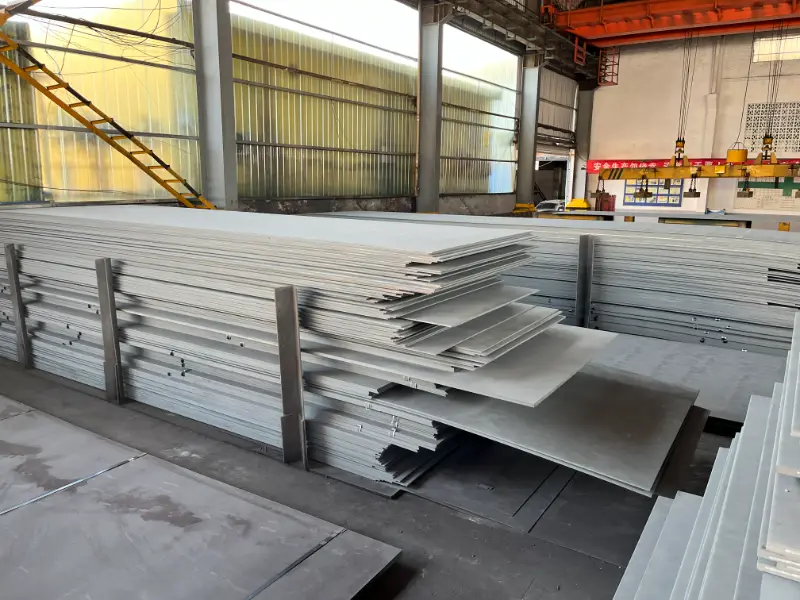
ABS Grade DQ51 Shipbuilding Steel Plate
ABS Grade DQ51 Shipbuilding Steel Plate: Properties, Equivalents & Applications
In-depth analysis of ABS Grade DQ51 quenched and tempered shipbuilding steel plate. Covers chemical composition, mechanical properties, thermal and electrical properties, international equivalents, and applications.
Hot rolling followed by quenching and tempering (Q&T); suitable for cold forming, cutting, welding (with preheating and post-weld heat treatment as needed).
- Phone : +8618037372205
- Email : [email protected]
- WhatsApp: Contact via Whtsapp
- WeChat: +8618037372205
ABS Grade DQ51 Shipbuilding Steel Plate Introduction
ABS Grade DQ51 is a high-strength quenched and tempered (Q&T) shipbuilding steel plate certified by the American Bureau of Shipping (ABS). The grade designation 'D' indicates a minimum Charpy impact test temperature of -20°C, and 'Q51' denotes quenched and tempered steel with a minimum yield strength of 51 ksi (355 MPa). It offers excellent weldability, good low-temperature toughness, and high strength, making it suitable for critical structural components in ships, offshore platforms, and marine equipment. The steel is produced by controlled rolling and heat treatment (quenching + tempering) to achieve a fine-grained microstructure with a typical tempered martensite/bainite structure. Stringent requirements on chemical composition (carbon equivalent, microalloying) ensure strength and toughness balance.
ABS Grade DQ51 Shipbuilding Steel Plate Chemical Composition
The chemical composition of ABS DQ51 is controlled to achieve a fine grain structure and the specified strength and toughness. Limits are based on heat analysis according to ABS rules. Elements such as C, Mn, Si, P, S are primary; microalloying additions (Nb, V, Ti) may be present for grain refinement. Residual elements (Cu, Ni, Cr, Mo) are limited unless added intentionally. Carbon equivalent (CEV) is typically ≤ 0.38% to ensure good weldability.
| Element | Content (max unless range given) | Notes |
|---|---|---|
| C | ≤ 0.18% | For higher strength steels, lower limits can be specified by the mill |
| Mn | 0.90 - 1.60% | Range may vary depending on plate thickness |
| Si | 0.10 - 0.50% | Deoxidation and strength |
| P | ≤ 0.030% | Maximum |
| S | ≤ 0.030% | Maximum; lower S improves toughness |
| Cu | ≤ 0.35% | Residual; may be added for corrosion resistance |
| Ni | ≤ 0.40% | Residual unless specified |
| Cr | ≤ 0.20% | May be added in some controlled compositions |
| Mo | ≤ 0.08% | Not typically required for 355 MPa grade |
| Nb | ≤ 0.05% | Grain refining element |
| V | ≤ 0.10% | May be added for strength |
| Ti | ≤ 0.02% | Grain refining, nitrogen fixing |
| Al total | ≥ 0.015% | Usually added for fine grain practice |
| N | ≤ 0.009% | Ensures aluminum nitride formation |
| Ceq (IIW) | ≤ 0.38% | Carbon equivalent = C+Mn/6+(Cr+Mo+V)/5+(Ni+Cu)/15 |
ABS Grade DQ51 Shipbuilding Steel Plate Thermal and Electrical Physical Properties
Physical properties of DQ51 steel are similar to typical carbon-manganese structural steels. These values are not part of the ABS specification but are provided for design purposes. The data are typical at room temperature unless otherwise noted.
| Property | Typical Value | Unit | Temperature/Notes |
|---|---|---|---|
| Density (ρ) | 7.85 | g/cm³ | 20°C |
| Modulus of Elasticity (E) | 205 | GPa | 20°C |
| Shear Modulus (G) | 80 | GPa | 20°C |
| Poisson's Ratio (ν) | 0.3 | — | 20°C |
| Thermal Expansion Coefficient (α) | 11.7 | 10⁻⁶/°C | 20 - 100°C |
| Thermal Expansion Coefficient (α) | 12.5 | 10⁻⁶/°C | 20 - 200°C |
| Thermal Expansion Coefficient (α) | 13.5 | 10⁻⁶/°C | 20 - 300°C |
| Thermal Conductivity (λ) | 45 | W/(m·K) | 20°C |
| Specific Heat Capacity (Cp) | 460 | J/(kg·K) | 20°C |
| Electrical Resistivity (ρ_e) | 0.15 - 0.20 | μΩ·m | 20°C |
ABS Grade DQ51 Shipbuilding Steel Plate Mechanical Properties
Mechanical properties for ABS DQ51 plate are verified by tensile testing and Charpy V-notch impact tests at -20°C. Standard test specimens are taken in the transverse direction for plate products. Bending tests (180° bend) are required with a mandrel diameter of 3 times the plate thickness (3t) for grades up to 355 MPa. Minimum absorbed energy for Charpy tests depends on thickness and specimen orientation; typical requirement is 34 J at -20°C for longitudinal direction.
| Property | Value | Unit | Condition |
|---|---|---|---|
| Yield Strength (ReH) | ≥ 355 | MPa | Transverse; for t ≤ 100mm; for t >100mm min may be 325 MPa |
| Tensile Strength (Rm) | 490 - 620 | MPa | Transverse |
| Elongation (A) | ≥ 21 | % | Gauge length 5.65√So, transverse |
| Bend Test, 180° | d = 3a | — | a = specimen thickness; no cracks acceptable |
| Charpy V-notch Impact (KV2) at -20°C | ≥ 34 | J | Longitudinal; transverse: ≥ 24 J (typical) |
| Charpy V-notch Impact (KV2) at -20°C (alternate) | ≥ 27 | J | For sub-size specimens, proportional values apply |
ABS Grade DQ51 Shipbuilding Steel Plate Exact Equivalent Materials
| Region/Country | Standard | Grade | Remarks |
|---|---|---|---|
| Europe | EN 10025-6:2004 | S355Q (1.0579) | Minimum yield 355 MPa, Q&T, impact at -20°C (S355Q) or -40°C (S355QL1) |
| USA | ASTM A131 / A131M | EH36 | EH36 is not Q&T but similar yield and -40°C impact; DQ51 is Q&T |
| France | BV Rules | DQ51 | Direct equivalent; Bureau Veritas |
| Norway/Germany | DNV Rules | S355Q | DNV equivalent for quenched & tempered plate |
| UK | LR Rules | DQ51 | Lloyd's Register equivalent |
| China | CCS Rules | DQ51 | China Classification Society equivalent |
| Japan | NK Rules | KDQ51 | Nippon Kaiji Kyokai equivalent |
| South Korea | KR Rules | RDQ51 | Korean Register equivalent |
| Italy | RINA Rules | DQ51 | Registro Italiano Navale equivalent |
ABS Grade DQ51 Shipbuilding Steel Plate Application Introduction
ABS DQ51 steel is specifically designed for demanding marine and offshore applications where high strength, excellent weldability, and low-temperature toughness are required. Its quenched and tempered microstructure ensures superior strength-to-weight ratio, enabling lighter structural designs with improved payload capacity. This steel grade can be fabricated into complex shapes using conventional welding, cutting, and forming processes. Typical end uses include shipbuilding, offshore oil & gas platforms, renewable energy structures (wind turbine foundations), and heavy-lift crane components.
Product Applications: Hull plates and stiffeners for ice-class vessels, Deck plates for heavy-lift vessels, Jack-up rig legs and spudcans, Offshore wind farm foundations (monopiles, jackets), Crane booms and lifting beams, Subsea structural frames
Processed into products: Transverse frames and bulkheads in ship hulls, Bottom shell plating and bilge strakes, Deck stringer plates, Offshore module support stools, Bracing members in jacket structures, Pin-joint connections and shackles
Application industries: Shipbuilding and ship repair, Offshore oil & gas (platforms, FPSO, subsea structures), Marine engineering, Renewable energy (offshore wind monopiles, transition pieces), Heavy equipment and crane manufacturing, Pressure vessels and storage tanks (when approved)
ABS Grade DQ51 Shipbuilding Steel Plate Similar / Comparable Materials
| Region/Country | Standard | Grade | Remarks |
|---|---|---|---|
| Europe | EN 10025-3:2004 | S355N / S355NL | Normalized fine-grain steel, 355 MPa yield, not Q&T; suitable for less demanding toughness |
| Europe | EN 10025-4:2004 | S355M / S355ML | Thermomechanical rolled; often used as alternative to Q&T |
| USA | ASTM A572/A572M | Grade 50 (345 MPa) | Structural steel, not for marine; but comparable strength |
| International | ISO 4950/1 | S355DQ | High yield strength flat steel; quenched and tempered |
| Russia | GOST 19281 | 16G2AF (similar) | Low-alloy structural steel, approximate yield 355 MPa |
Notes:
These properties represent typical values and minimum requirements based on ABS Rules for Materials and Welding. Actual mill certificates may show better values. For options like through-thickness tensile testing (Z-grade) or extra ultrasonic testing (S2E2 or S3E3), customers should specify at the time of order. Welding procedures must follow ABS approved consumables and preheat/interpass temperature recommendations to avoid cold cracking. Post-weld heat treatment is generally not required for DQ51 up to certain thicknesses.
- Share



