
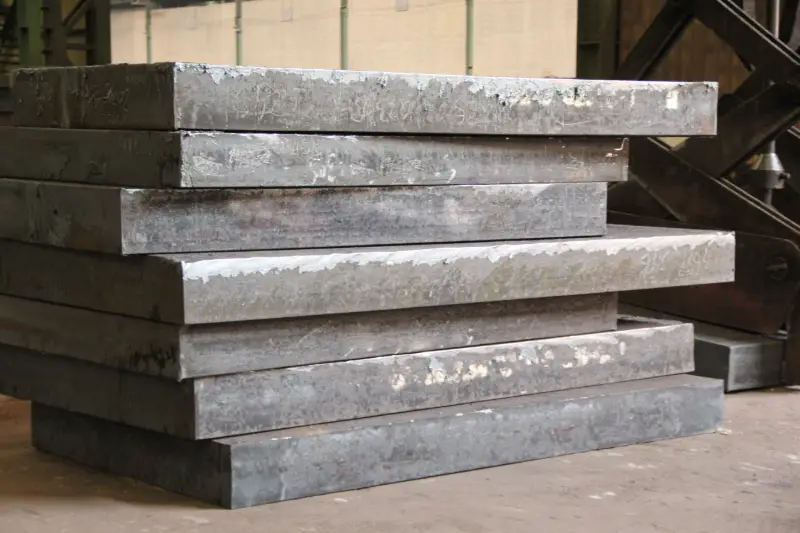
ABS Grade FH36 Shipbuilding Steel Plate
ABS Grade FH36 Shipbuilding Steel Plate - High Strength Low Temperature Toughness Marine Steel
ABS Grade FH36 is a high-strength hull structural steel plate with excellent low-temperature impact toughness, designed for critical shipbuilding and offshore engineering structures operating in cold environments.
Hot rolling, controlled rolling, TMCP, normalizing, quenching and tempering; suitable for cutting, forming, welding, machining
- Phone : +8618037372205
- Email : [email protected]
- WhatsApp: Contact via Whtsapp
- WeChat: +8618037372205
ABS Grade FH36 Shipbuilding Steel Plate Introduction
ABS Grade FH36 shipbuilding steel plate is a high-strength structural steel defined by the American Bureau of Shipping (ABS) for marine and offshore applications. It belongs to the category of normalized or thermo-mechanically controlled processed (TMCP) steels with a minimum yield strength of 355 MPa. The designation 'F' indicates its superior toughness guarantee at extremely low temperatures down to -60°C. FH36 offers an excellent combination of strength, weldability, and crack arrest capability, making it suitable for critical structural components in icebreakers, Arctic vessels, and offshore platforms exposed to severe cold climates. The steel is often supplied in normalized, TMCP, or quenched and tempered condition to meet specific property requirements. Typical applications include hull girders, decks, bottom shells, and stiffeners where high load-bearing capacity and resistance to brittle fracture are essential.
ABS Grade FH36 Shipbuilding Steel Plate Chemical Composition
Chemical composition according to ABS Rules for higher strength hull structural steel, Grade FH36. All values are maximum unless a range is indicated. Note: Fine grain practice elements (Al, Nb, V, Ti) may be added singly or in combination to meet strength and toughness requirements. Copper, chromium, nickel, and molybdenum are residual or intentional additions allowed within specified limits.
| Element | Standard Value (max, %) | Remarks |
|---|---|---|
| Carbon (C) | ≤ 0.18 | Ladle analysis; for product analysis, +0.02% tolerance applies |
| Silicon (Si) | 0.10 – 0.50 | Typical range |
| Manganese (Mn) | 0.90 – 1.60 | Depending on thickness and process |
| Phosphorus (P) | ≤ 0.025 | Low P for toughness |
| Sulfur (S) | ≤ 0.025 | Low S for cleanliness |
| Aluminum (total, Alt) | ≥ 0.020 | Acid-soluble Al; minimum for fine grain |
| Niobium (Nb) | 0.02 – 0.05 | Microalloying element |
| Vanadium (V) | 0.05 – 0.10 | Microalloying element |
| Titanium (Ti) | ≤ 0.02 | Optional, for grain refinement |
| Copper (Cu) | ≤ 0.35 | Residual or added for corrosion resistance |
| Chromium (Cr) | ≤ 0.20 | Residual element |
| Nickel (Ni) | ≤ 0.40 | Residual element; higher if agreed |
| Molybdenum (Mo) | ≤ 0.08 | Residual element |
| Nitrogen (N) | ≤ 0.009 | Unless nitrogen-fixing elements are present |
ABS Grade FH36 Shipbuilding Steel Plate Thermal and Electrical Physical Properties
Typical physical properties for FH36 steel at ambient temperature (20°C) unless otherwise stated. These values are representative for high-strength low-alloy shipbuilding steel and may vary slightly depending on exact composition and heat treatment. They are provided as a guide for design calculations; actual values should be verified with the material test certificate when critical. Thermal expansion, conductivity, and specific heat are important for welding and service analysis.
| Property | Typical Value | Unit | Test Condition (Temperature) |
|---|---|---|---|
| Density (ρ) | 7850 | kg/m³ | 20°C |
| Elastic Modulus (E) | 205 | GPa | 20°C, in tension |
| Shear Modulus (G) | 80 | GPa | 20°C, calculated from E and ν |
| Poisson's Ratio (ν) | 0.29 | - | Elastic range |
| Thermal Expansion Coefficient (α) | 11.5 | 10⁻⁶/K | 20 – 100°C |
| Thermal Expansion Coefficient (α) | 12.5 | 10⁻⁶/K | 20 – 200°C |
| Thermal Expansion Coefficient (α) | 13.2 | 10⁻⁶/K | 20 – 400°C |
| Thermal Conductivity (λ) | 50 | W/(m·K) | 20°C |
| Thermal Conductivity (λ) | 45 | W/(m·K) | 200°C |
| Specific Heat Capacity (cₚ) | 460 | J/(kg·K) | 20 – 100°C |
| Electrical Resistivity (ρₑ) | 0.22 | 10⁻⁶ Ω·m | 20°C |
ABS Grade FH36 Shipbuilding Steel Plate Mechanical Properties
Minimum mechanical property values for ABS FH36 steel plates according to the ABS standard. Tests are performed on specimens taken in the transverse direction unless otherwise agreed. Impact test values are given for full-size (10×10 mm) Charpy V-notch specimens. Properties apply to thickness range typically up to 50 mm; for thicker materials, slightly reduced requirements may apply per standard. Key features: High strength, excellent ductility, and guaranteed impact energy at -60°C.
| Property | Specified Value | Unit | Test Condition / Remarks |
|---|---|---|---|
| Yield Strength (ReH), min | 355 | MPa | Transverse specimen, plate thickness ≤ 50 mm |
| Tensile Strength (Rm) | 490 – 620 | MPa | Transverse specimen, all thicknesses |
| Elongation (A5), min | 21 | % | Gauge length 5.65√S₀ (proportional); transverse specimen, plate thickness ≤ 50 mm |
| Charpy V-Notch Impact Energy (KV), min, longitudinal | 34 | J | At -60°C, average of 3; single min 24 J |
| Charpy V-Notch Impact Energy (KV), min, transverse | 24 | J | At -60°C, average of 3; single min 17 J |
| Bend Test (Diameter/Thickness ratio) | 3t | - | 180° cold bend; crack-free on outer surface |
ABS Grade FH36 Shipbuilding Steel Plate Completely Equivalent Material Standards and Replaceable Grades
| Country / Region | Standard / Classification Society | Grade | Remarks |
|---|---|---|---|
| International | IACS (Unified Requirement UR W11) | H36 with low-temperature designation (-60°C, F-grade) | All IACS members recognize the same mechanical and impact requirements; notation may differ slightly (e.g., FH36, F36, etc.) |
| Norway / Germany | DNV (Det Norske Veritas) | DNV FH36 | Class notation with identical properties |
| United Kingdom | Lloyd's Register (LR) | LR FH36 | High strength, -60°C impact |
| France | Bureau Veritas (BV) | BV FH36 | High strength, -60°C impact |
| China | China Classification Society (CCS) | CCS FH36 | Chinese shipbuilding steel grade |
| Japan | ClassNK (Nippon Kaiji Kyokai) | NV F36 | NK equivalent; F36 denotes same properties |
| Italy | RINA | RINA FH36 | High strength low temperature grade |
| Russia | Russian Maritime Register (RS) | RS FH36 | Meets RS requirements |
| Korea | Korean Register (KR) | KR FH36 | Identical classification criteria |
| India | Indian Register of Shipping (IRS) | IRS FH36 | Approved for marine structures |
ABS Grade FH36 Shipbuilding Steel Plate Application Introduction
ABS FH36 is a premium shipbuilding steel tailored for critical low-temperature structural applications. Its high yield strength permits weight savings, while the guaranteed -60°C impact energy ensures safe operation in Arctic and sub-Arctic environments. It is extensively used in hull and offshore construction when proper welding procedures are followed. Suitable processing methods: Gas cutting, plasma cutting, cold forming, rolling, bending, and welding with low-hydrogen electrodes or SAW/ERW processes. Preheating may be required for thick sections. Post-weld heat treatment is generally not needed for TMCP variants.
Product Applications: Hull plates (bottom shell, side shell, deck plates), Longitudinal stiffeners and frames, Web frames and girders, Bulkheads and tank boundaries, Ice belt plates and icebreaker bow sections, Jacket legs and bracing for offshore platforms, Transition pieces and monopile cans for wind turbines
Processed into products: Cut and welded plate assemblies for ship blocks, Flame-cut ribs and brackets, Cold-formed stiffening profiles (L, T, bulb profiles), Longitudinal stiffener ends and collar plates, Bent shell plates for curved hull sections, Machine-finished foundation plates (machined edges, bolt holes), Structural pipe and tubular nodes (from plate rolled and welded)
Application industries: Shipbuilding (Ice-class vessels, LNG carriers, tankers, bulk carriers, Ro-Ro ships), Offshore Oil & Gas (Jack-up rigs, semi-submersibles, fixed platforms, FPSO modules), Renewable Energy (Offshore wind turbine foundations, transition pieces), Heavy Civil Engineering (Bridge components, lock gates, Arctic infrastructure), Defense & Naval (Naval vessels, polar icebreakers)
ABS Grade FH36 Shipbuilding Steel Plate Similar / Alternative Steel Grades for Consideration
| Country / Region | Standard / Classification Society | Grade | Remarks |
|---|---|---|---|
| International (IACS) | IACS UR W11 | AH36, DH36, EH36 | AH36: 0°C impact, DH36: -20°C, EH36: -40°C. Same strength; FH36 is chosen for most demanding low-temperature toughness (-60°C). |
| International | ISO 4995 / EN 10025-4 | S355ML (thermomechanical rolled, low-temperature impact ≥ -50°C) | Comparable strength; but FH36 guarantees -60°C Charpy. Close substitute for some offshore applications. |
| Europe | EN 10225 | S355G10+N / M / Q (+QT) | Weldable structural steel for fixed offshore structures; impact values down to -60°C possible (Grade N-Q). S355G10+M may match FH36. |
| USA | API 2W / API 2Y | API 2W Grade 50 (TMCP) with supplementary low-temp charpy | For offshore structural steel; requires specific low-temperature qualification. |
| Japan | JIS G 3106 | SM490YA/B (welded structure), with low-temperature charpy agreement | Not directly grade-for-grade with FH36; strength similar, toughness must be separately specified. |
| China | GB/T 712 | FH36 (Chinese standard for ship hull steel) | National adoption of IACS grade FH36, properties identical. |
Notes:
Material certification is mandatory and must be issued by ABS surveyor or approved manufacturer scheme. Important considerations: FH36 plates are typically delivered in normalized or TMCP condition. TMCP processed plates exhibit better toughness and weldability with leaner chemistry. Re-normalizing may be allowed but requires verification of properties. For welding, low-hydrogen processes and appropriate heat input control are essential to avoid cold cracking. Preheating is recommended when plate thickness exceeds 30 mm or when heat input is low. Ultrasonic testing (UT) is often mandatory for thickness ≥ 40 mm per ABS rules. Z-direction properties: If resistance to lamellar tearing is required, order steel with guaranteed through-thickness properties (Z-quality) according to ASTM A770 or EN 10164.
- Share



