
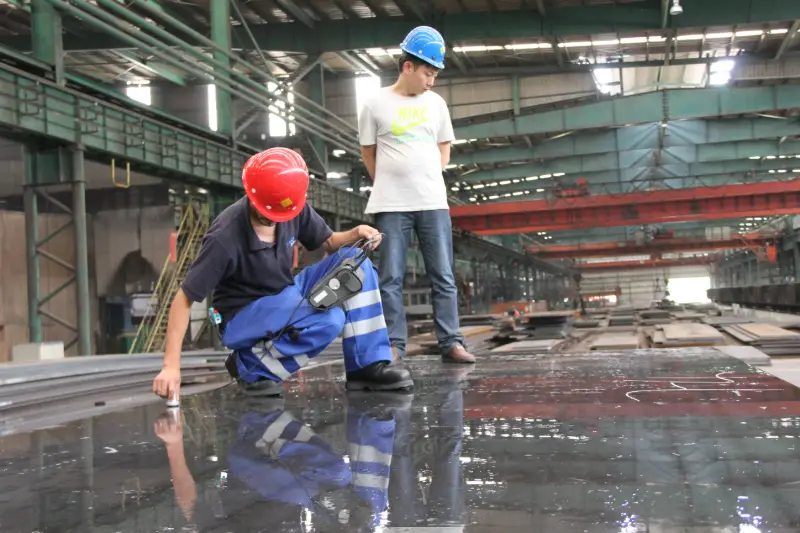
LR Grade DH32 Shipbuilding Steel Plate
LR Grade DH32 Shipbuilding Steel Plate: Properties, Equivalents & Applications
Comprehensive data sheet for LR Grade DH32 shipbuilding steel plate including chemical composition, mechanical and physical properties, international equivalents, similar grades, and typical applications.
Hot rolling, normalizing, thermo-mechanical controlled processing (TMCP), welding, cold forming
- Phone : +8618037372205
- Email : [email protected]
- WhatsApp: Contact via Whtsapp
- WeChat: +8618037372205
LR Grade DH32 Shipbuilding Steel Plate Introduction
LR Grade DH32 is a high-strength hull structural steel certified by Lloyd's Register (LR). It is designed for shipbuilding and offshore structures, offering a minimum yield strength of 315 MPa and excellent toughness at sub-zero temperatures. DH32 is supplied in normalized or thermo-mechanically controlled processed (TMCP) condition, ensuring good weldability and formability.
- Delivery condition: Normalized (N) or TMCP
- Impact test temperature: -20 °C
- Key feature: Reliable low-temperature toughness for cold environment marine applications
LR Grade DH32 Shipbuilding Steel Plate Chemical Composition
Chemical requirements according to LR Rules for Grade DH32 (typical ladle analysis for thickness ≤ 50 mm). Aluminum is added for grain refinement; small quantities of Nb, V, Ti may be present as grain-refining elements, but are not always mandatory. Maximum limits for P and S ensure good toughness and weldability.
| Element | Standard Value (wt%) | Remarks |
|---|---|---|
| Carbon (C) | ≤ 0.18 | Ladle analysis |
| Silicon (Si) | ≤ 0.50 | - |
| Manganese (Mn) | 0.90 – 1.60 | Depending on thickness and carbon equivalent requirement |
| Phosphorus (P) | ≤ 0.035 | - |
| Sulfur (S) | ≤ 0.035 | - |
| Aluminum (Als) | ≥ 0.015 | Total aluminum or acid-soluble aluminum |
| Niobium (Nb) | ≤ 0.05 | Optional grain-refining element |
| Vanadium (V) | ≤ 0.10 | Optional grain-refining element |
| Titanium (Ti) | ≤ 0.02 | Optional grain-refining element |
LR Grade DH32 Shipbuilding Steel Plate Thermal and Electrical Physical Properties
Physical properties are not specified in LR rules but are provided for engineering calculations. These values are typical for normalized or TMCP low-carbon-manganese structural steels at room temperature (20 °C) unless otherwise noted. Density, modulus, and thermal expansion are important for design and welding simulation.
| Property | Typical Value | Unit | Test Condition / Remark |
|---|---|---|---|
| Density (ρ) | 7.85 | g/cm³ | At 20 °C |
| Elastic Modulus (E) | 205 | GPa | At 20 °C |
| Shear Modulus (G) | 79 | GPa | Calculated from E and ν |
| Poisson's Ratio (ν) | 0.3 | - | At 20 °C |
| Thermal Expansion Coefficient (α) | 11.5 × 10⁻⁶ | K⁻¹ | 20 – 100 °C, linear expansion |
| Thermal Conductivity (λ) | 52 | W/(m·K) | At 20 °C, typical for C-Mn steel |
| Specific Heat Capacity (c) | 460 | J/(kg·K) | At 20 °C |
| Electrical Resistivity (ρₑ) | 0.15 × 10⁻⁶ | Ω·m | At 20 °C, typical for structural steel |
LR Grade DH32 Shipbuilding Steel Plate Mechanical Properties
Tensile and impact test requirements for LR DH32 plates in normalized or TMCP condition. Values apply to transverse test pieces unless otherwise noted. Impact tests are carried out at -20 °C; specimens taken in longitudinal direction meet higher absorbed energy requirements. Bending test is performed to verify formability.
| Property | Standard Requirement | Unit | Test Condition / Remark |
|---|---|---|---|
| Yield Strength (ReH) | ≥ 315 | MPa | Thickness t ≤ 50 mm (transverse) |
| Tensile Strength (Rm) | 440 – 590 | MPa | Thickness t ≤ 50 mm (transverse) |
| Elongation (A) | ≥ 22 | % | Gauge length 5.65√S₀, transverse, t ≤ 50 mm |
| Impact Energy (KV₂) | ≥ 27 (average) | J | Longitudinal, -20 °C, 10×10 mm specimen |
| Impact Energy (KV₂) | ≥ 20 (average) | J | Transverse, -20 °C, 10×10 mm specimen |
| Bend Test (180°) | Mandrel diameter 3 t | - | t ≤ 25 mm; no cracks |
| Bend Test (180°) | Mandrel diameter 4 t | - | 25 < t ≤ 40 mm; no cracks |
| Bend Test (180°) | Mandrel diameter 5 t | - | 40 < t ≤ 50 mm; no cracks |
LR Grade DH32 Shipbuilding Steel Plate Full Equivalents – Identical DH32 Grades from Other Classification Societies
| Country / Region | Standard / Society | Grade | Remarks |
|---|---|---|---|
| China | CCS | DH32 | China Classification Society |
| USA | ABS | DH32 | American Bureau of Shipping |
| France | BV | DH32 | Bureau Veritas |
| Norway/Germany | DNV | DH32 | DNV GL, now DNV |
| Germany | GL | DH32 | Germanischer Lloyd (merged into DNV) |
| South Korea | KR | DH32 | Korean Register |
| Japan | NK (ClassNK) | DH32 | Nippon Kaiji Kyokai |
| Italy | RINA | DH32 | Registro Italiano Navale |
| Russia | RS | DH32 | Russian Maritime Register of Shipping |
LR Grade DH32 Shipbuilding Steel Plate Application Introduction
LR DH32 steel is widely used in marine and offshore engineering where medium strength, good low-temperature toughness, and excellent weldability are required. Typical products range from entire ship hulls to specific structural components. It is suitable for cold forming and welding under controlled conditions.
Product Applications: Commercial ships (bulk carriers, tankers, container ships), Naval vessels and auxiliary ships, Offshore drilling platforms and accommodation modules, Floating production storage and offloading (FPSO) units, Barges and pontoons, Ice-strengthened vessels (where -20 °C toughness is sufficient)
Processed into products: Hull plating (shell, deck, bottom), Longitudinal and transverse stiffeners, Bulkheads and deep frames, Deck girders and hatch coamings, Brackets and web frames, Sea-fastening structures, Transition pieces and nodes in offshore structures, Anchor racks and towing brackets
Application industries: Shipbuilding, Offshore Oil & Gas, Marine Engineering, Port & Harbor Construction, Renewable Energy (Offshore Wind Turbine Foundations)
LR Grade DH32 Shipbuilding Steel Plate Similar or Alternative Materials
| Country / Region | Standard / Society | Grade | Remarks |
|---|---|---|---|
| International | LR | DH36 | Higher strength (min YS 355 MPa), same -20 °C impact test |
| International | LR | DH32Z | With through-thickness (Z) properties, improved lamellar tearing resistance |
| International | LR | EH32 | Same strength, even lower impact test temperature of -40 °C |
| International | LR | AH32 | Same strength, impact test at 0 °C (less demanding low-temperature toughness) |
| International | IACS | A32 | Normal strength hull steel, min YS 235 MPa; lower strength alternative |
| China | GB/T 712-2011 | DH32 | Identical chemistry and mechanical properties, national standard |
Notes:
Welding: DH32 steel is readily weldable using standard shipbuilding procedures; preheat may be required for thick sections. Carbon Equivalent (CEV): Usually controlled to ≤ 0.38% (ladle) to ensure weldability. Thickness Capability: LR rules cover up to 50 mm; thicker plates may be supplied with revised mechanical property requirements. Certification: All plates are supplied with LR inspection certificate 3.1 or 3.2 according to EN 10204. Corrosion Protection: Standard maritime coating systems are recommended.
- Share



