
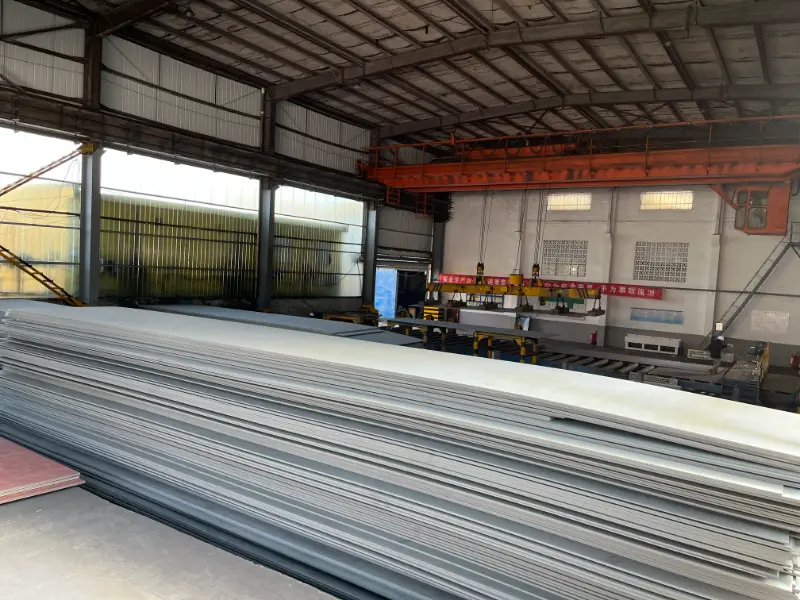
CCS Grade DH40 Shipbuilding Steel Plate
CCS Grade DH40 Shipbuilding Steel Plate - High Strength Marine Structural Material
Comprehensive technical data for CCS DH40 shipbuilding steel including chemical composition, mechanical properties, thermal/electrical characteristics, international equivalents, and applications per China Classification Society rules.
Hot rolling, controlled rolling, normalizing, or thermo-mechanical control process (TMCP); welding; flame cutting; cold forming (with precautions)
- Phone : +8618037372205
- Email : [email protected]
- WhatsApp: Contact via Whtsapp
- WeChat: +8618037372205
CCS Grade DH40 Shipbuilding Steel Plate Introduction
CCS Grade DH40 is a high-strength shipbuilding structural steel plate certified by the China Classification Society (CCS). It belongs to the normalized or controlled rolled condition of the high-strength series with a specified minimum yield strength of 390 MPa. DH40 offers excellent weldability, good low-temperature toughness (impact tested at -20°C), and superior resistance to brittle fracture, making it ideal for critical hull structure components, offshore platforms, and marine engineering applications. Its fine-grain steel composition and strict control of impurities ensure reliable performance under dynamic loading and harsh marine environments.
CCS Grade DH40 Shipbuilding Steel Plate Chemical Composition
The chemical composition conforms to CCS Rules. The steel is fully killed and fine-grained. Maximum limits are given unless a range is specified. Trace elements like Nb, V, Ti are added individually or in combination for grain refinement and precipitation strengthening. Carbon Equivalent (CEV) is typically restricted to ensure good weldability.
| Element | Specified Values (%) | Remarks |
|---|---|---|
| C (Carbon) | ≤ 0.18 | Ladle analysis |
| Si (Silicon) | 0.10 – 0.50 | |
| Mn (Manganese) | 0.90 – 1.60 | May be increased subject to CEV limits |
| P (Phosphorus) | ≤ 0.025 | Max limit |
| S (Sulfur) | ≤ 0.025 | Max limit |
| Cu (Copper) | ≤ 0.35 | |
| Cr (Chromium) | ≤ 0.20 | |
| Ni (Nickel) | ≤ 0.40 | |
| Mo (Molybdenum) | ≤ 0.08 | |
| Nb (Niobium) | 0.02 – 0.05 | Grain refiner |
| V (Vanadium) | 0.05 – 0.10 | May substitute Nb partially |
| Ti (Titanium) | ≤ 0.02 | Optional grain refiner |
| Al (Aluminium, acid soluble) | ≥ 0.015 | Minimum required for fine grain practice |
CCS Grade DH40 Shipbuilding Steel Plate Thermal and Electrical Physical Properties
The following values are typical for normalized DH40 grade steel and may vary slightly with composition and heat treatment. Thermal expansion is linear between 20°C and indicated temperature. These properties are essential for design calculations involving heat transfer and structural analysis.
| Property | Typical Value | Unit | Testing Condition / Remarks |
|---|---|---|---|
| Density (ρ) | 7850 | kg/m³ | At 20°C |
| Modulus of Elasticity (E) | 206 | GPa | At 20°C |
| Shear Modulus (G) | 79.3 | GPa | At 20°C |
| Poisson's Ratio (ν) | 0.30 | — | At 20°C |
| Thermal Expansion Coefficient (α) | 11.8 × 10⁻⁶ | K⁻¹ | 20°C – 100°C |
| Thermal Expansion Coefficient (α) | 12.8 × 10⁻⁶ | K⁻¹ | 20°C – 200°C |
| Thermal Expansion Coefficient (α) | 13.5 × 10⁻⁶ | K⁻¹ | 20°C – 300°C |
| Thermal Conductivity (λ) | 51.9 | W/(m·K) | At 20°C |
| Specific Heat Capacity (Cp) | 486 | J/(kg·K) | At 20°C |
| Electrical Resistivity (ρₑ) | 0.25 × 10⁻⁶ | Ω·m | At 20°C |
CCS Grade DH40 Shipbuilding Steel Plate Mechanical Properties
Mechanical properties are determined on transverse test pieces unless otherwise agreed. Impact energy requirements for DH40 apply at -20°C. Values vary with plate thickness and sampling direction. Bend test requires no cracks on the outer surface when bent to 180° over a mandrel diameter of 3t (t = specimen thickness).
| Property | Required Value | Unit | Testing Condition / Remarks |
|---|---|---|---|
| Yield Strength (ReH) | ≥ 390 | MPa | Thickness ≤ 50 mm |
| Yield Strength (ReH) | ≥ 370 | MPa | Thickness > 50 mm to 100 mm |
| Yield Strength (ReH) | ≥ 350 | MPa | Thickness > 100 mm (subject to agreement) |
| Tensile Strength (Rm) | 510 – 650 | MPa | All thicknesses |
| Elongation (A) | ≥ 20 | % | Gauge length L₀ = 5.65√S₀; thickness ≤ 50 mm |
| Elongation (A) | ≥ 19 | % | Thickness > 50 mm |
| Impact Energy (KV₂) longitudinal | ≥ 31 | J | At -20°C (average of 3 tests, individual min 22 J) |
| Impact Energy (KV₂) transverse | ≥ 22 | J | At -20°C (average, individual min 16 J) |
| Bend Test (Bend Diameter) | 3 × t | — | 180° bend, t = specimen thickness; no cracking |
CCS Grade DH40 Shipbuilding Steel Plate Fully Equivalent Material Standards and Substitutable Grades
| Country / Region | Standard / Classification Society | Equivalent Grade | Remarks |
|---|---|---|---|
| China | CCS | DH40 | Original designation |
| United States | ABS | DH40 | ABS DH40 identical requirements |
| United Kingdom / International | LR (Lloyd's Register) | DH40 | LR DH40 |
| Norway / Germany | DNV | DH40 | DNV DH40 (merged with GL) |
| France | BV (Bureau Veritas) | DH40 | BV DH40 |
| Japan | NK (ClassNK) | KD40 | NK grade designation |
| Italy | RINA | DH40 | RINA DH40 |
| South Korea | KR | DH40 | KR DH40 |
| Russia | RMRS (RS) | DH40 | RS DH40 |
| India | IRS | DH40 | IRS DH40 |
CCS Grade DH40 Shipbuilding Steel Plate Application Introduction
CCS DH40 steel is widely used in shipbuilding and offshore engineering where high strength and low-temperature toughness are essential. Strict compliance with welding consumables and procedures is required to maintain mechanical properties in the heat-affected zone. Preheating is seldom needed for moderate thicknesses, and post-weld heat treatment is generally not required.
Product Applications: Container ships, bulk carriers, tankers, FPSO (Floating Production Storage and Offloading) units, Jack-up rig legs and spud cans, Ship deck plates and hatch coamings, Offshore crane booms and pedestals
Processed into products: Main hull shell plating, Bottom and side longitudinal stiffeners, Transverse web frames and stringers, Strength deck panels, Bulkhead plates (including watertight doors), Rudder horns and shaft brackets, Offshore module support structures, Mooring equipment foundations
Application industries: Shipbuilding (commercial and naval vessels), Offshore oil and gas platforms, Marine renewable energy (wind turbine foundations), Heavy lifting and transportation barges, Port and harbor infrastructure
CCS Grade DH40 Shipbuilding Steel Plate Similar / Alternative Material Recommendations
| Country / Region | Standard | Grade | Remarks |
|---|---|---|---|
| European Union | EN 10025-4 | S420M | Thermo-mechanical rolled fine grain structural steel (non-marine); 420 MPa min yield, impact at -20°C optional. Not fully equivalent due to marine certification requirements. |
| United States | ASTM A572/A572M | Grade 60 [415] | High-strength low-alloy structural steel, min yield 415 MPa; similar strength but lacks mandatory -20°C impact and classification society ratification. |
| China | GB/T 712 | DH40 | Chinese national standard for shipbuilding steel; essentially the same chemical and mechanical requirements as CCS DH40. |
Notes:
Certification: Material must be produced by a CCS-approved manufacturer and delivered with CCS inspection certificate. Optional supplementary requirements for strain aging, ultrasonic testing, and Z-grade through-thickness properties can be agreed at the time of order. Weldability notes: Preheating temperature depends on plate thickness and hydrogen control; typical carbon equivalent (CEV) ≤ 0.40% is recommended for good weldability without high preheat.
- Share



