
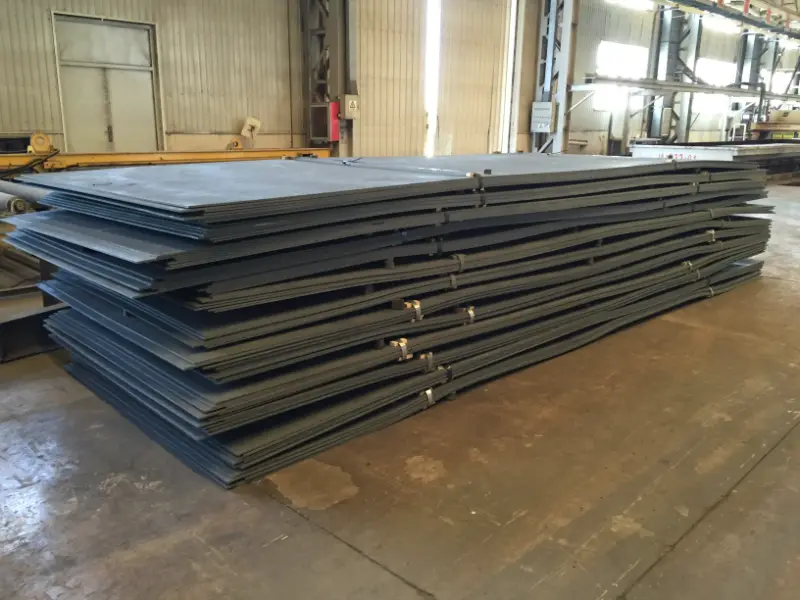
CCS Grade EH40 Shipbuilding Steel Plate
CCS Grade EH40 Shipbuilding Steel Plate - High Strength Hull Structural Steel
CCS EH40 is a high strength shipbuilding steel plate certified by China Classification Society, with minimum yield strength of 390 MPa. It is widely used in hull structures and offshore engineering, offering excellent toughness at -40°C.
Cutting, forming, welding, machining, hot rolling, thermo-mechanical controlled processing (TMCP), normalizing, quenching and tempering.
- Phone : +8618037372205
- Email : [email protected]
- WhatsApp: Contact via Whtsapp
- WeChat: +8618037372205
CCS Grade EH40 Shipbuilding Steel Plate Introduction
CCS Grade EH40 is a high strength structural steel plate for shipbuilding, classified under the China Classification Society (CCS) rules for hull structures. It is designed to provide a minimum yield strength of 390 MPa, with excellent weldability and impact toughness at low temperatures (down to -40°C). This steel grade is typically produced by thermo-mechanical controlled processing (TMCP) or normalizing rolling, ensuring a fine-grained microstructure that meets stringent requirements for notch toughness and crack propagation resistance. EH40 plates are widely applied in critical structural components of large vessels, offshore platforms, and marine engineering equipment, where a combination of high strength, good corrosion resistance, and reliable low-temperature performance is essential. Its chemical composition is carefully balanced with microalloying elements such as niobium, vanadium, and titanium to achieve superior mechanical properties while maintaining good formability and weldability. Delivery condition is usually normalized, TMCP, or quenched and tempered depending on thickness and customer requirements.
CCS Grade EH40 Shipbuilding Steel Plate Chemical Composition
The chemical composition of CCS EH40 is strictly controlled to ensure high strength and good low-temperature toughness. It includes microalloying elements for grain refinement, with limits on carbon equivalent (Ceq) to ensure weldability. The following values represent typical ladle analysis limits specified by CCS for thickness ≤50 mm; slight adjustments may apply for thicker plates or specific delivery conditions.
| Element | Max/Min (weight %) | Remarks |
|---|---|---|
| Carbon (C) | ≤ 0.18 | For plate thickness ≤ 50 mm; lower for thicker plates |
| Silicon (Si) | ≤ 0.50 | Minimum usually 0.10, not explicitly specified in some editions |
| Manganese (Mn) | 0.90 - 1.60 | Higher Mn for thicker sections to maintain strength |
| Phosphorus (P) | ≤ 0.035 | Low P for toughness and weldability |
| Sulfur (S) | ≤ 0.035 | Low S for toughness and weldability |
| Aluminum (Altot or Als) | ≥ 0.015 (acid soluble) | For grain refinement; total Al usually ≥ 0.020 |
| Niobium (Nb) | ≤ 0.05 | Microalloying, optional |
| Vanadium (V) | ≤ 0.10 | Microalloying, optional |
| Titanium (Ti) | ≤ 0.02 | Microalloying for grain refinement, optional |
| Nitrogen (N) | ≤ 0.012 | Combined with Al or Ti for grain size control |
| Carbon Equivalent (Ceq) | ≤ 0.40 | Ceq = C + Mn/6 + (Cr+Mo+V)/5 + (Ni+Cu)/15 |
CCS Grade EH40 Shipbuilding Steel Plate Thermal and Electrical Physical Properties
Physical properties are typical for low-alloy structural steels and may vary slightly with exact composition and heat treatment. The values are provided for design calculations and are not mandatory requirements in the CCS specification.
| Property | Typical Value | Unit | Conditions / Remarks |
|---|---|---|---|
| Density (ρ) | 7.85 | g/cm³ | Room temperature |
| Elastic Modulus (E) | 206 | GPa | At 20°C |
| Shear Modulus (G) | 79.3 | GPa | Calculated from E and ν |
| Poisson's Ratio (ν) | 0.3 | - | Room temperature |
| Thermal Expansion Coefficient (α) | 12.0 | 10⁻⁶/K | For 20-300°C, typical range 11.5-12.5 |
| Thermal Conductivity (λ) | 50 | W/(m·K) | At 20°C, may decrease with increasing temperature |
| Specific Heat Capacity (c) | 460 | J/(kg·K) | At 20°C, increases slightly with temperature |
| Electrical Resistivity (ρ_e) | 0.15 | µΩ·m | At 20°C, typical for low-alloy steel |
CCS Grade EH40 Shipbuilding Steel Plate Mechanical Properties
Mechanical properties are determined by standard tensile and impact tests. Requirements depend on plate thickness and testing direction. The values below refer to thickness ≤ 50 mm and longitudinal test direction unless otherwise noted. For transverse tests, impact values may be lower; the standard requires impact energy in longitudinal direction at -40°C min 34 J (longitudinal).
| Property | Specified Value | Unit | Test Condition / Thickness Range |
|---|---|---|---|
| Yield Strength (ReH, min) | 390 | MPa | t ≤ 50 mm |
| Yield Strength (ReH, min) | 370 | MPa | 50 < t ≤ 100 mm (typical reduction, check CCS) |
| Tensile Strength (Rm) | 510 - 650 | MPa | t ≤ 50 mm |
| Tensile Strength (Rm) | 490 - 630 | MPa | 50 < t ≤ 100 mm |
| Elongation (A5, min) | 20 | % | Longitudinal, gauge length 5.65√So |
| Elongation (A5, min) | 19 | % | Transverse (typical, may be specified in order) |
| Impact Energy (KV, min) | 34 | J | Longitudinal, at -40°C, standard specimen 10x10 mm |
| Impact Energy (KV, min) | 24 | J | Transverse, at -40°C (if required by thicker grades) |
| Bend Test (D = mandrel diameter) | 3a | - | t ≤ 50 mm, 180°, no cracks |
CCS Grade EH40 Shipbuilding Steel Plate Full Equivalent Materials: Identical Standards and Grade Replacements
| Country / Region | Standard | Grade | Remarks |
|---|---|---|---|
| International (IACS) | IACS UR W11 | E40 | Standard for all IACS classification societies |
| Norway (DNV) | DNV Rules | E40 | Equivalent to CCS EH40 |
| USA (ABS) | ABS Rules | EH40 | Directly equivalent |
| UK (LR) | Lloyd's Register Rules | EH40 | Directly equivalent |
| France (BV) | Bureau Veritas Rules | E40 | Directly equivalent |
| Japan (NK) | ClassNK Rules | KE40 | Equivalent to CCS EH40 |
| South Korea (KR) | KR Rules | EH40 | Equivalent; may have slight variations |
| Italy (RINA) | RINA Rules | E40 | Equivalent |
| Russia (RS) | RS Rules | E40 | Equivalent |
| Germany (GL) | DNV GL (merged to DNV) | E40 | Now DNV, previously GL E40 |
CCS Grade EH40 Shipbuilding Steel Plate Application Introduction
CCS EH40 steel is primarily used in the shipbuilding and marine engineering industries, where high structural strength and resistance to brittle fracture at low service temperatures are required. It is ideal for critical load-bearing components such as main deck plates, shell plating, bottom longitudinals, transverse frames, and bulkheads. Its excellent weldability allows efficient fabrication of complex hull geometries, while the balanced microalloying ensures uniform mechanical properties through thickness. Typical applications include large ocean-going vessels, ice-class ships, offshore oil and gas platforms, and wind turbine installation vessels.
Product Applications: Containership hulls, Bulk carriers and ore carriers, Oil tankers and chemical carriers, LNG/LPG carrier tanks and structural members, Jack-up rig legs and spudcans, Semi-submersible platform pontoons, Icebreaker hulls
Processed into products: Main deck plating, Bottom and side shell plates, Longitudinal stiffeners and girders, Transverse web frames, Watertight bulkheads, Hatch coamings and supports, Rudder horns and stock plating
Application industries: Shipbuilding (commercial, naval, and special-purpose vessels), Offshore oil & gas (platforms, rigs, FPSO modules), Marine renewable energy (wind turbine foundations, tidal energy structures), Port and harbor infrastructure (floating docks, breakwaters), Heavy engineering (pressure hulls, submersibles)
CCS Grade EH40 Shipbuilding Steel Plate Closely Related or Similar Alternative Materials for EH40
| Country / Region | Standard | Grade | Remarks |
|---|---|---|---|
| China (CCS) | CCS | EH36 | Lower yield strength (355 MPa), same toughness level, may substitute in less demanding structures |
| China (CCS) | CCS | EH47 | Higher yield strength (460 MPa), sometimes used for higher performance, weldability less favorable |
| China (GB/T) | GB/T 712 | DH40 | Same strength but impact test temperature -20°C instead of -40°C, suitable for non-freezing waters |
| International | IACS | FH40 | Even higher low-temperature toughness (-60°C), but similar strength |
| Europe (EN) | EN 10025-4 | S420ML / S420M | Thermomechanical rolled steel with similar yield but not ship-specific; impact at -50°C (ML) or -20°C (M) |
Notes:
The above data is based on CCS Rules for Materials and Welding (latest revision). Actual delivered plates may have slightly different chemical compositions as long as they meet the specified mechanical and toughness requirements. For thicknesses above 50 mm, reductions in yield and tensile strength may apply; consult the classification society's rules for details. Specific requirements for through-thickness properties (Z-direction) may be ordered with additional sulfur control. The thermal and electrical properties are typical and not part of the material certificate. Always verify certificates and test reports for the specific heat number.
- Share



