
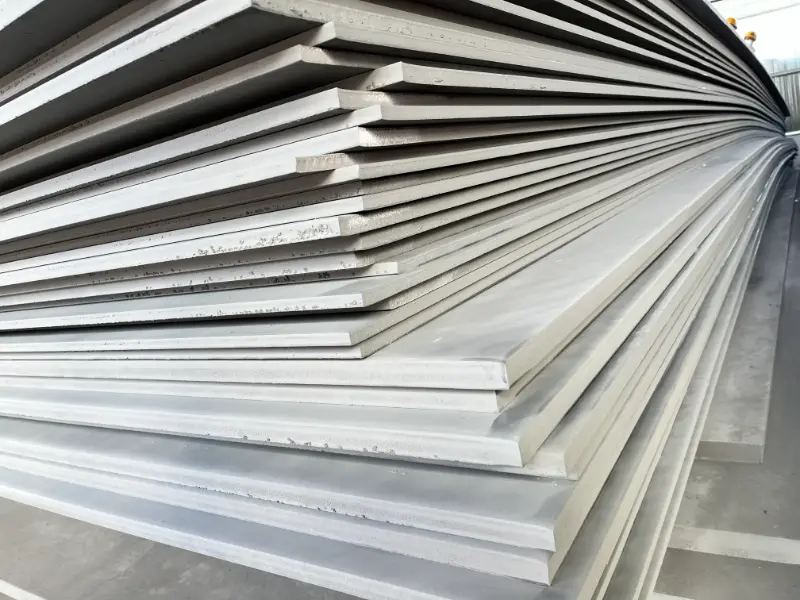
CCS FH40 Shipbuilding Steel Plate
CCS FH40 Shipbuilding Steel Plate - High Strength, Low-Temperature Toughness for Marine Applications
Comprehensive material data for CCS Grade FH40 shipbuilding steel: chemical composition, mechanical properties, thermal and electrical physical properties, equivalent international grades and similar alternatives.
Cutting, welding, bending, forming, machining (drilling, milling), blasting and painting
- Phone : +8618037372205
- Email : [email protected]
- WhatsApp: Contact via Whtsapp
- WeChat: +8618037372205
CCS FH40 Shipbuilding Steel Plate Introduction
CCS Grade FH40 is a high-strength hull structural steel plate governed by the China Classification Society (CCS) Rules for Materials and Welding. It belongs to the normalized or thermomechanical rolled fine-grain structural steels with a specified minimum yield strength of 390 MPa and ensures reliable low-temperature toughness at -60°C (F-grade).
Key features:
- Excellent weldability and formability due to controlled carbon equivalent (Ceq ≤ 0.40%).
- Superior impact resistance down to -60°C, making it suitable for ice-class vessels and Arctic offshore structures.
- Typical applications include main hull plates, deck plates, and critical structural members in shipbuilding and marine engineering.
- Supplied in normalized (N) or thermomechanical controlled processing (TMCP) condition as required.
CCS FH40 Shipbuilding Steel Plate Chemical Composition
The chemical composition complies with CCS Rules for FH40. All elements are controlled to achieve fine-grained microstructure and ensure weldability. Niobium, vanadium, titanium, and aluminium are added as grain-refining elements. Carbon equivalent Ceq = C + Mn/6 + (Cr+Mo+V)/5 + (Ni+Cu)/15 ≤ 0.40% unless otherwise agreed.
| Element | Standard Value (max, %) | Note |
|---|---|---|
| C | 0.16 | |
| Si | 0.50 | |
| Mn | 0.90 – 1.60 | |
| P | 0.025 | |
| S | 0.025 | |
| Als (acid soluble) | ≥ 0.015 | Total Al may be specified instead |
| Nb | 0.02 – 0.05 | |
| V | 0.05 – 0.10 | |
| Ti | ≤ 0.02 | |
| Cu | ≤ 0.35 | |
| Cr | ≤ 0.20 | |
| Ni | ≤ 0.40 | Higher Ni may be permitted for thickness >50 mm |
| Mo | ≤ 0.08 | |
| N | ≤ 0.009 | If present, adequate fixing elements shall be added |
CCS FH40 Shipbuilding Steel Plate Thermal and Electrical Physical Properties
The following values are typical for carbon‑manganese fine‑grain steel at room temperature unless a temperature range is indicated. They are provided for design and calculation purposes and are not mandatory specification requirements.
| Property | Standard Typical Value | Unit | Test Condition / Temperature |
|---|---|---|---|
| Density (ρ) | 7850 | kg/m³ | 20 °C |
| Modulus of Elasticity (E) | 208 | GPa | 20 °C |
| Modulus of Elasticity (E) | 200 | GPa | 100 °C |
| Modulus of Elasticity (E) | 192 | GPa | 200 °C |
| Shear Modulus (G) | 81 | GPa | 20 °C |
| Poisson's Ratio (ν) | 0.30 | — | 20 °C |
| Coefficient of Thermal Expansion (α) | 11.5 | ×10⁻⁶/K | 20 – 100 °C |
| Coefficient of Thermal Expansion (α) | 12.2 | ×10⁻⁶/K | 20 – 200 °C |
| Coefficient of Thermal Expansion (α) | 12.8 | ×10⁻⁶/K | 20 – 300 °C |
| Thermal Conductivity (λ) | 48 | W/(m·K) | 20 °C |
| Thermal Conductivity (λ) | 47 | W/(m·K) | 100 °C |
| Thermal Conductivity (λ) | 44 | W/(m·K) | 200 °C |
| Thermal Conductivity (λ) | 42 | W/(m·K) | 300 °C |
| Specific Heat Capacity (cp) | 460 | J/(kg·K) | 20 °C |
| Specific Heat Capacity (cp) | 480 | J/(kg·K) | 100 °C |
| Specific Heat Capacity (cp) | 510 | J/(kg·K) | 200 °C |
| Electrical Resistivity (ρe) | 0.15 | μΩ·m | 20 °C |
| Electrical Resistivity (ρe) | 0.22 | μΩ·m | 100 °C |
| Electrical Resistivity (ρe) | 0.33 | μΩ·m | 200 °C |
CCS FH40 Shipbuilding Steel Plate Mechanical Properties
Minimum mechanical properties according to CCS requirements. Tensile test specimens are taken in the transverse direction unless otherwise agreed; impact test specimens are taken in the longitudinal direction. For thicknesses above 50 mm, slight reduction in elongation is accepted. Impact energy is the average of three specimens (one individual minimum 70% of specified average).
| Property | Standard Required Value | Unit | Test Condition / Remark |
|---|---|---|---|
| Yield Strength (ReH) | ≥ 390 | MPa | Transverse specimen, thickness ≤ 50 mm |
| Yield Strength (ReH) | ≥ 370 | MPa | Transverse specimen, thickness > 50 to 70 mm |
| Tensile Strength (Rm) | 510 – 660 | MPa | Transverse specimen, all thicknesses |
| Elongation (A) | ≥ 20 | % | Gauge length 5.65√So, thickness ≤ 50 mm |
| Elongation (A) | ≥ 19 | % | Gauge length 5.65√So, thickness > 50 to 70 mm |
| Charpy V‑notch Impact Energy (KV2) | ≥ 41 (longitudinal) | J | Test temperature -60°C, average of 3 tests |
| Charpy V‑notch Impact Energy (KV2) | ≥ 27 (transverse) | J | Test temperature -60°C, average of 3 tests |
| Bend Test (180°) | d = 3a | Mandrel diameter d, specimen thickness a, no cracks |
CCS FH40 Shipbuilding Steel Plate Full Equivalent Grades and Substitute Designations
| Country / Region | Standard | Grade / Designation | Remark |
|---|---|---|---|
| International (IACS) | UR W11 | FH40 | Unified requirement by all IACS members |
| USA | ABS Rules | FH40 | American Bureau of Shipping |
| France | BV Rules | FH40 | Bureau Veritas |
| Norway / Germany | DNV Rules | FH40 | DNV GL (now DNV) |
| UK | LR Rules | FH40 | Lloyd's Register |
| Japan | NK Rules | FH40 | ClassNK (Nippon Kaiji Kyokai) |
| Korea | KR Rules | FH40 | Korean Register of Shipping |
| Italy | RINA Rules | FH40 | Registro Italiano Navale |
| China | GB 712‑2011 | FH40 | National standard, identical technical requirements |
CCS FH40 Shipbuilding Steel Plate Application Introduction
FH40 steel plates are primarily designed for the most demanding structural parts of ships and offshore installations where high strength and excellent toughness at sub‑zero temperatures are essential. The material is fully weldable and can be formed using standard shipyard processes. Typical industries and products are listed below.
Product Applications: Container ships, bulk carriers, tankers, LNG carriers, Ice‑breakers and ice‑class vessels, Offshore platform topside structures, Steel foundation structures for offshore wind turbines
Processed into products: Main hull plates (bottom, side and deck plating), Longitudinal stiffeners and web frames, Bilge keels and rudder horns, Hatch coamings and heavy lifting padeyes, Brackets and gusset plates in high‑stress zones
Application industries: Shipbuilding (hull structures, decks, bulkheads, longitudinal and transverse members), Offshore engineering (jack‑up rig legs, semi‑submersible platforms, FPSO modules), Marine equipment (crane pedestals, heavy‑duty hatch covers), Port and harbour construction (sheet piling, dolphins, fenders)
CCS FH40 Shipbuilding Steel Plate Similar or Comparable Substitute Grades
| Country / Region | Standard | Grade | Remark / Comparison |
|---|---|---|---|
| China | CCS Rules | FH36 | Lower yield strength (355 MPa) but same F‑grade (-60°C) toughness. |
| China | CCS Rules | EH40 | Same strength, but only -40°C impact; less severe low‑temperature requirement. |
| China | CCS Rules | DH40 | Same strength, -20°C impact; used where moderate toughness suffices. |
| Europe | EN 10025‑4 | S420ML | Thermomechanical rolled, yield 420 MPa, impact at -50°C; close in strength but not identical low‑temperature range. |
| USA | ASTM A131 / API 2H | FH40 | ASTM A131 Grade FH40 has similar requirements; API 2H Grade 50 may be comparable but needs separate approval. |
Notes:
- Certification: All plates are delivered with CCS certificates (or other IACS class certificates upon request), including chemical analysis, tensile and impact test results.
- Thickness range: Typically 6 mm to 100 mm, wider dimensions available after agreement.
- Tolerances: Conform to the dimensional and flatness tolerances of the ordering specification (e.g., EN 10029 or ASTM A6).
- Welding: FH40 has good weldability using all common methods (SMAW, SAW, GMAW) with appropriate low‑hydrogen consumables; pre‑heating usually not required for moderate thicknesses.
- Corrosion protection: The steel has no inherent corrosion resistance and requires protective coatings or cathodic protection in marine environments.
- Share



