
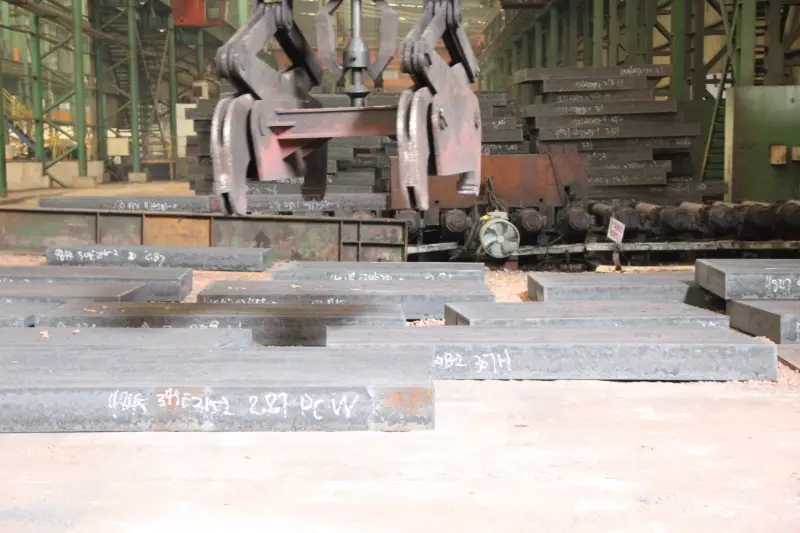
CCS Grade AQ47 Shipbuilding Steel Plate
CCS Grade AQ47 Shipbuilding Steel Plate - High Strength Quenched & Tempered for Critical Marine Structures
Explore the detailed material properties, chemical composition, mechanical and thermal characteristics of CCS Grade AQ47 shipbuilding steel plate, including full international equivalent grades and application guidance.
Hot rolling, quenching and tempering, welding, hot/cold forming (with care due to high strength), machining
- Phone : +8618037372205
- Email : [email protected]
- WhatsApp: Contact via Whtsapp
- WeChat: +8618037372205
CCS Grade AQ47 Shipbuilding Steel Plate Introduction
CCS Grade AQ47 is a high-strength quenched and tempered structural steel plate governed by the China Classification Society (CCS) Rules for Materials and Welding. It belongs to the family of ultra-high strength hull structural steels with a minimum yield strength of 460 MPa (designated as the 47 ksi class, reflecting its historical tensile strength reference).
- Excellent strength-to-weight ratio enabling lighter ship designs without compromising safety.
- Controlled carbon equivalent and microalloying ensure good weldability and low-temperature toughness.
- Available in normalized or quenched and tempered condition, meeting stringent requirements for notch toughness at 0 °C (Grade A).
- Widely applied in the construction of high-stress zones of container ships, bulk carriers, naval vessels, and offshore platforms.
CCS Grade AQ47 Shipbuilding Steel Plate Chemical Composition
The chemical composition complies with CCS Rule requirements for high-strength quenched and tempered ships' steel. Values shown are maximum unless a range is given. The steel is microalloyed for grain refinement and precipitation strengthening to achieve the required mechanical properties. Carbon equivalent (CEV) is controlled to ensure weldability.
| Chemical Element | Standard Value (max %) | Remarks |
|---|---|---|
| Carbon (C) | 0.18 | Ladle analysis; product analysis may be slightly higher |
| Silicon (Si) | ≤ 0.55 | Deoxidizing element |
| Manganese (Mn) | 1.00 - 1.60 | Contributes to strength and hardenability |
| Phosphorus (P) | ≤ 0.020 | Low P for improved toughness |
| Sulfur (S) | ≤ 0.020 | Low S for improved cleanliness and Z-property when specified |
| Copper (Cu) | ≤ 0.35 | Residual element, beneficial for corrosion resistance |
| Chromium (Cr) | ≤ 0.30 | May be added for strength |
| Nickel (Ni) | ≤ 0.80 | Improves notch toughness |
| Molybdenum (Mo) | ≤ 0.50 | Increases hardenability |
| Vanadium (V) | ≤ 0.10 | Grain refiner and precipitation strengthener |
| Titanium (Ti) | ≤ 0.02 | Grain refiner, reduces weld zone softening |
| Niobium (Nb) / Columbium | ≤ 0.05 | Grain refiner, improves strength |
| Aluminium (Al) total | ≥ 0.015 | For deoxidation and grain refinement |
| Nitrogen (N) | ≤ 0.009 | Controlled to avoid ageing effects |
CCS Grade AQ47 Shipbuilding Steel Plate Thermal and Electrical Physical Properties
The following physical properties are typical for low-alloy quenched and tempered steels and are provided for engineering design reference. Actual values may vary slightly depending on exact composition and heat treatment condition. These data are not specification requirements but serve as a guide.
| Property | Typical Value | Unit | Test Condition / Remark |
|---|---|---|---|
| Density (ρ) | 7.85 | g/cm³ | At room temperature |
| Modulus of Elasticity (E) | 205 | GPa | At room temperature, tension |
| Shear Modulus (G) | 80 | GPa | Calculated from E and Poisson's ratio |
| Poisson's Ratio (ν) | 0.30 | - | Elastic range |
| Thermal Expansion Coefficient (α) | 11.8 | 10⁻⁶/°C | At 20-100°C |
| Thermal Expansion Coefficient (α) | 12.5 | 10⁻⁶/°C | At 20-200°C |
| Thermal Expansion Coefficient (α) | 13.3 | 10⁻⁶/°C | At 20-400°C |
| Thermal Conductivity (λ) | 47 | W/(m·K) | At 20°C |
| Thermal Conductivity (λ) | 45 | W/(m·K) | At 200°C |
| Thermal Conductivity (λ) | 40 | W/(m·K) | At 400°C |
| Specific Heat Capacity (cp) | 460 | J/(kg·K) | At 20°C |
| Electrical Resistivity (ρₑ) | 0.22 | µΩ·m | At 20°C |
CCS Grade AQ47 Shipbuilding Steel Plate Mechanical Properties
Mechanical testing is carried out on transverse specimens in accordance with CCS Rules Part 1, Chapter 3. Unless otherwise agreed, testing is performed in the as-delivered (quenched and tempered) condition. Tensile and impact properties are guaranteed for plates up to 50 mm thickness; properties for thicker plates may require special negotiation.
| Property | Required Value | Unit | Test Condition |
|---|---|---|---|
| Yield Strength (ReH) min. | 460 | MPa | Transverse, 0.2% offset, at room temperature |
| Tensile Strength (Rm) | 570 - 720 | MPa | Transverse, at room temperature |
| Elongation after fracture (A5) | ≥ 17 | % | Gauge length 5.65√So, transverse |
| Bend Test (180°) | No cracks | - | Bend diameter = 3t (t = plate thickness), transverse |
| Charpy V-notch impact (KV2) min., at 0°C | ≥ 34 (average of 3), ≥ 24 (single) | J | Transverse, 10×10 mm specimen, for Grade A; higher temperatures for thicker plates may apply |
CCS Grade AQ47 Shipbuilding Steel Plate Fully Equivalent Material Standards and Substitute Grades
| Country / Region | Standard | Grade | Remarks |
|---|---|---|---|
| International Association of Classification Societies (IACS) | UR W11 | A460 (or AQ460) | Specifies minimum yield 460 MPa quenching & tempering steel; directly equivalent in chemical and mechanical requirements. |
| European Union | EN 10025-6 | S460Q | Quenched and tempered structural steel with min. yield 460 MPa and similar impact properties at 0°C (J0) or -20°C (J2). |
| American Bureau of Shipping (ABS) | ABS Rules | AQ46 | ABS equivalent to 460 MPa QT steel; absorbed energy and chemistry aligned with IACS. |
| DNV (Det Norske Veritas) | DNV Rules | NV AQ470 | DNV designation; AQ473 indicates min. yield 470 MPa, technically compatible. |
| Lloyd's Register (LR) | LR Rules | AH47 | LR grade AH47 represents minimum tensile strength 47 kgf/mm² class, equivalent to 460 MPa yield. |
| Bureau Veritas (BV) | BV Rules | AQ460 | BV definition is 460 MPa minimum yield, fully interchangeable. |
| Korean Register (KR) | KR Rules | KA47 | KR 47K class matching 460 MPa Q&T steel. |
CCS Grade AQ47 Shipbuilding Steel Plate Application Introduction
CCS AQ47 steel is specifically engineered for critical load-bearing components in ships and offshore structures where high strength, good toughness, and weldability are essential. Its balanced chemistry and consistent properties make it suitable for heavily stressed areas. The following outlines common usage:
Product Applications: Container ship hulls and hatch coamings, Bulk carrier side shells and double bottom, LNG carrier membrane support structures, FPSO (Floating Production Storage and Offloading) modules, Naval destroyer and frigate decks and bulkheads, Offshore wind turbine transition pieces and foundation plates
Processed into products: Main deck plates and bottom strakes, Longitudinal girders and transverse web frames, Bilge keel and skeg plates, Heavy lifting padeyes and crane pedestal inserts, Collision bulkheads and ice strengthening frames, Thruster support structures, Fatigue-critical welded connections
Application industries: Shipbuilding (commercial and naval), Offshore oil & gas platforms (jackets, topsides), Port and heavy machinery, Bridge structural components exposed to marine environment, Pressure vessels and storage tanks (subject to code endorsement)
CCS Grade AQ47 Shipbuilding Steel Plate Similar/Comparable Material Grades
| Country / Region | Standard | Grade | Remarks |
|---|---|---|---|
| China | GB/T 712-2011 (Shipbuilding Steel) | EH46 (AQ46) | EH46 is normalised or TMCP high-strength hull steel with min. yield 460 MPa, but without mandatory Q&T; toughness may differ. |
| USA | ASTM A514/A517 | Grade B, H, Q | Quenched and tempered alloy steels with min. yield 690 MPa, higher strength than AQ47 but similar application in structural plates. |
| Japan | JIS G 3128 | SHY685NS | High yield strength plate for welded structures (min. yield 685 MPa), often used in shipbuilding but significantly stronger. |
| Russia | ГОСТ Р 52927-2015 (Marine steel) | К60 (К520) | Welded structural steels for shipbuilding with yield strengths around 500-600 MPa; may serve as alternatives with design modifications. |
| Germany | DIN EN 10025-6 | S500Q | Higher strength (500 MPa) quenched and tempered steel; can substitute AQ47 in thicker sections with weight savings but requires revised welding procedures. |
Notes:
Welding: Preheating may be required for thicknesses > 30 mm; low hydrogen processes and post-weld heat treatment (PWHT) should be assessed. Through-thickness properties: Can be ordered with Z15, Z25, or Z35 quality per CCS rules to prevent lamellar tearing. Certification: Each plate is stamped with CCS mark and heat number traceability. When substituting with other classification society grades, confirm equivalence via IACS unified requirements.
- Share



