
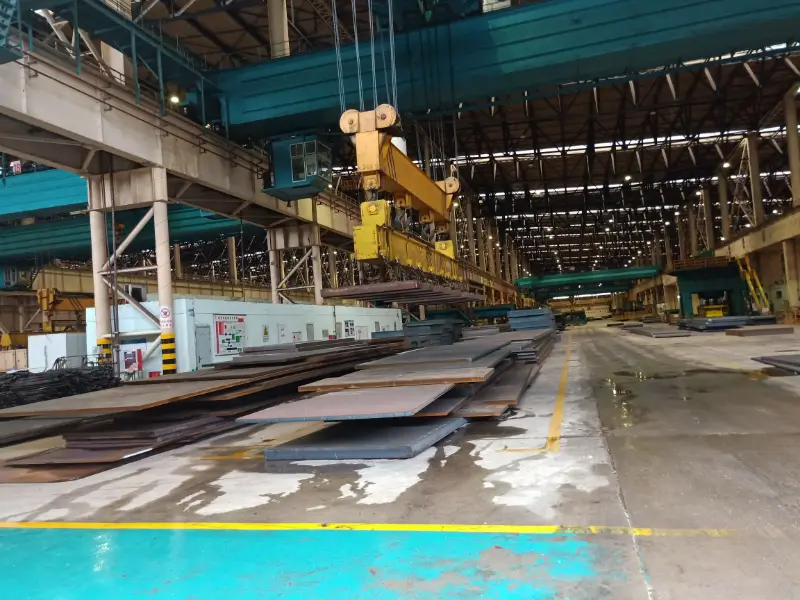
ABS Grade D Shipbuilding Steel Plate
ABS Grade D Shipbuilding Steel Plate - Key Data & International Equivalents
Complete material data for ABS Grade D shipbuilding steel including chemical composition, mechanical properties, thermal and electrical physical values, equivalent standards grades, and application guide.
Suitable for welding, cold forming, bending, flame cutting, and machining; can be hot rolled, normalized, or TMCP
- Phone : +8618037372205
- Email : [email protected]
- WhatsApp: Contact via Whtsapp
- WeChat: +8618037372205
ABS Grade D Shipbuilding Steel Plate Introduction
ABS Grade D is a normal-strength shipbuilding structural steel plate governed by the American Bureau of Shipping (ABS) rules. It is widely used in the construction of hulls, decks, and other marine structures where moderate strength and good weldability are required. The steel is typically supplied in normalized or thermo-mechanically controlled rolled (TMCP) condition. It offers a minimum yield strength of 235 MPa, guaranteed impact toughness at -20 °C, and excellent corrosion resistance in seawater environments. Grain refinement with aluminum is common, ensuring fine ferritic-pearlitic microstructure and consistent mechanical properties. Low carbon equivalent values promote easy fabrication and welding without preheating under normal conditions.
ABS Grade D Shipbuilding Steel Plate Chemical Composition
Requirements for ABS Grade D ordinary strength steel as per ABS Rules Part 2, Chapter 1, Table 1. The steel is killed and fine-grain treated, usually with aluminum. Values represent maximum limits unless a range or minimum is specified. Residual elements are controlled to ensure weldability and are typically within the limits listed in the remarks.
| Element | Standard Requirement (wt%) | Remarks |
|---|---|---|
| Carbon (C) | ≤ 0.21 | Maximum |
| Manganese (Mn) | ≥ 0.60 (no specified maximum) | Must be at least 0.60%; typical 0.80–1.50 |
| Silicon (Si) | ≤ 0.50 | Deoxidizer; typical 0.10–0.50 |
| Phosphorus (P) | ≤ 0.035 | Maximum |
| Sulfur (S) | ≤ 0.035 | Maximum |
| Aluminum (Al, acid soluble) | ≥ 0.015 | If aluminum grain refining is used; total Al ≥ 0.020 |
| Chromium (Cr) | ≤ 0.20 (residual) | Not explicitly specified in the standard; typical residual maximum |
| Nickel (Ni) | ≤ 0.40 (residual) | Typical residual limit |
| Copper (Cu) | ≤ 0.35 (residual) | Typical residual limit |
| Molybdenum (Mo) | ≤ 0.08 (residual) | Typical residual limit |
| Carbon Equivalent (CEV) | ≤ 0.38 (typical for ≤ 50 mm) | CEV = C + Mn/6 + (Cr+Mo+V)/5 + (Ni+Cu)/15; may be specified in the steelworks |
ABS Grade D Shipbuilding Steel Plate Thermal and Electrical Physical Properties
The following typical physical data apply to ABS Grade D carbon-manganese steel at room temperature unless otherwise indicated. These values are not part of the ABS material specification but are representative for low-carbon structural steel and may be used for design calculations, thermal analysis, and fabrication planning.
| Property | Typical Value | Unit | Test Condition |
|---|---|---|---|
| Density (ρ) | 7.85 | g/cm³ | At 20 °C |
| Modulus of Elasticity (E) | 210 | GPa | At room temperature |
| Shear Modulus (G) | 81 | GPa | Calculated from E and ν |
| Poisson's Ratio (ν) | 0.30 | – | Elastic range |
| Thermal Expansion Coefficient (α) | 11.8 | ×10⁻⁶/K | 20–100 °C |
| Thermal Expansion Coefficient (α) | 12.8 | ×10⁻⁶/K | 20–200 °C |
| Thermal Expansion Coefficient (α) | 13.5 | ×10⁻⁶/K | 20–300 °C |
| Thermal Conductivity (λ) | 51.9 | W/(m·K) | At 20 °C |
| Thermal Conductivity (λ) | 48.5 | W/(m·K) | At 100 °C |
| Specific Heat Capacity (c) | 486 | J/(kg·K) | At 20 °C |
| Electrical Resistivity (ρₑ) | 0.159 | ×10⁻⁶ Ω·m | At 20 °C |
ABS Grade D Shipbuilding Steel Plate Mechanical Properties
Mechanical test results for ABS Grade D plates according to ABS Rules. Properties depend on plate thickness. Impact testing is performed longitudinally at -20 °C. The bend test requires that the specimen remains free of cracks or defects after being bent through 180° around a mandrel of specified diameter.
| Property | Standard Requirement | Unit | Test Condition / Thickness |
|---|---|---|---|
| Yield Strength (ReH) | ≥ 235 | MPa | t ≤ 50 mm |
| Yield Strength (ReH) | ≥ 225 | MPa | 50 < t ≤ 70 mm |
| Yield Strength (ReH) | ≥ 215 | MPa | 70 < t ≤ 100 mm |
| Tensile Strength (Rm) | 400 – 520 | MPa | All thicknesses |
| Elongation (A) | ≥ 22 | % | t ≤ 50 mm; gauge length 200 mm |
| Elongation (A) | ≥ 24 | % | t ≤ 50 mm; gauge length 50 mm |
| Elongation (A) | ≥ 21 | % | 50 < t ≤ 70 mm; gauge length 200 mm |
| Elongation (A) | ≥ 20 | % | 70 < t ≤ 100 mm; gauge length 200 mm |
| Impact Energy (KV₂, longitudinal) | ≥ 27 (average), ≥ 20 (single) | J | -20 °C; t ≤ 50 mm |
| Impact Energy (KV₂, longitudinal) | ≥ 27 (average), ≥ 20 (single) | J | -20 °C; 50 < t ≤ 70 mm |
| Impact Energy (KV₂, longitudinal) | ≥ 27 (average), ≥ 20 (single) | J | -20 °C; 70 < t ≤ 100 mm |
| Bend Test (180°) | No cracks or defects | – | Mandrel diameter: 2t (t ≤ 25 mm), 3t (t > 25 mm) |
ABS Grade D Shipbuilding Steel Plate Fully Equivalent Material Standards and Replaceable Grades
| Country / Region | Standard | Grade | Remarks |
|---|---|---|---|
| International | American Bureau of Shipping (ABS) | ABS Grade D | Original designation |
| France | Bureau Veritas (BV) | BV Grade D | Identical mechanical and impact requirements |
| Norway / Germany | DNV GL (now DNV) | DNV NV D / GL D | Fully equivalent ordinary strength grade |
| United Kingdom | Lloyd's Register (LR) | LR Grade D | Same yield, tensile, and -20°C impact |
| Japan | Nippon Kaiji Kyokai (ClassNK) | NK KD | Direct equivalent; KD stands for Grade D |
| Italy | Registro Italiano Navale (RINA) | RINA Grade D | Same specification |
| South Korea | Korean Register (KR) | KR D | Equivalent ordinary strength grade |
| China | China Classification Society (CCS) | CCS D | Same chemical and mechanical limits |
| United States | ASTM A131 / A131M | ASTM A131 Grade D | Requires impact at -20°C; essentially the same |
ABS Grade D Shipbuilding Steel Plate Application Introduction
ABS Grade D is specifically designed for the shipbuilding and offshore industry. Its combination of moderate strength, reliable -20°C toughness, and excellent weldability allows it to be used in critical structural components. The steel can be formed, welded, and machined using conventional techniques without special preheating for thicknesses up to 30–40 mm (depending on carbon equivalent). It is compatible with all common welding consumables suitable for carbon-manganese steels, such as E7018 or ER70S-6. Common applications include:
Product Applications: Ocean-going cargo vessels, tankers, and bulk carriers, Hull shells, deck plating, and bottom plates, Transverse and longitudinal bulkheads, Superstructures and deckhouses, Structural stiffeners, girders, and frames, Offshore platform topsides and jackets, Floating docks and pontoons, Ship hatch covers and coamings
Processed into products: Main deck and inner bottom plating, Side shell strakes and sheer strakes, Watertight bulkheads and swash bulkheads, Web frames, stringers, and transverse webs, Engine room brackets and foundations, Mast and crane pedestals (subject to thickness limitations), Rudder horn plates and stern frame components
Application industries: Shipbuilding and ship repair, Offshore oil and gas platforms, Marine and coastal engineering, Port equipment and crane structures, Barge and pontoon manufacturing, Defense and naval vessels
ABS Grade D Shipbuilding Steel Plate Similar / Closely Matching Alternative Materials
| Country / Region | Standard | Grade | Remarks |
|---|---|---|---|
| Europe | EN 10025-2 | S235J2 (+N) | 235 MPa yield; guaranteed impact at -20°C; CEV limit and thickness ranges may differ; suitable for structural use but marine certification not automatic |
| Europe | EN 10025-2 | S235JR (+AR/N) | Same strength, but impact at +20°C only; not suitable for sub-zero marine service without additional testing |
| International | ABS | ABS Grade B | Same strength, impact at 0°C; less stringent toughness; may be used if -20°C toughness is not required |
| International | ABS | ABS Grade E | Same strength, impact at -40°C; superior low-temperature toughness; may be used when extra safety margin is needed |
Notes:
- The material is typically supplied with inspection certificates (3.1 or 3.2 according to EN 10204) as required by classification societies.
- Thickness tolerances should conform to the dimensional standard referenced in the purchase order (e.g., ASTM A6/A6M, EN 10029).
- When used for critical crack-arrest applications, additional fracture toughness testing such as CTOD may be specified by the designer.
- Surface condition and freedom from defects are normally checked by ultrasonic testing (UT) to acceptance criteria agreed upon at ordering.
- For welded structures, a welding procedure specification (WPS) should be qualified in accordance with the relevant shipyard or offshore standard and approved by the classification surveyor.
- Share



