
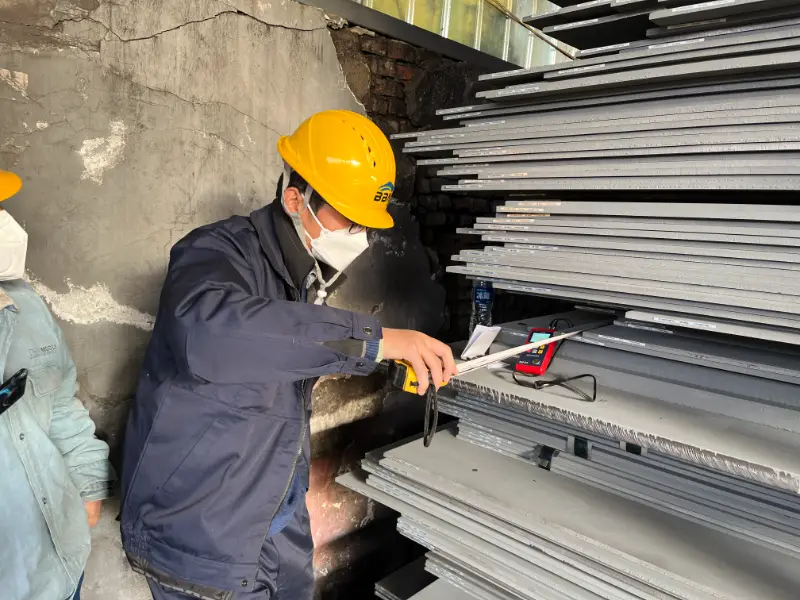
ABS Grade E Shipbuilding Steel Plate
ABS Grade E Shipbuilding Steel Plate - Properties, Composition & Equivalents
Comprehensive data sheet for ABS Grade E shipbuilding steel plate, including chemical composition, mechanical properties, thermal and electrical properties, international equivalents, and application guidance according to ABS Rules.
Hot rolling, controlled rolling, normalizing, thermo-mechanical control process (TMCP) as per supplier capability
- Phone : +8618037372205
- Email : [email protected]
- WhatsApp: Contact via Whtsapp
- WeChat: +8618037372205
ABS Grade E Shipbuilding Steel Plate Introduction
ABS Grade E is a normal-strength hull structural steel grade certified by the American Bureau of Shipping (ABS). It is primarily intended for the construction of ship hulls and offshore structures operating in low-temperature environments. As a Grade E material, it guarantees excellent notch toughness at -40°C, making it suitable for critical structural components exposed to severe cold. This steel is produced in a fully killed and fine-grain condition, often normalized or controlled-rolled, with a minimum yield strength of 235 MPa and tensile strength ranging from 400 to 520 MPa. It offers good weldability, formability, and reliable performance under dynamic loading. The plate is widely used in shipyards worldwide for building vessels such as container ships, bulk carriers, tankers, and ice-class vessels, as well as for offshore platforms and marine equipment. Its compliance with ABS Rules ensures acceptance across major classification societies, and it is interchangeable with equivalent grades like LR Grade E, DNV Grade E, and BV Grade E.
ABS Grade E Shipbuilding Steel Plate Chemical Composition
The chemical composition of ABS Grade E steel is strictly controlled to ensure good weldability and low-temperature toughness. Maximum limits are specified for carbon, phosphorus, and sulfur to enhance ductility and reduce the risk of cracking. Manganese is added to deoxidize the melt and refine the grain structure. The steel is fully killed with a minimum soluble aluminum to acid ratio or equivalent grain-refining practices.
- Carbon equivalent (CE) is typically limited to below 0.38% for improved weldability.
- Residual elements like copper, nickel, and chromium may be present but are not mandated; if added intentionally, they shall be reported.
| Element | Standard Value (max) | Remarks |
|---|---|---|
| Carbon (C) | 0.18% | max |
| Manganese (Mn) | 0.70 - 1.50% | Depending on thickness; for thickness > 25 mm, Mn ≥ 0.70% |
| Silicon (Si) | 0.10 - 0.50% | min 0.10% required for killed steel |
| Phosphorus (P) | 0.035% | max |
| Sulfur (S) | 0.035% | max |
| Aluminum (Al) acid soluble | ≥ 0.015% | Alternative grain-refining elements may be used |
| Nitrogen (N) | Typically ≤ 0.009% | If not controlled by Al, V or Nb |
| Copper (Cu) | ≤ 0.35% | Residual (if applicable) |
| Chromium (Cr) | ≤ 0.20% | Residual (if applicable) |
| Nickel (Ni) | ≤ 0.40% | Residual (if applicable) |
| Molybdenum (Mo) | ≤ 0.08% | Residual (if applicable) |
ABS Grade E Shipbuilding Steel Plate Thermal and Electrical Properties
Physical properties are typical for carbon-manganese structural steels and are not specifically required by ABS for certification. Values provided are for general engineering purposes at room temperature unless otherwise noted. Properties are influenced by microstructure and manufacturing route but remain within narrow ranges.
- Density, elastic moduli, and thermal expansion are comparable to those of ASTM A131 Grade E.
- Electrical resistivity increases with temperature; the given value is for 20°C.
| Property | Typical Value | Unit | Condition / Temperature |
|---|---|---|---|
| Density (ρ) | 7.85 | g/cm³ | Room temperature |
| Elastic Modulus (E) | 200 - 210 | GPa | Room temperature |
| Shear Modulus (G) | ~80 | GPa | Room temperature |
| Poisson's Ratio (ν) | 0.3 | - | Room temperature |
| Thermal Expansion Coefficient (α) | 11.5 - 12.5 | 10⁻⁶/K | 20–100 °C |
| Thermal Conductivity (λ) | 45 - 55 | W/(m·K) | 20°C |
| Specific Heat Capacity | ~470 | J/(kg·K) | 20°C |
| Electrical Resistivity (ρ_e) | 0.20 - 0.25 | µΩ·m | 20°C |
ABS Grade E Shipbuilding Steel Plate Mechanical Properties
Mechanical properties are verified on test specimens taken from the plate in the final delivery condition. Tensile testing is performed transversely or longitudinally as per order. Charpy V-notch impact tests are mandatory at -40°C for Grade E, with minimum energy values depending on specimen orientation and plate thickness. Bend tests ensure formability without cracking.
- For thicknesses above 50 mm, impact energy values may vary; refer to the specific ABS Rules for heavy plates.
- Test specimens are prepared according to ASTM A370 or equivalent.
| Property | Required Value | Unit | Test Condition |
|---|---|---|---|
| Yield Strength (ReH) | ≥ 235 | MPa | Transverse/Longitudinal, thickness ≤ 100 mm |
| Tensile Strength (Rm) | 400 - 520 | MPa | Transverse/Longitudinal |
| Elongation (A) | ≥ 22 | % | Gauge length 5.65√So, thickness ≤ 50 mm |
| Elongation (A) | ≥ 21 | % | Thickness > 50 mm ≤ 70 mm |
| Elongation (A) | ≥ 20 | % | Thickness > 70 mm ≤ 100 mm |
| Charpy V-notch Impact (KV) | ≥ 27 (Longitudinal) | J | -40 °C, standard 10x10 mm specimen |
| Charpy V-notch Impact (KV) | ≥ 20 (Transverse) | J | -40 °C, standard 10x10 mm specimen |
| Bend Test (d is bend diameter, a is specimen thickness) | No cracks after 180° bending | - | d = 3a for thickness ≤ 50 mm, d = 4a for 50-70 mm |
ABS Grade E Shipbuilding Steel Plate Exact Equivalent Grade and Substitution Recommendations
| Country/Region | Standard | Grade | Remarks |
|---|---|---|---|
| International (IMO) | IACS UR W11 | Grade E | Common base standard for major classification societies |
| United Kingdom | Lloyd's Register (LR) | LR Grade E | Identical chemical and mechanical requirements |
| Norway/Germany | DNV | DNV Grade E | Compatible with ABS Grade E; often certified for both |
| France | Bureau Veritas (BV) | BV Grade E | Directly interchangeable |
| China | CCS | CCS Grade E | Same properties, widely used in Chinese shipyards |
| Japan | Nippon Kaiji Kyokai (NK) | NK Grade E | Equivalent in all aspects |
| South Korea | Korean Register (KR) | KR Grade E | Accepted substitute |
| Italy | RINA | RINA Grade E | Identical requirements |
| India | IRS | IRS Grade E | Follows IACS unified requirements |
| Russia | Russian Register (RS) | RS Grade E | Comparable normal strength hull steel |
| USA (non-shipbuilding) | ASTM A131 / A131M | Grade E | Structural steel for ships; identical chemistry and mechanics, but may not carry ABS certification |
ABS Grade E Shipbuilding Steel Plate Application Introduction
ABS Grade E steel plate is specifically designed for the construction of seagoing vessels, offshore platforms, and other marine structures where high resistance to brittle fracture at low temperatures is required. Its good balance of strength, ductility, and weldability makes it a primary choice for critical hull members.
- The steel can be cut, cold formed, and welded using standard shipyard practices, with low preheat requirements due to the low carbon equivalent.
- Post-weld heat treatment is generally not required for thicknesses up to 50 mm, but may be recommended for very heavy sections to reduce residual stress.
- It is suitable for service temperatures down to -40°C and is often used in the construction of ice-strengthened vessels, Arctic tankers, and LNG carriers.
Product Applications: Container ships, bulk carriers, tankers, LNG/LPG carriers, Ice-class vessels, icebreakers, FPSO (Floating Production Storage and Offloading) units, Jack-up rigs, semi-submersible platforms, Hull and deck plating, Longitudinal and transverse bulkheads, Marine cranes and heavy lift equipment
Processed into products: Main deck, side shell, bottom shell plates, Stiffeners, girders, webs, and stringers, Watertight bulkheads and tank boundaries, Stern and bow structural parts, Rudder horns, skegs, and engine room structures, Mooring equipment foundations, Transition piece flanges for offshore wind towers
Application industries: Shipbuilding (commercial and naval), Offshore oil and gas platforms, Marine engineering, Port and harbor construction, Renewable energy (offshore wind turbine foundations)
ABS Grade E Shipbuilding Steel Plate Similar and Alternative Materials
| Country/Region | Standard | Grade | Remarks |
|---|---|---|---|
| Worldwide | IACS UR W11 | Grades A, B, D | Normal-strength hull steels with higher temperature impact requirements (A: 20°C, B: 0°C, D: -20°C); lower cost but less suitable for very cold service |
| USA | ASTM A131 / A131M | Grades EH32, EH36, EH40 | Higher-strength hull steels (yield ≥ 315, 355, 390 MPa) with similar -40°C impact toughness; used when lighter weight and higher strength are needed |
| Europe | EN 10025-4 | S355ML, S420ML | Thermo-mechanically rolled structural steels with low-temperature toughness; not specifically for shipbuilding but often used in offshore structures |
| Japan | JIS G 3106 | SM400B, SM490B | Welding structural steels with moderate strength; impact test temperatures are less severe (+0°C), require verification for -40°C use |
Notes:
Certification: All plates shall be stamped with the ABS mark, heat number, and grade. Mill test certificates according to EN 10204 Type 3.1 or 3.2 are provided. Ultrasonic testing: By agreement, plates can be tested according to ASTM A578/A578M Level A or B, or EN 10160. Surface condition: Blast cleaning to Sa 2½ (ISO 8501) and shop-primed with a weldable pre-construction primer is common. Weldability: Carbon Equivalent (CE) typically ≤0.38% based on IIW formula, enabling welding without significant preheat. Consult approved welding consumables and procedures.
- Share



