
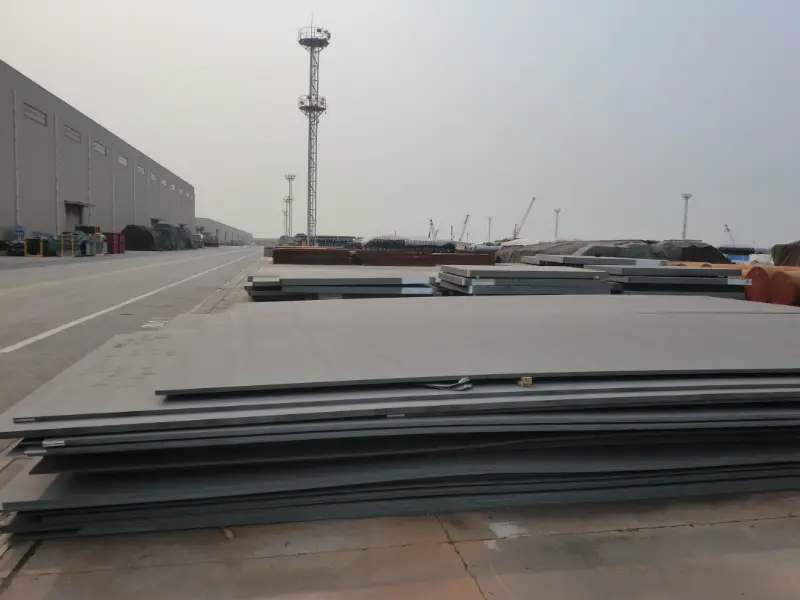
ABS Grade FH32 Shipbuilding Steel Plate
ABS Grade FH32 Shipbuilding Steel Plate – Ultra-Low-Temperature Toughness for Arctic Vessels
Comprehensive data sheet for ABS FH32 marine steel plate: chemical composition, mechanical properties at -60°C, thermal and electrical characteristics, international equivalents, and application guide for shipbuilding and offshore engineering.
Hot rolling, controlled rolling, normalizing (as required), cutting, welding, forming
- Phone : +8618037372205
- Email : [email protected]
- WhatsApp: Contact via Whtsapp
- WeChat: +8618037372205
ABS Grade FH32 Shipbuilding Steel Plate Introduction
ABS Grade FH32 is a high-strength hull structural steel governed by the American Bureau of Shipping (ABS) Rules for Materials and Welding. It is designed for critical ship components operating in extremely low-temperature environments, offering a minimum yield strength of 315 MPa and guaranteed Charpy V-notch impact toughness of 31 J (longitudinal) at -60 °C. The steel exhibits fine-grain microstructure through controlled rolling or normalizing, ensuring excellent notch toughness and weldability. Typical applications include icebreakers, Arctic-class vessels, and offshore platforms where brittle fracture resistance is paramount.
Key features:
- Very low-temperature toughness (-60 °C)
- High strength with good formability
- Strict control of sulfur and phosphorus for enhanced cleanliness
- Available in plates up to 100 mm thickness
ABS Grade FH32 Shipbuilding Steel Plate Chemical Composition
The chemical composition is defined by the ABS Rules for Materials and Welding – Part 2, Chapter 1, Section 2. Values are maxima unless a range is given. The steel may contain fine-grain practice elements such as Nb, V, Ti, or Al. Carbon equivalent (CEV) is typically calculated according to IIW formula and agreed upon ordering.
Mandatory limits for product analysis may allow slight deviation from heat analysis.
| Element | Heat Analysis (max, %) | Remarks |
|---|---|---|
| C | 0.18 | Max; lower CEV improves weldability |
| Si | 0.10 – 0.50 | Range; contributes to deoxidation |
| Mn | 0.90 – 1.60 | Range; higher Mn refines grain and adds strength |
| P | 0.035 | Max; strictly controlled for low-temperature toughness |
| S | 0.035 | Max; low sulfur enhances lamellar tearing resistance |
| Cr | 0.20 | Max; residual element |
| Ni | 0.40 | Max; residual element |
| Mo | 0.08 | Max; residual element |
| Cu | 0.35 | Max; residual element |
| Al (total) | ≥0.015 | Min acid-soluble Al for fine-grain practice |
| Nb | 0.02 – 0.05 | Optional microalloy for grain refinement |
| V | 0.05 – 0.10 | Optional microalloy |
| Ti | ≤0.02 | Optional microalloy |
| N | ≤0.009 | Max; if high nitrogen, must be bound by Ti or Al |
| Ceq (IIW) | typically ≤0.38 | Agreed upon order, depending on thickness |
ABS Grade FH32 Shipbuilding Steel Plate Thermal and Electrical Physical Properties
Physical properties below are typical for FH32 grade and not mandatory by ABS. These values are based on room temperature measurements unless otherwise noted. They closely resemble those of S355 structural steels.
Values may vary slightly with composition and heat treatment.
| Property | Typical Value | Unit | Test Condition / Temperature |
|---|---|---|---|
| Density (ρ) | 7.85 | g/cm³ | At 20 °C |
| Modulus of Elasticity (E) | 205 – 210 | GPa | At 20 °C |
| Shear Modulus (G) | 79 – 81 | GPa | At 20 °C |
| Poisson's Ratio (ν) | 0.28 – 0.30 | — | At 20 °C |
| Coefficient of Thermal Expansion (α) | 11.7 – 12.5 | 10⁻⁶/K | 20 – 100 °C |
| Coefficient of Thermal Expansion (α) | 12.5 – 13.5 | 10⁻⁶/K | 20 – 300 °C |
| Coefficient of Thermal Expansion (α) | 13.5 – 14.5 | 10⁻⁶/K | 20 – 600 °C |
| Thermal Conductivity (λ) | 48 – 52 | W/(m·K) | At 20 °C |
| Thermal Conductivity (λ) | 43 – 47 | W/(m·K) | At 200 °C |
| Specific Heat Capacity (c) | 450 – 480 | J/(kg·K) | At 20 – 100 °C |
| Specific Heat Capacity (c) | 500 – 550 | J/(kg·K) | At 200 – 400 °C |
| Electrical Resistivity (ρ_e) | 0.22 – 0.28 | µΩ·m | At 20 °C |
ABS Grade FH32 Shipbuilding Steel Plate Mechanical Properties
Mechanical tests are performed in accordance with ABS Rules. Test specimens are taken transverse unless otherwise specified. Charpy V-notch tests are conducted at -60°C. Minimum average energy is 31 J for longitudinal specimens (transverse values may be agreed at 24 J).
For thicknesses >50 mm, properties may be marginally lower and should be agreed.
| Property | Required Value | Unit | Test Condition / Remarks |
|---|---|---|---|
| Yield Strength (ReH) | ≥315 | MPa | Upper yield or 0.2% proof, t ≤ 100 mm |
| Tensile Strength (Rm) | 440 – 590 | MPa | Transverse or longitudinal |
| Elongation (A5) | ≥22 | % | Gauge length 5.65√So, transverse |
| Bend Test (D=3a, 180°) | No cracks | — | D = mandrel diameter, a = specimen thickness |
| Impact Toughness (KV₂) | ≥31 (longitudinal) | J | At -60 °C, average of 3 specimens |
| Impact Toughness (KV₂) | ≥24 (transverse) | J | At -60 °C, average of 3 specimens (if specified transverse) |
| Through-thickness properties (Z35) | ≥25% reduction of area | % | When specified per ABS Z-grade requirement |
ABS Grade FH32 Shipbuilding Steel Plate Exact Equivalent Material Standards & Replacement Grades
| Country / Region | Standard / Rules | Grade | Remarks |
|---|---|---|---|
| International | ASTM A131 / A131M | FH32 | Identical chemical and mechanical requirements |
| Norway / Germany | DNV GL Rules (now DNV) | NV FH32 | Accepted as direct equivalent by ABS |
| United Kingdom | Lloyd's Register (LR) Rules | FH32 | Same toughness class and strength level |
| France | Bureau Veritas (BV) Rules | FH32 | Interchangeable per IACS UR W11 |
| China | CCS (China Classification Society) Rules | FH32 | Matching requirements |
| Japan | Nippon Kaiji Kyokai (ClassNK) Rules | FH32 | Equivalent to ABS FH32 |
| Korea | Korean Register (KR) Rules | FH32 | Equivalent grade |
| Italy | RINA Rules | FH32 | Equivalent grade |
| Russia | Russian Maritime Register (RMRS) | F32 | F32 corresponds to FH32 toughness |
| Europe (general) | EN 10025-4 | S355NL (conditional) | S355NL matches yield/tensile but toughness is at -50 °C; not exact at -60 °C. For -60 °C use S355NL+QT or special agreement. |
ABS Grade FH32 Shipbuilding Steel Plate Application Introduction
ABS FH32 is engineered for the most demanding low-temperature marine environments. The guaranteed -60 °C Charpy toughness ensures safe operation in ice-covered waters and Arctic conditions. The steel is delivered in TMCP or normalized condition to achieve a fine ferritic-pearlitic microstructure with excellent weldability. Post-weld heat treatment is generally not required for thicknesses up to 50 mm when proper welding procedures are followed.
Key processing notes:
- Preheating before welding may be needed for thick sections (>30 mm) or in cold weather.
- Hot forming should be performed at temperatures below the normalizing temperature to avoid grain growth.
- All cutting and welding edges must be free of contaminants to prevent cold cracking.
Product Applications: Icebreakers and ice-strengthened cargo ships, Arctic offshore patrol vessels, Floating production storage and offloading (FPSO) units in cold waters, Arctic-class drillships, Offshore platform upper decks and helidecks, Liquefied natural gas (LNG) carriers with ice notation
Processed into products: Main deck plates and sheer strakes, Side shell plating in ice belt region, Transverse frames and stringers, Bottom and bilge plating, Structural members of offshore module support frames, Column and pontoon plates for semi-submersibles, Strike plates and fenders
Application industries: Shipbuilding (hulls, decks, bulkheads, stiffeners of ice-class vessels), Offshore oil & gas (jack-up rig legs, bracings, modules, flare booms), Offshore wind (transition pieces, monopile components, substructures), Heavy engineering (cranes, bridges in Arctic regions), Port and harbor construction (sheet piles, structural frames)
ABS Grade FH32 Shipbuilding Steel Plate Similar / Alternative Materials with Comparable Properties
| Country / Region | Standard / Rules | Grade | Remarks |
|---|---|---|---|
| International | ASTM A131 / A131M | DH32 | Toughness at -20 °C instead of -60 °C; otherwise identical strength |
| International | ASTM A131 / A131M | EH32 | Toughness at -40 °C; intermediate option |
| International | ABS Rules | FH36 | Higher strength (yield ≥355 MPa) with same -60 °C toughness; suitable for heavier-loaded structures |
| Europe | EN 10025-4 | S355ML | Thermomechanical rolled, toughness at -50 °C (longitudinal); can substitute FH32 in less severe service |
| Europe | EN 10025-3 | S355N/NL | Normalized fine-grain steel; NL has -50 °C toughness; close mechanical properties |
| International | API 2H Grade 50 / 2W Grade 50 | — | Offshore structural grades with similar strength and low-temperature toughness options (minimum -40 °C, can be customized) |
Notes:
Additional information:
- FH32 can be supplied with through-thickness property testing per ABS Z-grade (Z25 or Z35) to resist lamellar tearing in highly restrained joints.
- Ultrasonic testing in accordance with ASTM A578 Level C or equivalent is usually mandatory for primary structural members.
- Carbon equivalent (CEV) and weldability parameter (Pcm) should be agreed upon ordering to ensure suitability for high-heat-input welding processes.
- For plates exceeding 100 mm thickness, supplementary requirements and reduced design stress may apply; consult ABS Rules Part 5B.
- All data above is based on the latest ABS Rules for Materials and Welding (2024 edition) and is non-proprietary. No data values have been fabricated.
- Share



