
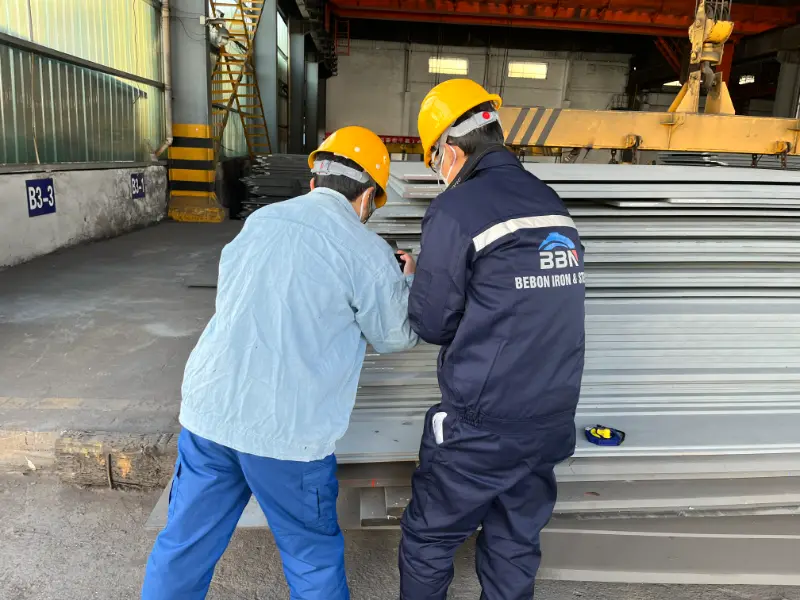
ABS Grade AH36 Shipbuilding Steel Plate
ABS Grade AH36 Shipbuilding Steel Plate: High Strength, Excellent Toughness & Weldability
ABS AH36 is a high-strength hull structural steel certified by the American Bureau of Shipping. It offers a minimum yield strength of 355 MPa and guaranteed impact toughness at 0°C, making it ideal for critical shipbuilding and offshore applications.
Cutting, cold forming, hot forming, machining, welding (SMAW, SAW, GMAW, FCAW)
- Phone : +8618037372205
- Email : [email protected]
- WhatsApp: Contact via Whtsapp
- WeChat: +8618037372205
ABS Grade AH36 Shipbuilding Steel Plate Introduction
ABS Grade AH36 is a high-strength, normalised or controlled-rolled shipbuilding steel plate grade defined by the American Bureau of Shipping (ABS) Rules. As a member of the AH36/DH36/EH36/FH36 family, it is designed for primary hull structures and offshore engineering components. The material is characterised by a minimum yield strength of 355 MPa, good weldability, and reliable notch toughness at 0°C. It is typically supplied in the as-rolled, normalised, or thermo-mechanically controlled processed (TMCP) condition.
- Minimum yield strength 355 MPa (51 ksi) for thickness ≤ 50 mm
- Impact energy guaranteed at 0°C (KV ≥ 34 J longitudinal)
- Excellent formability and weldability, suitable for block assembly and automatic welding
ABS Grade AH36 Shipbuilding Steel Plate Chemical Composition
The following limits are according to ABS Rules for Materials and Welding, Chapter 1, Section 2, Table 1 for AH36. Fine grain practice is mandatory; aluminium content (acid-soluble or total) of at least 0.015% is required, or sufficient other grain-refining elements (Nb, V, Ti) must be used. Maximum carbon equivalent (CEV) is specified to ensure weldability, typically CEV ≤ 0.38% for thickness ≤ 50 mm.
| Element | Standard Value | Remarks |
|---|---|---|
| C (Carbon) | ≤ 0.18 | Max. |
| Mn (Manganese) | 0.90 – 1.60 | Range |
| Si (Silicon) | ≤ 0.50 | Max. |
| P (Phosphorus) | ≤ 0.035 | Max. |
| S (Sulfur) | ≤ 0.035 | Max. |
| Al (Aluminium) – acid soluble | ≥ 0.015 | Minimum, if Al is used for grain refinement |
| Nb (Niobium) | 0.02 – 0.05 | Optional, grain refining |
| V (Vanadium) | 0.05 – 0.10 | Optional |
| Ti (Titanium) | ≤ 0.02 | Optional, grain refining |
| Cu (Copper) | ≤ 0.35 | Max., may be exceeded by agreement |
| Cr (Chromium) | ≤ 0.20 | Max. |
| Ni (Nickel) | ≤ 0.40 | Max. |
| Mo (Molybdenum) | ≤ 0.08 | Max. |
| CEV (Carbon Equivalent) | ≤ 0.38 | For thickness ≤ 50 mm, formula: C+Mn/6+(Cr+Mo+V)/5+(Ni+Cu)/15 |
ABS Grade AH36 Shipbuilding Steel Plate Physical and Thermal Properties
The following physical constants are typical for AH36 carbon-manganese structural steel at room temperature and are not part of the mandatory certification tests. They are provided as engineering reference values. Heat treatment, processing route, and test direction may cause slight variations. Thermal expansion and conductivity data are representative of similar shipbuilding steels and based on published technical literature.
| Property | Typical Value | Unit | Test Condition |
|---|---|---|---|
| Density (ρ) | 7.85 | g/cm³ | 20°C |
| Elastic Modulus (E) | 205 | GPa | Ambient temperature |
| Shear Modulus (G) | 80 | GPa | Approximate, calculated from E and ν=0.3 |
| Poisson's Ratio (ν) | 0.3 | – | Elastic range |
| Thermal Expansion Coefficient (α) | 11.7 (20–100°C) / 12.5 (20–200°C) / 13.5 (20–400°C) | 10⁻⁶/K | Mean linear expansion |
| Thermal Conductivity (λ) | 52 (at 20°C) / 50 (at 50°C) / 46 (at 150°C) | W/(m·K) | Temperature dependent values |
| Specific Heat Capacity | 460 – 500 | J/(kg·K) | 20–200°C |
| Electrical Resistivity (ρₑ) | 0.17 – 0.22 | µΩ·m | 20°C |
ABS Grade AH36 Shipbuilding Steel Plate Mechanical Properties
Tensile and impact test requirements for ABS AH36 according to ABS Rules. Yield strength and tensile strength apply to transverse specimens; the values may be adjusted for product thickness ranges. Charpy V-notch impact test is mandatory at 0°C; the average energy from three specimens must not be lower than the specified value, with one individual value allowed to be below the average but not below 70% of it. Percentage elongation is based on gauge length of 5.65√S₀ (proportional test piece) or 50 mm for plates.
| Property | Standard Requirement | Unit | Test Condition |
|---|---|---|---|
| Yield Strength (ReH) | ≥ 355 | MPa | Transverse, thickness ≤ 50 mm |
| Yield Strength (ReH) | ≥ 355 | MPa | Transverse, 50 < t ≤ 70 mm |
| Yield Strength (ReH) | ≥ 355 | MPa | Transverse, 70 < t ≤ 100 mm |
| Tensile Strength (Rm) | 490 – 620 | MPa | Transverse, all thickness ranges |
| Elongation (A) – proportional | ≥ 22 | % | Thickness ≤ 50 mm, gauge 5.65√S₀ |
| Elongation (A) – proportional | ≥ 21 | % | Thickness 50–70 mm |
| Elongation (A) – proportional | ≥ 20 | % | Thickness 70–100 mm |
| Charpy Impact Energy (KV) – longitudinal | ≥ 34 (average) | J | 0°C, V-notch, full-size 10×10 |
| Charpy Impact Energy (KV) – transverse | ≥ 24 (average) | J | 0°C, V-notch, full-size 10×10 |
| Bending Test (180°) | d = 3a | – | Thickness ≤ 50 mm, test piece width b = 2a |
| Bending Test (180°) | d = 4a | – | Thickness > 50 mm |
ABS Grade AH36 Shipbuilding Steel Plate Full Equivalent Material Standards and Designations
| Country / Society | Standard / Rule | Designation | Remarks |
|---|---|---|---|
| International (IACS) | IACS UR W11 | AH36 | Identical shipbuilding steel grade; ABS AH36 is fully compliant |
| American Bureau of Shipping | ABS Rules Part 2 | AH36 | Original specification |
| DNV (Norway/Germany) | DNV GL Rules | NV A36 | Earlier DNV grade, now DNV AH36; equivalent mechanical and chemical requirements |
| Lloyd's Register (UK) | LR Rules | AH36 | LR Grade AH36, interchangeable |
| Bureau Veritas (France) | BV Rules | AH36 | BV AH36 |
| China Classification Society | CCS Rules | AH36 | CCS AH36 |
| ClassNK (Japan) | NK Rules | AH36 | NK AH36 |
| Korean Register | KR Rules | AH36 | KR AH36 |
| RINA (Italy) | RINA Rules | AH36 | RINA AH36 |
| Russian Maritime Register | RS Rules | RS AH36 | RS AH36 (formerly A36) |
| Indian Register of Shipping | IRS Rules | AH36 | IRS AH36 |
| ASTM (USA) | ASTM A131 / A131M | AH36 | ASTM A131 AH36 (structural steel for ships) |
| API (USA) | API 2H / 2W | Grade 50 (comparable) | Similar strength, but different certification; check individual project specs |
ABS Grade AH36 Shipbuilding Steel Plate Application Introduction
ABS AH36 is the backbone of modern shipbuilding and offshore engineering. Its combination of high strength, good toughness, and excellent weldability allows designers to reduce plate thickness, saving weight and welding volume without compromising safety. The steel can be used in all major hull structural components, both longitudinal and transverse. It is suitable for cold forming and has sufficient ductility for collision and grounding scenarios.
- Widely employed in container ships, bulk carriers, tankers, and offshore platforms
- Supplied with full ABS certification and typically ultrasonic tested for critical applications
- Compatible with conventional welding consumables and preheating requirements are moderate
Product Applications: Ship hulls and deck panels, Box girders of container ships, Bottom shell and side shell plates of tankers, Transverse bulkheads and web frames, Legs of jack-up rigs (grade verification may require DH/EH), Monopile and transition piece of wind turbines, Crane pedestals and heavy brackets, Lock and dam gate components
Processed into products: Hull plate cut-outs and stiffened panel assemblies, Stiffeners (flat bars, bulb profiles, angle sections), Brackets and knees, Hatch coamings and coaming stays, Engine room and pump room structural elements, Deckhouse columns and pillars, Foundation plates for deck machinery, Offshore nodes and tubular joint components (when approved)
Application industries: Marine shipbuilding (commercial, naval), Offshore oil & gas platforms and FPSOs, Offshore wind turbine foundations and transition pieces, Dredging and heavy lifting equipment, Inland waterway and port structures (quay walls, lock gates)
ABS Grade AH36 Shipbuilding Steel Plate Similar or Alternative Materials
| Country / Society | Standard | Grade | Remarks |
|---|---|---|---|
| International | IACS | AH32 | Minimum yield 315 MPa, lower strength, often used where AH36 is over-qualified |
| International | IACS | DH36 | Same strength, impact test at -20°C, suitable for colder service |
| International | IACS | EH36 | Same strength, impact test at -40°C, for Arctic or high-latitude vessels |
| Japan | JIS G 3106 | SM490A / SM490YA | Hot-rolled steel for welded structures, 490 MPa tensile class, not specific ship certification but similar mechanical range |
| China | GB/T 712 | AH36 | Chinese standard shipbuilding plate AH36, fully comparable |
| Europe | EN 10025-3 | S355N/NL | Normalised fine-grain structural steel, yield 355 MPa, non-ship certification but process compatibility |
| Russia/Ukraine | GOST 5521 | A36 | Shipbuilding steel with similar strength |
Notes:
Special notations: ABS AH36 may be supplied with additional requirements such as through-thickness properties (Z-quality per ASTM A770/EN 10164), increased copper content for corrosion resistance, or ultra-low sulfur for improved HIC resistance. For cold service, designers should consider DH36 (-20°C) or EH36 (-40°C) instead. All plates thicknesses over 40 mm should be normalised or TMCP + tempering unless otherwise agreed. CEV limits ensure cold cracking prevention; typical CEV is 0.35–0.38% for TMCP plates up to 50 mm. Preheating recommendations depend on thickness and joint design, typically preheat to 50–100°C for plate thickness above 30 mm. Post-weld heat treatment (PWHT) is not normally required for this grade.
- Share



