
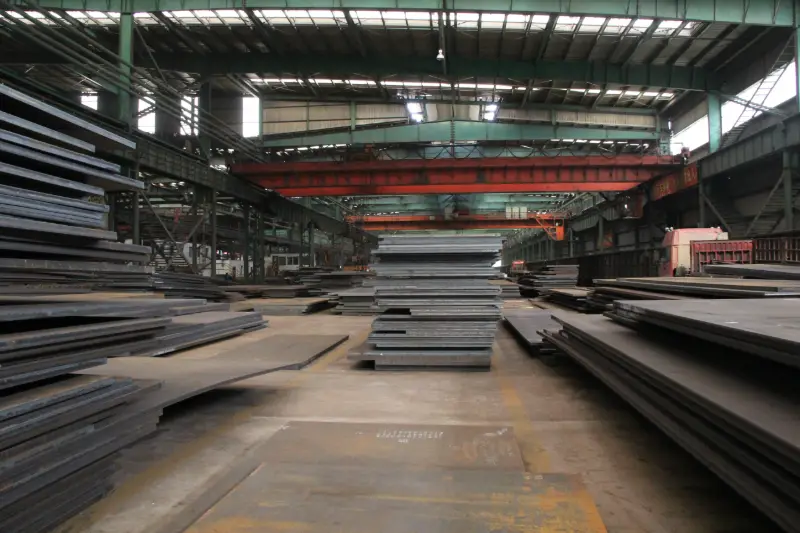
LR Grade A Shipbuilding Steel Plate
LR Grade A Shipbuilding Steel Plate: Properties, Equivalents & Applications
Comprehensive technical data for LR Grade A shipbuilding steel plate according to Lloyd's Register Rules. Includes chemical composition, mechanical properties, thermal and electrical physical properties, equivalent grades, and detailed application guidance.
Hot rolling, cold forming, welding, cutting, machining
- Phone : +8618037372205
- Email : [email protected]
- WhatsApp: Contact via Whtsapp
- WeChat: +8618037372205
LR Grade A Shipbuilding Steel Plate Introduction
LR Grade A is a normal-strength hull structural steel plate certified by Lloyd's Register (LR), one of the world's leading classification societies. It is primarily used in the construction of ships, barges, and offshore structures. This grade is characterized by its excellent weldability, good formability, and reliable mechanical properties under as-rolled or normalized delivery conditions.
Key features include a minimum yield strength of 235 MPa, a tensile strength range of 400–520 MPa, and guaranteed elongation depending on thickness. The steel is designed for general marine applications where moderate strength and high toughness are not mandatory, as it typically does not require impact testing unless specified for thicker sections or low-temperature service.
LR Grade A is delivered in various product forms such as plates, sheets, and wide flats, and is widely accepted for hull structures, superstructures, and other marine components. It conforms to the chemical and mechanical requirements outlined in the LR Rules for the Manufacture, Testing and Certification of Materials.
LR Grade A Shipbuilding Steel Plate Chemical Composition
The following chemical composition is based on LR Rules for normal-strength shipbuilding steel Grade A. Maximum limits apply to heat analysis. For product analysis, slight deviations are permitted but must not exceed the specified limits.
- Carbon equivalent (CEV) is not mandatory but typically ≤ 0.40% to ensure weldability.
- Aluminum is often added for grain refinement and may be present as total Al ≥ 0.015% if required.
| Element | Standard Value (max %) | Remarks |
|---|---|---|
| C | 0.21 | Maximum; for thickness ≤ 50 mm, C max 0.21% |
| Mn | 0.80 (min 2.5×C) | Minimum manganese content is 2.5 times the carbon content, maximum 0.80% |
| Si | 0.50 | Maximum |
| S | 0.035 | Maximum |
| P | 0.035 | Maximum |
| Al (total) | ≥ 0.015 (if added) | Acid-soluble aluminum when grain-refining practice is applied |
| N | 0.012 (if exceeding, sufficient fixing elements required) | Nitrogen may be restricted; if above 0.012%, sufficient Al or Nb shall be present |
LR Grade A Shipbuilding Steel Plate Thermal and Electrical Physical Properties
These physical properties are typical for mild steel similar to LR Grade A and are based on general engineering data, not directly from LR Rules. Actual values may vary slightly depending on composition and temperature. They are provided for design reference.
| Property | Typical Value | Unit | Test Condition |
|---|---|---|---|
| Density (ρ) | 7850 | kg/m³ | At room temperature (20°C) |
| Modulus of Elasticity (E) | 205 – 215 | GPa | At 20°C; decreases with temperature |
| Shear Modulus (G) | 79 – 83 | GPa | Calculated from E and Poisson's ratio |
| Poisson's Ratio (ν) | 0.29 – 0.30 | – | Elastic range, room temperature |
| Coefficient of Thermal Expansion (α) | 11.5 – 12.5 | 10⁻⁶/K | Temperature range 20 – 100°C |
| Thermal Conductivity (λ) | 50 – 55 | W/(m·K) | At 20°C; decreases with temperature |
| Specific Heat Capacity (cp) | 460 – 480 | J/(kg·K) | At 20°C |
| Electrical Resistivity (ρ_e) | 0.20 – 0.25 | μΩ·m | At 20°C, typical for low-carbon steel |
LR Grade A Shipbuilding Steel Plate Mechanical Properties
The mechanical properties comply with LR Rules for Grade A. Testing is performed on transverse specimens unless otherwise specified.
- Bend test mandrel diameter is based on plate thickness.
- Impact test is not normally required, but if specified (e.g., for thickness > 50 mm or low-temperature applications), typical requirement could be at 0°C or 20°C with minimum average energy 27 J.
| Property | Required Value | Unit | Test Condition |
|---|---|---|---|
| Yield Strength (ReH) | ≥ 235 | MPa | Lower yield or 0.2% proof stress, transverse specimens, for t ≤ 100 mm; for t > 100 mm, ≥ 215 MPa |
| Tensile Strength (Rm) | 400 – 520 | MPa | For thickness ≤ 50 mm; for 50 < t ≤ 100 mm, 400 – 520 MPa; for t > 100 mm, 380 – 520 MPa |
| Elongation (A) | ≥ 22 (t ≤ 50 mm); ≥ 21 (50 < t ≤ 100 mm); ≥ 20 (t > 100 mm) | % | Gauge length 5.65√S0 (proportional test piece), transverse |
| Bend Test (mandrel diameter) | 3t (t ≤ 50 mm); 4t (50 < t ≤ 100 mm); 5t (t > 100 mm) | – | 180° bend, no cracks, transverse specimen; t = thickness of test piece |
| Impact Energy (KV2) – optional | ≥ 27 (when specified) | J | Charpy V-notch, transverse, at 0°C or 20°C, if required by specification; otherwise impact test is waived for Grade A |
LR Grade A Shipbuilding Steel Plate Fully Equivalent Material Standards and Substitutable Grades
| Country / Region | Standard | Grade | Remarks |
|---|---|---|---|
| United Kingdom / International | LR Rules | LR Grade A | Base material; all Lloyd's Register shipbuilding rules |
| International | IACS (International Association of Classification Societies) | Grade A (common) | All IACS members have a Grade A for normal-strength hull steel |
| USA | ABS Rules | ABS Grade A | American Bureau of Shipping – interchangeable |
| France | BV Rules | BV Grade A | Bureau Veritas – identical requirements |
| China | CCS Rules | CCS Grade A | China Classification Society – equivalent |
| Norway/Germany | DNV GL Rules (formerly DNV & GL) | DNV Grade A / GL Grade A | Now unified under DNV GL; fully equivalent |
| South Korea | KR Rules | KR Grade A | Korean Register – equivalent |
| Japan | NK Rules | NK Grade A | ClassNK – equivalent |
| Italy | RINA Rules | RINA Grade A | Registro Italiano Navale – equivalent |
LR Grade A Shipbuilding Steel Plate Application Introduction
LR Grade A steel plate is the most widely used grade for ordinary marine structures. It is suitable for all parts of the ship except those requiring higher strength or guaranteed low-temperature toughness.
Key advantages:
- Excellent weldability using all common arc welding processes (SMAW, SAW, GMAW, FCAW) with minimal preheat.
- Good formability and machinability.
- Economic price point and global availability.
Product Applications: Hull shell plates (bottom, side, deck), Transverse bulkheads, Web frames and stiffeners, Superstructure panels, Hatch coamings and covers, Tween decks, Barge hulls, Caissons and cofferdams
Processed into products: Plasma or flame-cut panels for ship sections, Stiffeners (flat bars, angles, bulb flats), Welded built-up girders, Brackets and connections, Rudders and rudder horns (non-critical areas), Masts and pedestals (non-dynamic areas), Non-pressure bulkheads
Application industries: Shipbuilding, Offshore engineering, Barge and floating platform construction, Marine equipment manufacturing, Port and harbor structures
LR Grade A Shipbuilding Steel Plate Similar / Near-Equivalent Material Recommendations
| Country / Region | Standard | Grade | Remarks |
|---|---|---|---|
| European Union | EN 10025-2 | S235JR (1.0038) | Similar yield and tensile strength; S235JR has specified impact energy 27J at 20°C, while LR A normally waives impact. CEV may be higher. Can often substitute with agreement. |
| USA | ASTM A36 / A36M | A36 | Comparable strength (250 MPa yield). Not subject to marine quality control; impact requirements differ. Check weldability and toughness. |
| China | GB/T 700 | Q235B | Similar mechanical properties; Q235B requires 20°C impact test. Suitable for non-critical structural replacement if accepted by classification society. |
| Japan | JIS G 3101 | SS400 | Close tensile properties (400–510 MPa), lower yield 245 MPa. No impact guarantee. Often used as a general structural steel but not certified for marine use without additional testing. |
| International | ISO 630-2 | S235G | Structural steel for general structures, similar strength. No mandatory impact for thin gauges. Not a direct marine grade. |
Notes:
Certification and Testing: LR Grade A plates must be produced by approved mills and issued with LR certificates after inspection.
Welding consumables should be matched to the base material; ordinary E43xx series electrodes for manual welding are suitable.
Surface quality and tolerances comply with EN 10029 or equivalent standards, unless otherwise agreed.
Supplementary requirements: If impact testing is desired (e.g., for service at 0°C), the purchaser must specify at the time of inquiry and order. In such cases, Grade A can be upgraded to meet Grade B or D requirements.
Note on physical properties: The thermal and electrical data are typical reference values for carbon steel and not normative parts of the LR specification; they are provided for engineering calculations only.
- Share



