
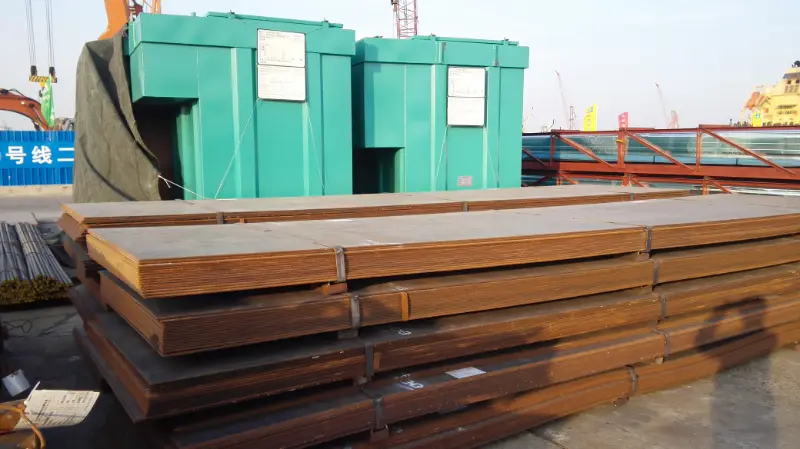
CCS Grade FQ70 Shipbuilding Steel
CCS Grade FQ70 Shipbuilding Steel: Properties, Equivalents & Applications
Complete technical data of CCS FQ70 quenched and tempered shipbuilding steel plate: chemical composition, mechanical properties, physical properties, international equivalents, and application guide.
Welding, cold/hot bending, flame cutting, machining
- Phone : +8618037372205
- Email : [email protected]
- WhatsApp: Contact via Whtsapp
- WeChat: +8618037372205
CCS Grade FQ70 Shipbuilding Steel Introduction
CCS Grade FQ70 is a high-strength quenched and tempered steel plate for shipbuilding and offshore engineering, certified by the China Classification Society (CCS). It is designed for critical structural components requiring a minimum yield strength of 620 MPa combined with excellent low-temperature toughness down to -60°C. Delivered in quenched and tempered condition, FQ70 provides:
- High strength-to-weight ratio, enabling lighter structures without sacrificing safety
- Good weldability when proper preheating and interpass procedures are followed
- Reliable impact resistance in Arctic and cold-climate environments
- Widespread use in heavy ship hulls, self-elevating platform legs, and large crane booms
CCS Grade FQ70 Shipbuilding Steel Chemical Composition
Chemical composition limits according to CCS Rules (based on IACS UR W11 for 620 MPa yield strength grade). All values are in weight percent. The total of Nb+V+Ti shall not exceed 0.12%. Note: For products with thickness >50 mm, some elements (e.g., Cr, Ni, Mo) may be adjusted with approval by CCS.
| Chemical Element | Standard Value (wt%) | Remarks |
|---|---|---|
| Carbon (C) | ≤ 0.20 | max |
| Silicon (Si) | 0.10 – 0.55 | range |
| Manganese (Mn) | 0.90 – 1.70 | range |
| Phosphorus (P) | ≤ 0.020 | max |
| Sulfur (S) | ≤ 0.010 | max |
| Chromium (Cr) | ≤ 0.30 | max |
| Nickel (Ni) | ≤ 0.80 | max |
| Molybdenum (Mo) | ≤ 0.30 | max |
| Copper (Cu) | ≤ 0.35 | max |
| Aluminium (Als, acid soluble) | ≥ 0.015 | min |
| Niobium + Vanadium + Titanium (Nb+V+Ti) | ≤ 0.12 | max |
| Nitrogen (N) | ≤ 0.012 | max |
CCS Grade FQ70 Shipbuilding Steel Physical Properties
The following values are typical for quenched and tempered low-alloy high-strength steels similar to CCS FQ70. They are provided for engineering reference and are not part of the material specification. Actual values may vary with specific chemical composition and heat treatment. Density: approximately 7850 kg/m³. Thermal expansion coefficient typical for the range 20-100°C.
| Property | Typical Value | Unit | Test Condition / Remarks |
|---|---|---|---|
| Density (ρ) | 7850 | kg/m³ | At 20 °C |
| Elastic Modulus (E) | 205 | GPa | At room temperature |
| Shear Modulus (G) | 80 | GPa | Estimated from E and ν |
| Poisson's Ratio (ν) | 0.3 | — | At room temperature |
| Thermal Expansion Coefficient (α) | 11.5 × 10⁻⁶ | /K | 20 °C to 100 °C |
| Thermal Conductivity (λ) | 45 | W/(m·K) | At 20 °C |
| Specific Heat Capacity | 460 | J/(kg·K) | At 20 °C |
| Electrical Resistivity (ρ_e) | 0.20 | μΩ·m | At 20 °C |
CCS Grade FQ70 Shipbuilding Steel Mechanical Properties
Tensile and impact properties as required by CCS for FQ70 in quenched and tempered condition. Longitudinal tensile test specimens are used. Impact tests are performed on Charpy V-notch specimens at -60°C. Bend test: D=3a (thickness ≤50 mm) or D=4a (thickness >50 mm); no cracks or defects allowed.
| Property | Standard Requirement | Unit | Test Condition / Remarks |
|---|---|---|---|
| Yield Strength (ReH) | ≥ 620 | MPa | Plate thickness ≤ 50 mm |
| Yield Strength (ReH) | ≥ 600 | MPa | Plate thickness > 50 mm ≤ 70 mm |
| Yield Strength (ReH) | ≥ 580 | MPa | Plate thickness > 70 mm ≤ 100 mm |
| Tensile Strength (Rm) | 720 – 890 | MPa | Plate thickness ≤ 50 mm |
| Tensile Strength (Rm) | 700 – 870 | MPa | Plate thickness > 50 mm ≤ 70 mm |
| Tensile Strength (Rm) | 680 – 860 | MPa | Plate thickness > 70 mm ≤ 100 mm |
| Elongation (A) | ≥ 14 | % | Plate thickness ≤ 50 mm, gauge length 5.65√So |
| Elongation (A) | ≥ 15 | % | Plate thickness > 50 mm ≤ 100 mm |
| Charpy Impact Energy (KV2, longitudinal) | ≥ 62 (average) | J | -60 °C, 10×10 mm specimen |
| Charpy Impact Energy (KV2, transverse) | ≥ 41 (average) | J | -60 °C, 10×10 mm specimen |
| Bend Test (bend angle 180°) | D=3a | — | Plate thickness ≤ 50 mm |
| Bend Test (bend angle 180°) | D=4a | — | Plate thickness > 50 mm |
CCS Grade FQ70 Shipbuilding Steel Exact Equivalent Grades from Major Classification Societies
| Country / Region | Standard / Society | Grade | Remarks |
|---|---|---|---|
| China | CCS | FQ70 | Base material |
| USA | ABS | EQ70 | American Bureau of Shipping |
| France | BV | E690 | Bureau Veritas |
| Norway / Germany | DNV | E690 | DNV (merged with GL) |
| Germany | GL | E690 | Germanischer Lloyd (now DNV) |
| UK | LR | E690 | Lloyd's Register |
| Japan | NK (ClassNK) | E690 | Nippon Kaiji Kyokai |
| Italy | RINA | E690 | Registro Italiano Navale |
| South Korea | KR | E690 | Korean Register |
| Russia | RS | E690 | Russian Maritime Register of Shipping |
CCS Grade FQ70 Shipbuilding Steel Application Introduction
CCS FQ70 is designed for heavy-duty welded structures in shipbuilding and offshore engineering where high strength and low-temperature toughness are essential. Typical applications are listed below. All welding must follow CCS-approved procedures, including preheat (>100°C) and controlled interpass temperature, to avoid hydrogen cracking.
Product Applications: Ship hulls, decks, and superstructures, Self-elevating platform legs, spudcans, and rack chords, LPG/LNG tank shells and containment systems, Offshore wind turbine foundation structures (transition pieces), Crane booms, lattice booms, and heavy-lift frames
Processed into products: Welded main girders and stiffeners in ship hulls, Gear racks for jack-up drilling platforms, Anchor brackets and towing structural parts, Heavy plate flanges and welded nodes in tubular frameworks, Support beams and high-load attachment plates
Application industries: Shipbuilding (naval vessels, heavy cargo ships), Marine and offshore engineering (jack-up rigs, semi-submersibles), Heavy construction machinery (crawler cranes, excavators), Pressure vessels and storage tanks for low-temperature service, Port cranes and heavy lifting equipment
CCS Grade FQ70 Shipbuilding Steel Similar High-Strength Quenched and Tempered Steels
| Country / Region | Standard / Specification | Grade | Remarks |
|---|---|---|---|
| China | GB/T 16270 | Q690D / Q690E | Structural steel with similar strength; verify toughness class for -60°C |
| EU | EN 10025-6 | S690Q / S690QL | Yield 690 MPa; QL grade ensures low-temperature toughness; not automatically certified for marine service |
| USA | ASTM A514 | Grade Q / Grade S | High-yield quenched and tempered alloy steel; check Charpy requirements for marine use |
| Japan | JIS G3128 | SHY685 / SHY70N | High-strength steel for welded structures; additional qualification needed for ship classification |
| International | API 2W / API 2Y | Grade 60, 65, 70 | Offshore structural steels; similar mechanical properties, subject to classification society approval |
Notes:
For thicknesses above 100 mm, supplementary requirements may apply per CCS rules. Welding consumables shall be low-hydrogen type matching the strength of base metal. Post-weld heat treatment (PWHT) is not normally required but, if applied, must be validated. Ultrasonic testing to class standards is typically specified for thick plates. Z-direction through-thickness properties (Z35) can be ordered optionally.
- Share



