
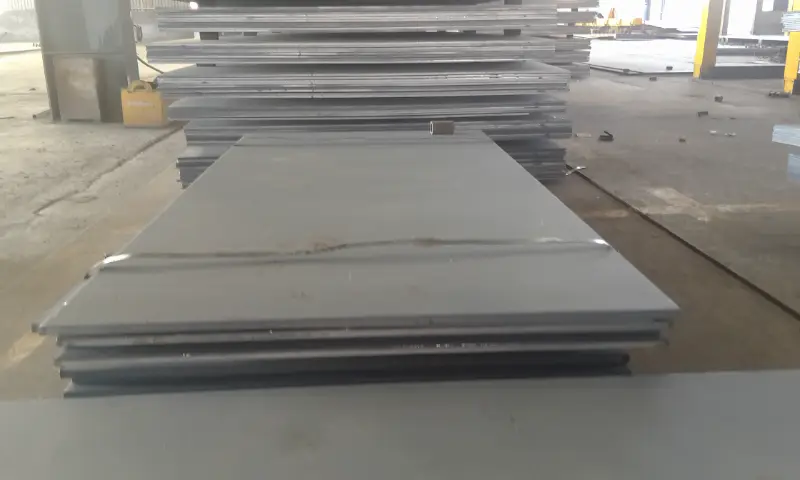
CCS Grade EQ70 Shipbuilding Steel Plate
CCS Grade EQ70 Shipbuilding Steel Plate - Ultra-High Strength Quenched & Tempered Steel for Marine & Offshore Structures
Comprehensive datasheet for CCS Grade EQ70 shipbuilding steel plate: chemical composition, mechanical properties, thermal & electrical physical properties, international equivalents, and application guidance.
Welding, cutting (thermal/mechanical), cold and hot forming, machining; preheating may be required for forming or welding
- Phone : +8618037372205
- Email : [email protected]
- WhatsApp: Contact via Whtsapp
- WeChat: +8618037372205
CCS Grade EQ70 Shipbuilding Steel Plate Introduction
CCS EQ70 is an ultra-high strength quenched and tempered shipbuilding structural steel governed by the China Classification Society (CCS) Rules for Materials and Welding. With a minimum yield strength of 690 MPa, it offers an excellent strength-to-weight ratio and reliable low-temperature toughness down to -40°C. The steel is microalloyed to achieve fine grain structure and good weldability. Typical delivery condition is quenched and tempered (Q+T). It is widely used in critical welded components of large vessels, offshore platforms, and heavy lifting equipment where high structural performance and safety are required.
CCS Grade EQ70 Shipbuilding Steel Plate Chemical Composition
The following chemical composition limits apply to CCS Grade EQ70 according to CCS Rules. The steel employs microalloying elements such as Nb, V, Ti, and Al to refine grain size and improve mechanical properties. Carbon equivalent (CEV) and cold cracking susceptibility parameter (Pcm) are controlled to ensure weldability. Actual values are reported on mill certificates.
| Element | Standard Requirement (max unless range specified) | Remarks |
|---|---|---|
| Carbon (C) | ≤0.20 | |
| Silicon (Si) | ≤0.55 | |
| Manganese (Mn) | ≤1.70 | |
| Phosphorus (P) | ≤0.025 | |
| Sulfur (S) | ≤0.025 | |
| Chromium (Cr) | ≤1.50 | |
| Nickel (Ni) | ≤2.00 | |
| Molybdenum (Mo) | ≤0.70 | |
| Copper (Cu) | ≤0.50 | |
| Niobium (Nb) | ≤0.06 | |
| Vanadium (V) | ≤0.10 | |
| Titanium (Ti) | ≤0.05 | |
| Aluminium (Alt) | ≥0.015 (minimum) | total aluminium |
| Carbon Equivalent (CEV, IIW) | typically ≤0.52 | depends on thickness; reported on certificate |
| Pcm (cold cracking parameter) | typically ≤0.28 | for improved weldability; often required |
CCS Grade EQ70 Shipbuilding Steel Plate Thermal and Electrical Physical Properties
Physical properties are typical for quenched and tempered steels of this strength grade (e.g., S690QL). These values are provided for engineering calculations and may vary slightly depending on exact chemical composition and heat treatment. They are not mandatory requirement values but are widely acknowledged for this steel category.
| Property | Typical Value | Unit | Test Condition |
|---|---|---|---|
| Density (ρ) | 7850 | kg/m³ | at 20°C |
| Modulus of Elasticity (E) | 205 | GPa | at 20°C |
| Shear Modulus (G) | 80 | GPa | at 20°C |
| Poisson's Ratio (ν) | 0.3 | at 20°C | |
| Thermal Expansion Coefficient (α) | 11.5 – 12.5 | 10⁻⁶/K | between 20°C and 100°C |
| Thermal Conductivity (λ) | 40 – 50 | W/(m·K) | at 20°C |
| Specific Heat Capacity (Cp) | 460 – 500 | J/(kg·K) | at 20°C |
| Electrical Resistivity (ρ_e) | 0.25 – 0.35 | μΩ·m | at 20°C |
CCS Grade EQ70 Shipbuilding Steel Plate Mechanical Properties
Mechanical property requirements for CCS Grade EQ70 plates at ambient temperature, as specified in CCS Rules. Tests are performed on transverse specimens unless otherwise noted. Elongation is measured on a gauge length of 5.65√So (A5). Impact testing is carried out at -40°C on standard Charpy V-notch specimens.
| Property | Standard Requirement | Unit | Test Condition |
|---|---|---|---|
| Yield Strength (ReH) | ≥690 | MPa | For all thicknesses ≤100 mm |
| Tensile Strength (Rm) | 770–940 | MPa | For all thicknesses ≤100 mm |
| Elongation (A5) | ≥14 | % | Longitudinal, thickness ≤100 mm |
| Charpy Impact Energy (KV2) | ≥46 (longitudinal) | J | At -40°C, standard specimen |
| Charpy Impact Energy (KV2) | ≥31 (transverse) | J | At -40°C, standard specimen |
| Bend Test (180°) | D = 3a, no cracks | a = specimen thickness; applies up to 100 mm |
CCS Grade EQ70 Shipbuilding Steel Plate International Equivalent Materials to CCS EQ70
| Country/Region | Standard | Grade | Remarks |
|---|---|---|---|
| European Union | EN 10025-6 | S690QL | Quenched and tempered steel; minimum yield 690 MPa, Charpy at -40°C; closely matches EQ70 chemistry and mechanical requirements. |
| United States | ASTM A514/A514M | Grade Q | High-yield-strength quenched and tempered alloy steel plate; yield ≥690 MPa for thickness ≤65 mm; verify low-temperature toughness for -40°C. |
| Japan | JIS G 3128 | SHY 685 | High yield strength steel for welded structures; yield ≥685 MPa; very similar strength level and often accepted with supplementary requirements. |
| DNV (Norway) | DNV Rules | EH690 (VL EH690) | Direct equivalent in DNV classification; same strength and impact temperature. |
| BV (France) | BV Rules | EH690 | Bureau Veritas equivalent; identical performance requirements. |
| LR (UK) | LR Rules | EH690 | Lloyd's Register equivalent; interchangeable with CCS EQ70. |
| ABS (USA) | ABS Rules | EQ70 | American Bureau of Shipping equivalent; designation EQ70, minimum yield 690 MPa. |
CCS Grade EQ70 Shipbuilding Steel Plate Application Introduction
CCS EQ70 is engineered for highly loaded welded structures in shipbuilding, offshore, and heavy engineering where high strength, good low-temperature toughness, and reliable weldability are mandatory. Its quenched and tempered condition provides a fine bainitic/martensitic microstructure. Components made from EQ70 often require controlled heat input during welding, and preheating is recommended for thicker sections. The steel can be formed and machined using standard practices, though its high strength requires appropriate tooling and power.
Product Applications: Hull plates for ultra-large container ships, tankers, and bulk carriers, Deck plating and hatch covers on cargo vessels, Legs, chords, and rack systems of jack-up offshore rigs, Boom sections and arms of heavy crawler cranes and mobile harbour cranes, Subsea structural frames and lifting appliances
Processed into products: Welded T-joints and cruciform joints in ship panels, Stiffeners, stringers, and transverse frames, Padeyes, lifting lugs, and towing brackets, Transition pieces between different plate thicknesses, Reinforcement pads and doubler plates, Structural nodes and connection hubs in tubular structures
Application industries: Shipbuilding & Marine Engineering, Offshore Oil & Gas Platforms, Heavy Construction Machinery, Pressure Vessels & Boilers (with necessary certifications), Bridge & Structural Engineering
CCS Grade EQ70 Shipbuilding Steel Plate Similar Substitution Materials
| Country/Region | Standard | Grade | Remarks |
|---|---|---|---|
| China (CCS) | CCS Rules | EQ63 | Lower yield strength (≥620 MPa); can be considered when design allows a strength reduction, offering better weldability and cost. |
| China (CCS) | CCS Rules | EQ56 | Yield ≥550 MPa; suitable for less demanding structural parts. |
| European Union | EN 10025-6 | S690Q | Similar to S690QL but impact tested at -20°C; may require additional qualification for -40°C applications. |
| European Union | EN 10025-6 | S890QL | Higher strength grade (yield ≥890 MPa); for weight-critical designs where 690 MPa is insufficient. |
Notes:
- CCS requires Charpy V-notch impact testing at -40°C; the absorbed energy values are mandatory for approval.
- Carbon equivalent (CEV) and Pcm are usually recorded on mill test certificates to assist in developing welding procedures.
- Depending on end use, ultrasonic testing (UT) to a specific acceptance standard (e.g., EN 10160, ASTM A578) may be required.
- Surface condition and freedom from surface defects are controlled; plates are often supplied with a primed shop coat.
- Maximum thickness under CCS rules is typically 100 mm; for greater thicknesses, special agreement with the classification society is necessary.
- Always consult the latest edition of CCS Rules for Materials and Welding for the exact and current requirements.
- Share



