
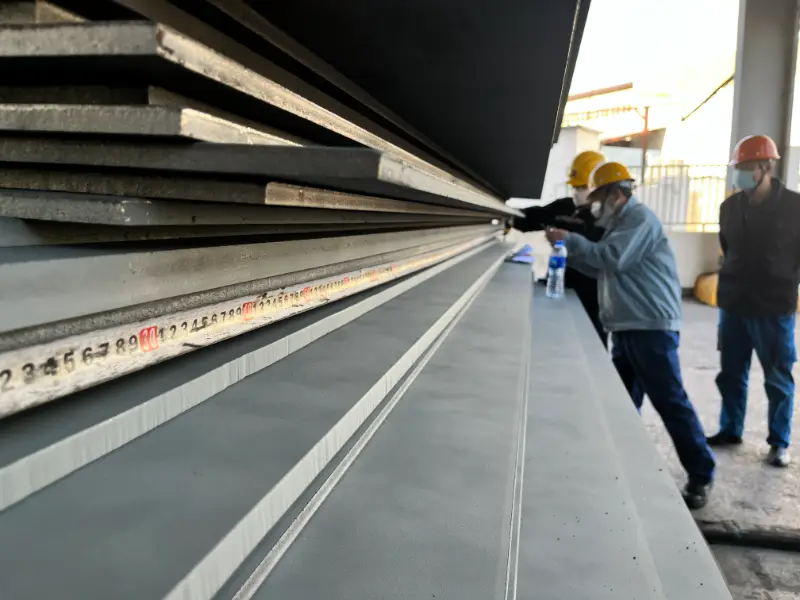
CCS Grade FQ47 Shipbuilding Steel Plate
CCS Grade FQ47 Shipbuilding Steel Plate: Comprehensive Properties, Equivalents and Marine Applications
In-depth analysis of CCS Grade FQ47 shipbuilding steel plate, including chemical composition, mechanical properties, thermal physical data, international equivalent grades, and application in marine engineering and naval architecture.
Welding (with preheating and low hydrogen processes), cutting (flame, plasma, laser), cold and hot forming (bending, rolling), machining
- Phone : +8618037372205
- Email : [email protected]
- WhatsApp: Contact via Whtsapp
- WeChat: +8618037372205
CCS Grade FQ47 Shipbuilding Steel Plate Introduction
CCS Grade FQ47 is a high-strength quenched and tempered hull structural steel plate specified by the China Classification Society (CCS) for use in shipbuilding and offshore structures. The designation 'FQ47' denotes a minimum yield strength of 460 MPa (47 kgf/mm²) with a toughness grade 'F' meaning guaranteed Charpy impact properties at -60°C. This steel offers excellent strength-to-weight ratio, good weldability, and superior low-temperature toughness, making it ideal for critical structural components in large vessels and Arctic-class ships. Key features:
- High yield strength (≥460 MPa) reduces section thickness and weight.
- Exceptional notch toughness at -60°C for low-temperature service.
- Strict control of carbon equivalent (Ceq) to ensure weldability.
- Homogeneous microstructure through quenching and tempering.
- Suitable for highly stressed areas such as strength decks and bottom shells.
CCS Grade FQ47 Shipbuilding Steel Plate Chemical Composition
The chemical composition of CCS Grade FQ47 is controlled to achieve high strength and low-temperature toughness while ensuring good weldability. Typical limits are specified by CCS Rules for Materials and Welding. Notes:
- Carbon equivalent Ceq = C + Mn/6 + (Cr+Mo+V)/5 + (Ni+Cu)/15 shall not exceed 0.41% for t≤100mm, or as agreed.
- Microalloying elements Nb, V, Ti are added singly or in combination, total Nb+V+Ti ≤0.12%.
- Aluminum is required as a grain refiner, acid-soluble Al ≥0.020%.
| Element | Content (max or range) | Remarks |
|---|---|---|
| Carbon (C) | ≤0.18 | Ladle analysis; lower C improves weldability |
| Silicon (Si) | 0.10 - 0.50 | |
| Manganese (Mn) | 0.90 - 1.70 | Solid solution strengthener |
| Phosphorus (P) | ≤0.020 | |
| Sulfur (S) | ≤0.015 | Low S for toughness |
| Copper (Cu) | ≤0.50 | |
| Chromium (Cr) | ≤0.25 | |
| Nickel (Ni) | ≤0.40 | Improves low-temperature toughness |
| Molybdenum (Mo) | ≤0.08 | |
| Niobium (Nb) | 0.02 - 0.05 | Microalloying; grain refinement |
| Vanadium (V) | 0.05 - 0.10 | Precipitation strengthening |
| Titanium (Ti) | 0.007 - 0.05 | Grain refinement |
| Aluminum (Al) | ≥0.020 (acid soluble) | Grain refinement, deoxidation |
| Nitrogen (N) | ≤0.012 | |
| Iron (Fe) | Balance |
CCS Grade FQ47 Shipbuilding Steel Plate Thermal and Electrical Physical Properties
The following physical properties are typical for quenched and tempered carbon-manganese alloy steels similar to CCS FQ47 and are not directly specified in the CCS standard but are provided for engineering design reference. Note:
- Values may vary slightly with exact composition and heat treatment condition.
- Thermal conductivity and expansion are critical for welding and service temperature calculations.
| Property | Typical Value | Unit | Condition / Remarks |
|---|---|---|---|
| Density (ρ) | 7.85 | g/cm³ | Room temperature |
| Modulus of elasticity (E) | 200 – 210 | GPa | Room temperature; typical for HSLA steel |
| Shear modulus (G) | 80 | GPa | Calculated from E and Poisson ratio |
| Poisson ratio (ν) | 0.3 | – | |
| Thermal expansion coefficient (α) | 11.5 | 10⁻⁶/K | Ambient to 100°C |
| Thermal expansion coefficient (α) | 12.5 | 10⁻⁶/K | Ambient to 300°C |
| Thermal conductivity (λ) | 42 | W/(m·K) | At 20°C |
| Thermal conductivity (λ) | 40 | W/(m·K) | At 200°C |
| Specific heat capacity (cp) | 460 | J/(kg·K) | At 20°C |
| Electrical resistivity (ρₑ) | 0.22 – 0.25 | μΩ·m | At 20°C |
CCS Grade FQ47 Shipbuilding Steel Plate Mechanical Properties
Mechanical properties are verified by tensile and impact tests in accordance with CCS rules. All tests are performed on specimens taken in the transverse direction, unless otherwise agreed. Key points:
- Yield strength and tensile strength values depend on plate thickness; multiple thickness ranges are shown.
- Charpy V-notch impact energy (KV) is measured at -60°C; longitudinal specimens generally require higher energy than transverse.
- Bend test ensures ductility without cracking.
| Property | Required Value | Unit | Test Condition / Remarks |
|---|---|---|---|
| Yield strength (ReH) | ≥460 | MPa | Thickness ≤ 100 mm |
| Yield strength (ReH) | ≥440 | MPa | Thickness > 100 mm to ≤ 150 mm |
| Tensile strength (Rm) | 570 – 720 | MPa | All thicknesses |
| Elongation (A) | ≥17 | % | Gauge length 5.65√So, t ≤ 50 mm |
| Elongation (A) | ≥16 | % | Gauge length 5.65√So, 50 < t ≤ 100 mm |
| Elongation (A) | ≥15 | % | Gauge length 5.65√So, 100 < t ≤ 150 mm |
| Bend test (180°) | d = 3a | - | Mandrel diameter d, a = specimen thickness, t ≤ 25 mm |
| Bend test (180°) | d = 4a | - | t > 25 mm |
| Impact energy (KV, transverse) | ≥27 | J | -60°C, V-notch, average of 3 specimens, one min. single value 19 J |
| Impact energy (KV, longitudinal) | ≥41 | J | -60°C, V-notch, average of 3 specimens, one min. single value 27 J |
CCS Grade FQ47 Shipbuilding Steel Plate Direct Equivalent Material Standards and Replaceable Grades
| Country / Region | Standard / Classification Society | Grade / Designation | Remarks |
|---|---|---|---|
| International | IACS UR W31 | F460 | Thickness ≤ 150 mm; similar requirements depending on member society |
| USA | ABS | EQ47 | Equivalent to CCS FQ47; same -60°C toughness |
| Norway / Germany | DNV | F47 | Also acceptable under DNV F460 specification |
| United Kingdom | Lloyd's Register (LR) | FH47 | Often designated as FH47 |
| France | Bureau Veritas (BV) | F47 | Same base specification |
| Japan | ClassNK (NK) | KF47 | May have minor compositional adjustments |
| South Korea | KR | RF47 | Equivalent to IACS F460/F47 |
| Italy | RINA | F47 | Direct substitute |
CCS Grade FQ47 Shipbuilding Steel Plate Application Introduction
CCS FQ47 steel is engineered for the most demanding marine and offshore structural applications. Its high strength and superior fracture toughness at -60°C make it suitable for ice-class vessels and critical members where weight reduction without compromising safety is paramount. Typical application guidelines include:
- Highly stressed hull girders, especially in large container ships and Arctic tankers.
- Strength decks, sheer strakes, and bilge keels subjected to high bending moments.
- Offshore platform legs, bracings, and decks where low-temperature service is required.
- Components requiring cold forming or welding under strict quality control (preheating and low hydrogen processes).
Product Applications: Arctic-class tankers and bulk carriers, Container ships with high hull girder loads, Naval auxiliary ships, Self-elevating drilling units (jack-ups), Reinforcement plates for offshore wind turbine foundations, Heavy-duty crane booms and pedestals
Processed into products: Main deck and strength deck plates, Bottom shell and bilge plating, Shear strake and longitudinal stiffeners, Girder webs and frame brackets, Rudder horn plates, Offshore module support beams and transition pieces, Lifting lugs and pad-eyes (with additional certification)
Application industries: Shipbuilding (merchant ships, naval vessels, icebreakers, LNG carriers), Offshore oil & gas (fixed platforms, jack-up rigs, FPSO hulls), Marine heavy lift and crane structures, Bridge construction (specialist marine bridges), Port and harbor machinery
CCS Grade FQ47 Shipbuilding Steel Plate Similar / Alternative Materials with Comparable Performance
| Country / Region | Standard | Grade | Remarks |
|---|---|---|---|
| China | CCS | F460 | Normalized or TMCP version; similar strength but may have different toughness classification; check toughness level (e.g., F460 may be -60°C) |
| China | CCS | D460 | Lower toughness grade (-20°C), same strength; substitute if service temperature permits |
| Europe | EN 10025-6 | S460Q | Quenched and tempered structural steel; suitable for marine applications with proper certification |
| International | ASTM A537 / A537M | Class 2 | Pressure vessel quality, similar strength, but requires additional verification for shipbuilding use |
| Japan | JIS G 3128 | SHY685 | Higher strength (685 MPa), but similar quenched and tempered approach; may be used for specialized heavy-lift structures |
Notes:
Additional requirements:
- CCS may require supplementary tests such as through-thickness tensile (Z-grade) for highly restrained welded joints, e.g., Z25 or Z35 according to CCS Rules.
- Ultrasonic testing (UT) is often mandatory for thickness >40 mm; acceptance levels per CCS or EN 10160.
- Weldability: Preheating (100–150°C) and interpass temperature control are recommended for thick sections; low hydrogen electrodes (H4 or lower) mandatory.
- For service below -60°C, special additional Charpy tests may be agreed.
- Supply condition marking: Each plate shall be stamped with CCS stamp, grade, heat number, and additional markings as per classification society rules.
- Share



