
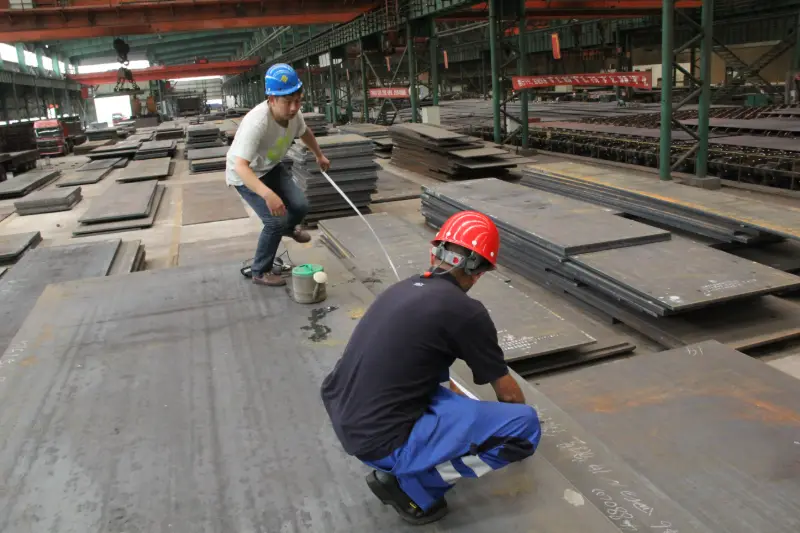
CCS Grade EQ47 Shipbuilding Steel Plate
CCS Grade EQ47 Shipbuilding Steel Plate – High Strength Quenched & Tempered Steel for Offshore & Marine Structures
Detailed material data for CCS EQ47: chemistry, mechanical properties, thermal physics, equivalents, and application guides for a 460 MPa yield strength steel used in ship and ocean engineering.
Hot rolling, controlled rolling, quenching and tempering, cutting, cold forming, welding
- Phone : +8618037372205
- Email : [email protected]
- WhatsApp: Contact via Whtsapp
- WeChat: +8618037372205
CCS Grade EQ47 Shipbuilding Steel Plate Introduction
CCS Grade EQ47 is a high-strength quenched and tempered shipbuilding steel plate specified by China Classification Society (CCS). With a minimum yield strength of 460 MPa, it belongs to the extra-high strength category for marine and offshore construction. EQ47 provides excellent weldability, good toughness at low temperatures (down to -40°C), and high resistance to brittle fracture.
- Commonly supplied in thicknesses from 6 mm to 100 mm.
- Delivered in quenched and tempered (Q+T) condition.
- Used in critical structural parts of ships, offshore platforms, and heavy-lift crane booms.
- Meets stringent requirements for crack tip opening displacement (CTOD) when specified.
CCS Grade EQ47 Shipbuilding Steel Plate Chemical Composition
The chemical composition meets CCS Rules for EQ47. Grain-refining elements such as Al, Nb, V, Ti may be added singly or in combination.
- Carbon equivalent (CEV) is typically controlled to ensure weldability: CEV = C + Mn/6 + (Cr+Mo+V)/5 + (Ni+Cu)/15 ≤ 0.53%.
- For thicknesses above 50 mm, extra restrictions on CEV and alloy content may apply.
| Element | Specified Value (max unless range) | Remarks |
|---|---|---|
| C | 0.20 | |
| Si | 0.10 – 0.55 | |
| Mn | 0.90 – 1.70 | For thickness > 25 mm, Mn min may be 1.0 |
| P | 0.025 | |
| S | 0.025 | |
| Cr | 0.25 | |
| Ni | 0.40 | |
| Mo | 0.08 | |
| Cu | 0.30 | |
| Nb | 0.05 | Grain refiner; if added alone min 0.02 |
| V | 0.10 | Grain refiner; if added alone min 0.02 |
| Ti | 0.02 | Grain refiner; if added alone min 0.005 |
| Al (acid soluble) | 0.015 min | Total Al by agreement |
| N | 0.009 | If sufficient aluminum or other nitrogen binders are present, allowed up to 0.012 |
CCS Grade EQ47 Shipbuilding Steel Plate Thermal and Electrical Physical Properties
These values are typical for low-alloy high-strength steel plates in the quenched and tempered condition and are not part of the mandatory CCS specification. Actual properties may vary slightly with exact composition and heat treatment.
| Property | Typical Value | Unit | Test Condition / Remarks |
|---|---|---|---|
| Density (ρ) | 7850 | kg/m³ | At 20 °C |
| Elastic Modulus (E) | 205 – 210 | GPa | At 20 °C, tension |
| Shear Modulus (G) | 80 | GPa | Calculated from E and Poisson's ratio |
| Poisson's Ratio (ν) | 0.3 | - | At 20 °C |
| Thermal Expansion Coefficient (α) | 11.7 – 12.5 | ×10⁻⁶/K | Between 20–100 °C |
| Thermal Expansion Coefficient (α) | 12.5 – 13.2 | ×10⁻⁶/K | Between 20–200 °C |
| Thermal Expansion Coefficient (α) | 13.0 – 13.8 | ×10⁻⁶/K | Between 20–300 °C |
| Thermal Conductivity (λ) | 42 – 45 | W/(m·K) | At 20 °C |
| Thermal Conductivity (λ) | 40 – 43 | W/(m·K) | At 100 °C |
| Specific Heat Capacity | 460 – 480 | J/(kg·K) | At 20 °C |
| Electrical Resistivity (ρ_e) | 0.25 – 0.30 | ×10⁻⁶ Ω·m | At 20 °C |
CCS Grade EQ47 Shipbuilding Steel Plate Mechanical Properties
Tensile and impact properties are determined on test pieces taken transverse to the rolling direction. Charpy V-notch impact test at -40 °C.
- For thicknesses > 50 mm, requirements may be adjusted as agreed with CCS.
- Bend test: 180° with specified mandrel diameter, no cracks or breaks.
| Property | Required Value | Unit | Test Condition / Remarks |
|---|---|---|---|
| Yield Strength (ReH) | ≥ 460 | MPa | Thickness ≤ 50 mm, transverse |
| Yield Strength (ReH) | ≥ 440 | MPa | Thickness > 50 to 70 mm, transverse |
| Yield Strength (ReH) | ≥ 420 | MPa | Thickness > 70 to 100 mm, transverse |
| Tensile Strength (Rm) | 570 – 720 | MPa | Thickness ≤ 100 mm, transverse |
| Elongation (A5) | ≥ 17 | % | Gauge length 5.65√So, thickness ≤ 50 mm |
| Elongation (A5) | ≥ 17 | % | Thickness > 50 to 70 mm |
| Elongation (A5) | ≥ 17 | % | Thickness > 70 to 100 mm |
| Charpy V-Notch Impact Energy (KV) | ≥ 31 | J | At -40 °C, transverse; average of 3 tests, one individual min 22 J |
| Bend Test (Bend angle 180°) | d = 3a | - | Thickness ≤ 50 mm, mandrel diameter |
| Bend Test | d = 3a | - | Thickness > 50 mm, by agreement |
CCS Grade EQ47 Shipbuilding Steel Plate Exact Equivalent Grades and Substitution Recommendations
| Country/Region | Standard | Designation | Remarks |
|---|---|---|---|
| International | IACS (all member societies) | EQ/E47 | Common unified requirement for extra-high strength 460 MPa ship steel |
| USA | ABS Rules | ABS EQ47 | American Bureau of Shipping equivalent, identical requirements |
| Norway/Germany | DNV Rules | DNV E47 | Formerly NV E47; DNV GL now DNV |
| UK | LR Rules | LR EH47 | Lloyd's Register; identical chemical and mechanical limits |
| France | BV Rules | BV E47 | Bureau Veritas equivalent |
| Japan | NK Rules | NK KE47 | ClassNK, identical properties |
| South Korea | KR Rules | KR RE47 | Korean Register, identical specifications |
| Italy | RINA Rules | RINA E47 | Registro Italiano Navale equivalent |
| Russia | RMRS Rules | RMRS E47 | Russian Maritime Register of Shipping equivalent |
CCS Grade EQ47 Shipbuilding Steel Plate Application Introduction
CCS EQ47 is designed for heavy-loaded marine structures where high strength and excellent low-temperature toughness are essential. It is approved for welded fabrication under ship classification society rules. Processing notes:
- Preheating before welding typically not required for thicknesses ≤ 50 mm (low carbon equivalent), but thick sections (>50 mm) may require preheat 100–150 °C.
- Post weld heat treatment (PWHT) is generally not used; if required, careful control to avoid temper embrittlement.
- Forming and bending: cold forming with a minimum bending radius of 3t for longitudinal direction, hot forming should be followed by quenching and tempering.
Product Applications: Hull plating (deck, bottom, side shell, longitudinal bulkhead), Strength deck stringer plates, Cargo hold frames, Hatch coaming, crane pedestal structures, Offshore platform deck plates and main girders, Jack-up leg rack chords and bracings, Mooring system components (padeyes, fairlead plates), Heavy lift crane boom chords and lattice members
Processed into products: Main hull girder elements, Transverse web frames and stiffeners, Rudder horns and propeller brackets, Skeg and stern frame plates, Helideck support beams, Wellhead deck plates, Subsea protection structure parts, Cutting edges for ice-strengthened bows
Application industries: Shipbuilding: container ships, bulk carriers, tankers, passenger vessels, naval auxiliary ships., Offshore oil & gas: fixed platforms, semi-submersibles, jack-up rig legs, FPSO hull structures., Marine heavy lifting & engineering: crane pedestals, A-frames, heavy-lift pipelay vessels., Polar & ice-class vessels: icebreaker hulls, arctic shuttle tankers due to toughness at -40 °C., Renewable energy: offshore wind turbine substructures, transition pieces, monopile reinforcement.
CCS Grade EQ47 Shipbuilding Steel Plate Similar / Neighbouring Grade Alternatives
| Country/Region | Standard | Designation | Remarks |
|---|---|---|---|
| China | CCS Rules | CCS EQ43 / EQ51 | Lower yield (420 MPa) or higher yield (500 MPa) options within same extra-high strength family; careful re-engineering required. |
| EN / Europe | EN 10025-6 | S460Q / S460QL / S460QL1 | Quenched and tempered structural steels with min 460 MPa yield; similar strength but not specifically for ship class approval; supplementary testing needed. |
| USA | ASTM A514/A514M | Grade Q (type of ASTM A514) | Yield 690 MPa higher than EQ47; used in structural heavy equipment, may be considered after design adjustment. |
| Japan | JIS G 3128 | SHY 685 | Higher strength (685 MPa yield) for high tensile steel plates; can be alternate for weight reduction but weldability and fracture toughness differ. |
Notes:
Additional testing and certification:
- Ultrasonic testing (UT) in accordance with EN 10160 class S1 or CCS requirements is usually performed.
- For critical structural nodes, CTOD (Crack Tip Opening Displacement) testing can be specified to guarantee resistance to brittle fracture.
- Through-thickness properties (Z35/Z25) per EN 10164 may be required for highly restrained welded joints.
- Supplier must hold CCS factory approval certificate for EQ47. Material certificates marked with CCS stamp and surveyor's signature.
- Share



