
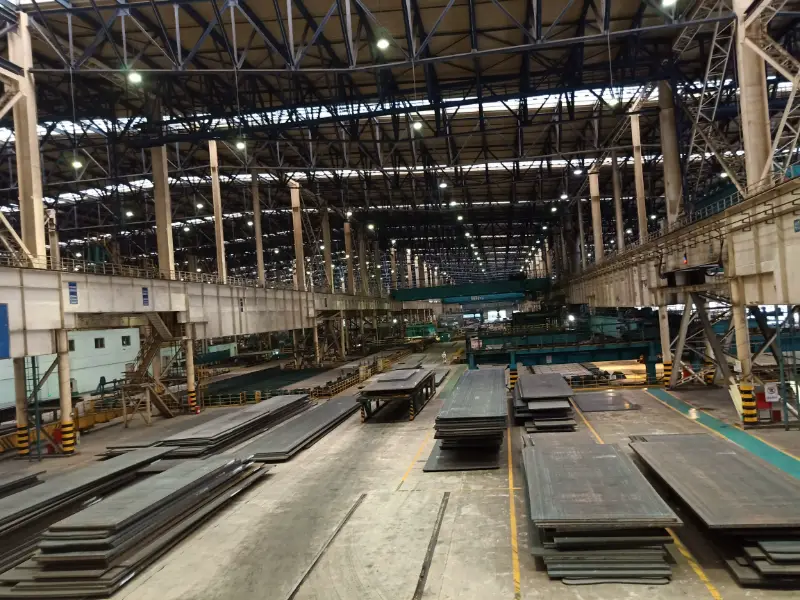
ABS Grade B Shipbuilding Steel Plate
ABS Grade B Shipbuilding Steel Plate - Complete Material Properties and Specifications
In-depth material data for ABS Grade B ordinary-strength hull structural steel plate according to ABS Rules, covering chemical composition, mechanical and physical properties, exactly equivalent interchangeable grades, similar alternatives, and application guidance.
Hot rolling, controlled rolling, normalizing, thermo-mechanical control process (TMCP)
- Phone : +8618037372205
- Email : [email protected]
- WhatsApp: Contact via Whtsapp
- WeChat: +8618037372205
ABS Grade B Shipbuilding Steel Plate Introduction
ABS Grade B is an ordinary-strength hot-rolled structural steel plate primarily used for shipbuilding and marine construction, certified under the American Bureau of Shipping (ABS) Rules for Building and Classing Steel Vessels. It delivers a minimum yield strength of 235 MPa (for thicknesses up to 50 mm) and guaranteed impact toughness at 0°C (longitudinal Charpy V-notch energy ≥ 27 J).
Key features include:
- Excellent weldability and formability for complex hull geometries
- Consistent mechanical properties in as-rolled, controlled-rolled, or normalized conditions
- Good low-temperature toughness for mid-range service temperatures (0°C impact test)
- Wide availability across global mills with full classification society traceability
Grade B is one of the most widely specified ordinary-strength shipbuilding grades, balancing cost and toughness for general structural applications such as shell plating, decks, bulkheads, and stiffeners in both inland and ocean-going vessels.
ABS Grade B Shipbuilding Steel Plate Chemical Composition
The following chemical requirements are in accordance with ABS Rules for ordinary-strength hull structural steel Grade B. The steel is typically fully killed and made to fine grain practice. Residual elements are controlled to ensure weldability and toughness. The carbon equivalent (CEV) is usually limited to ≤ 0.40% for thicknesses above 25 mm.
| Chemical Element | Mass Fraction (%) | Remarks |
|---|---|---|
| Carbon (C) | ≤ 0.21 | Ladle analysis; the manganese content shall be at least 2.5 times the carbon content |
| Manganese (Mn) | 0.60 – 1.00¹ | Minimum 2.5 × C; commonly supplied in this range |
| Silicon (Si) | ≤ 0.50 | Typical range 0.15 – 0.50 |
| Phosphorus (P) | ≤ 0.035 | Usually controlled to lower levels |
| Sulfur (S) | ≤ 0.035 | Usually controlled to lower levels |
| Aluminum (Al, total) | ≥ 0.015 | When fully killed with Al; required for fine grain practice |
| Chromium (Cr) | ≤ 0.25 | Residual element |
| Nickel (Ni) | ≤ 0.30 | Residual element |
| Copper (Cu) | ≤ 0.35 | Residual element |
| Molybdenum (Mo) | ≤ 0.08 | Residual element |
| Nitrogen (N) | ≤ 0.012 | For unkilled steels; with Al addition typically ≤ 0.009 |
ABS Grade B Shipbuilding Steel Plate Thermal and Electrical Physical Properties
The physical constants below are representative for ordinary-strength shipbuilding steel at room temperature (20 °C) unless otherwise noted. They are not part of the ABS certification requirements but are essential for design calculations, welding procedure development, and heat transfer analysis. Slight variations may occur depending on exact chemical composition and heat treatment condition.
| Physical Property | Typical Value | Unit | Test Condition / Remarks |
|---|---|---|---|
| Density (ρ) | 7.85 | g/cm³ | At 20 °C |
| Modulus of Elasticity (E) | 205 – 210 | GPa | At 20 °C, static |
| Shear Modulus (G) | 79 – 81 | GPa | Calculated from E and ν |
| Poisson's Ratio (ν) | 0.29 – 0.30 | – | Elastic range, at 20 °C |
| Thermal Expansion Coefficient (α) | 11.5 – 12.5 | ×10⁻⁶ /K | 20 – 100 °C; increases with temperature |
| Thermal Conductivity (λ) | 45 – 55 | W/(m·K) | At 20 °C; decreases with temperature |
| Specific Heat Capacity (c) | 440 – 480 | J/(kg·K) | At 20 °C |
| Electrical Resistivity (ρₑ) | 0.15 – 0.25 | µΩ·m | At 20 °C |
ABS Grade B Shipbuilding Steel Plate Mechanical Properties
The mechanical properties of Grade B steel plates are determined on transverse tensile specimens and longitudinal Charpy V-notch impact specimens. Impact testing at 0°C distinguishes Grade B from Grade A (no impact requirement) and Grade D (-20°C). The bending test is carried out at ambient temperature with a specified mandrel diameter depending on plate thickness. All values are minimum requirements unless a range is given.
| Property | Specified Value | Unit | Test Condition / Remarks |
|---|---|---|---|
| Yield Strength (ReH) | ≥ 235 | MPa | Plate thickness t ≤ 50 mm, transverse test |
| Yield Strength (ReH) | ≥ 225 | MPa | 50 mm < t ≤ 70 mm, transverse test |
| Yield Strength (ReH) | ≥ 215 | MPa | 70 mm < t ≤ 100 mm, transverse test |
| Tensile Strength (Rm) | 400 – 520 | MPa | All thicknesses, transverse test |
| Elongation (A, 5.65√S₀) | ≥ 22 | % | t ≤ 50 mm, transverse test |
| Elongation (A, 5.65√S₀) | ≥ 21 | % | 50 mm < t ≤ 70 mm, transverse test |
| Elongation (A, 5.65√S₀) | ≥ 20 | % | 70 mm < t ≤ 100 mm, transverse test |
| Charpy V-notch Impact Energy (KV₂) | ≥ 27 (average), ≥ 20 (single) | J | 0 °C, longitudinal, 10×10 mm specimen |
| Bending Test (180°) | Mandrel diameter d = 0.5a | – | t ≤ 25 mm, no cracks |
| Bending Test (180°) | Mandrel diameter d = 1.0a | – | 25 mm < t ≤ 50 mm |
| Bending Test (180°) | Mandrel diameter d = 1.5a | – | 50 mm < t ≤ 75 mm |
| Bending Test (180°) | Mandrel diameter d = 2.0a | – | t > 75 mm |
ABS Grade B Shipbuilding Steel Plate Exactly Equivalent Grades under Other Classification Societies
| Country / Region | Standard / Rule | Grade Designation | Remarks |
|---|---|---|---|
| International (IACS member) | CCS Rules | CCS B | Identical chemical and mechanical requirements |
| International (IACS member) | LR Rules | LR B | Same impact test at 0 °C |
| International (IACS member) | DNV Rules | DNV B | Equivalent ordinary-strength ship plate |
| International (IACS member) | BV Rules | BV B | 0 °C impact, yield ≥ 235 MPa |
| International (IACS member) | NK Rules | NK B | Identical technical delivery conditions |
| International (IACS member) | KR Rules | KR B | Same grade designation |
| International (IACS member) | RINA Rules | RINA B | Fully interchangeable |
| International (IACS member) | RS Rules | RS B | Russian Maritime Register equivalent |
| International (IACS member) | IRS Rules | IRS B | Indian Register of Shipping |
ABS Grade B Shipbuilding Steel Plate Application Introduction
ABS Grade B is trusted for a wide spectrum of shipbuilding and marine engineering components where a balance of strength, weldability, and moderate low-temperature toughness is essential. Its guaranteed impact energy at 0 °C allows it to be used in hull structures that are not exposed to the most severe arctic temperatures. Typical areas of use include:
- Main hull shell plating for bulk carriers, tankers, container ships, and general cargo vessels
- Longitudinal and transverse bulkheads, decks, and inner bottom plates
- Web frames, stiffeners, and girders in ship structures
- Components for offshore platforms, floating docks, and barges
- Structural elements in river-sea going vessels
Product Applications: Ship hull plates and shell plating, Structural decks and bulkheads, Web frames and longitudinal stiffeners, Bottom and inner bottom plates, Transverse rings and girder webs, Offshore platform topside and jacket braces, Floating dock pontoons
Processed into products: Hull side and bottom plates, Main deck plates, Bulkhead plates and stiffeners, Keel plates and bilge strakes, Floor plates and brackets, Stool plates for hatch coamings, Transverse web frames and stringers, Foundation plates for machinery
Application industries: Merchant shipbuilding (bulk carriers, tankers, container vessels, ro-ro ships), Naval architecture and marine engineering, Offshore oil & gas platforms and FPSOs, Barge and pontoon construction, Dredging and port equipment, Renewable energy (offshore wind turbine foundations, transition pieces)
ABS Grade B Shipbuilding Steel Plate Similar or Analogous Materials within Ordinary-Strength Ship Plates
| Country / Region | Standard / Rule | Grade Designation | Remarks |
|---|---|---|---|
| General IACS | All major classification rules | Grade A | No impact test requirement; lowest cost ordinary-strength plate. Suitable for non-critical structures where toughness is not mandatory. |
| General IACS | All major classification rules | Grade D | Impact test at -20 °C; used for moderately cold regions. Higher toughness than Grade B. |
| General IACS | All major classification rules | Grade E | Impact test at -40 °C; for severe cold service. Required for exposed structures in polar class vessels. Much tougher than Grade B. |
| EN / EU | EN 10025-2 | S235JR / S235J0 / S235J2 | Structural steels with similar yield strength. J2 (impact -20 °C) approaches Grade B toughness but not directly certified by class societies. Requires additional testing for marine use. |
| China GB | GB/T 712 | B | Chinese national standard ship steel B; almost identical to ABS Grade B, suitable for domestic shipbuilding and replacement. |
Notes:
Welding and fabrication: Grade B is suitable for all standard arc welding processes (SMAW, SAW, FCAW, GMAW) without preheat at moderate thicknesses, although preheat may be applied for thicker sections (>50 mm) to control hydrogen cracking. Compliance with an approved welding procedure specification (WPS) is mandatory.
Carbon Equivalent: While not a mandatory classification test, many shipyards demand a maximum CEV (IIW) of 0.40–0.43% to ensure reliable weldability.
Corrosion protection: As unprotected carbon steel, Grade B requires coating or cathodic protection in marine environments. Shop primers are commonly applied before fabrication.
Alternative supply: When ABS-certified Grade B is unavailable, other IACS-recognised equivalent grades (CCS B, LR B, etc.) are generally accepted by classification societies, subject to agreement. Test certificates must confirm impact testing at 0 °C.
- Share



