
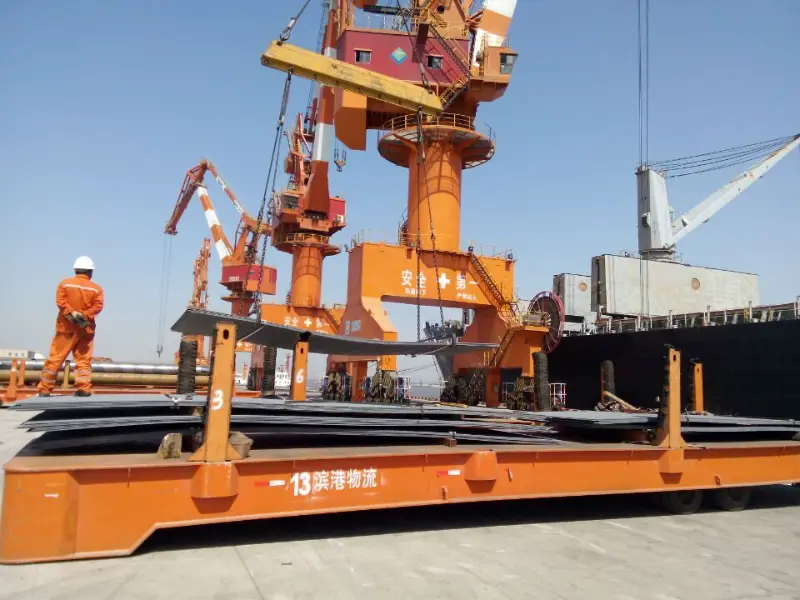
CCS Grade DQ47 Marine Steel
CCS Grade DQ47 Shipbuilding Steel Plate: High Strength Quenched & Tempered Plate for Marine Environments
Comprehensive material data for CCS Grade DQ47 shipbuilding steel plate including chemical composition, mechanical properties, thermal and electrical physical properties, international equivalents, and application guidance.
Hot rolling followed by quenching and tempering (QT); suitable for cold forming, hot forming (with re-heat treatment), welding, cutting
- Phone : +8618037372205
- Email : [email protected]
- WhatsApp: Contact via Whtsapp
- WeChat: +8618037372205
CCS Grade DQ47 Marine Steel Introduction
CCS Grade DQ47 is a high strength quenched and tempered steel plate specifically designed for shipbuilding and offshore structures, certified by China Classification Society (CCS). With a minimum yield strength of 460 MPa and excellent impact toughness at -20°C, DQ47 is ideal for critical structural applications requiring high strength and reliable low-temperature performance. It is part of the CCS high strength hull structural steel series and is intended for welded construction in section modulus critical areas. The steel is produced by quenching and tempering (QT) heat treatment to achieve fine-grained microstructure, ensuring a good balance of strength, toughness and weldability. Typical applications include container ships, bulk carriers, tankers, and offshore platforms where weight savings and structural integrity are paramount.
CCS Grade DQ47 Marine Steel Chemical Composition
Maximum limits of chemical elements for CCS DQ47 in heat analysis as per CCS Rules. Fine grain practice shall be applied using Al, Nb, V, Ti or a combination. Carbon equivalent (CEV) is typically controlled to ensure weldability. Actual values may be lower to meet mechanical requirements.
| Element | Standard Value (max %) | Remarks |
|---|---|---|
| Carbon (C) | 0.20 | CEV control required |
| Silicon (Si) | 0.55 | Killed steel practice |
| Manganese (Mn) | 1.70 | Higher Mn may be allowed subject to approval |
| Phosphorus (P) | 0.025 | |
| Sulfur (S) | 0.025 | |
| Copper (Cu) | 0.50 | |
| Chromium (Cr) | 0.25 | |
| Nickel (Ni) | 0.40 | |
| Molybdenum (Mo) | 0.08 | |
| Niobium (Nb) | 0.05 | Grain refining element |
| Vanadium (V) | 0.10 | Grain refining element |
| Titanium (Ti) | 0.02 | Grain refining element |
| Aluminium (Als) | 0.015 min | Acid soluble aluminium; or total Al ≥ 0.020 |
| Nitrogen (N) | 0.012 |
CCS Grade DQ47 Marine Steel Thermal and Electrical Physical Properties
The following values are typical for quenched and tempered high-strength low-alloy steel similar to DQ47. These are not specification requirements but engineering reference data. Variations may occur depending on exact composition and condition.
| Property | Typical Value | Unit | Conditions / Notes |
|---|---|---|---|
| Density (ρ) | 7850 | kg/m³ | At 20°C |
| Modulus of elasticity (E) | 205 | GPa | At 20°C; average static modulus |
| Shear modulus (G) | 80 | GPa | Calculated from E and ν |
| Poisson's ratio (ν) | 0.3 | - | Ambient temperature |
| Thermal expansion coefficient (α) | 12.0 x 10⁻⁶ | 1/K | Temperature range 20-100°C |
| Thermal expansion coefficient (α) | 13.0 x 10⁻⁶ | 1/K | Temperature range 20-200°C |
| Thermal conductivity (λ) | 50 | W/(m·K) | At 20°C |
| Specific heat capacity (Cp) | 460 | J/(kg·K) | At 20°C |
| Electrical resistivity (ρ_e) | 0.20 x 10⁻⁶ | Ω·m | At 20°C |
CCS Grade DQ47 Marine Steel Mechanical Properties
Specified mechanical properties for CCS DQ47 steel plates based on CCS Rules. All tests shall be performed on specimens from the delivered condition (quenched and tempered). Impact testing is carried out at -20°C using Charpy V-notch specimens.
- Yield strength is specified for transverse specimens unless otherwise agreed.
- Elongation applies to gauge length L0 = 5.65√S0.
- Bend test: no cracks or ruptures.
| Property | Required Value | Unit | Test Conditions |
|---|---|---|---|
| Yield Strength (ReH) | ≥ 460 | MPa | Transverse, thickness ≤ 100 mm |
| Tensile Strength (Rm) | 570 - 720 | MPa | Transverse |
| Elongation after fracture (A) | ≥ 17 | % | L0 = 5.65√S0; thickness ≤ 50 mm |
| Elongation after fracture (A) | ≥ 16 | % | L0 = 5.65√S0; thickness > 50 mm ≤ 70 mm |
| Elongation after fracture (A) | ≥ 15 | % | L0 = 5.65√S0; thickness > 70 mm ≤ 100 mm |
| Charpy V-notch impact energy (KV2) | ≥ 31 (longitudinal) | J | At -20°C; standard 10x10 mm specimen |
| Charpy V-notch impact energy (KV2) | ≥ 22 (transverse) | J | At -20°C; standard 10x10 mm specimen |
| Bend test (d = mandrel diameter, a = specimen thickness) | d = 3a, 180° no cracks | - | Thickness ≤ 50 mm |
CCS Grade DQ47 Marine Steel Fully Equivalent International Grades & Substitutes
| Country / Region / Society | Standard / Rule | Grade Designation | Remarks |
|---|---|---|---|
| International (IACS) | IACS UR W11 | High strength hull structural steel, min yield 460 MPa, impact -20°C, QT | Base common requirements; individual class societies adapt. |
| Norway (DNV) | DNV Rules Pt.2 Ch.2 | VL D47 (Quality D, min yield 460 MPa, QT) | Delivery condition QT; impact test at -20°C |
| USA (ABS) | ABS Rules Pt.2 | EH47 (higher toughness) / EQ47 (if QT) | ABS EQ47 is direct equivalent; EH47 has -40°C impact but commonly accepted |
| UK (LR) | Lloyd's Rules Pt.4 | EH47 (with QT marking) | Grade EH47 supplied in quenched and tempered condition |
| France (BV) | BV Rules Pt.2 | EH47 (QT) | Same strength level; QT required |
| Japan (NK) | ClassNK Rules Pt.K | KE47 (QT) | Direct equivalent with -20°C impact |
| Korea (KR) | KR Rules Pt.2 | REH47 (QT) | Equivalent high strength steel |
| Italy (RINA) | RINA Rules Pt.2 | EH47 (QT) | Same specification |
CCS Grade DQ47 Marine Steel Application Introduction
CCS DQ47 steel is primarily utilized in shipbuilding and offshore engineering where high strength, weldability, and reliable low-temperature toughness are essential. Its quenching and tempering treatment provides a fine bainitic/martensitic structure that delivers excellent mechanical properties. Key advantages:
- High yield strength (≥460 MPa) allows weight reduction in structural design.
- Guaranteed impact energy at -20°C ensures safety in cold-water operations.
- Good weldability with low carbon equivalent and controlled impurities.
Product Applications: Hull structural members: sheer strake, bilge keel, main deck plating, Deck structures and hatch coamings, Crane boom and pedestal structures on offshore vessels, Jack-up rig legs and chords, Caissons and subsea templates, Pressure hulls for submersibles (after class approval)
Processed into products: Longitudinal stiffeners and girders, Transverse frames and web frames, Bulkhead plating, Leg sections and spud cans, Boom sections and crane pedestals, Towing brackets and foundation plates, Lifting trunnions and heavy-duty brackets
Application industries: Shipbuilding (container ships, bulk carriers, tankers, LNG carriers), Offshore oil & gas platforms (jack-ups, semi-submersibles), Marine engineering (wind turbine installation vessels, heavy lift cranes), Port and harbor infrastructure (quay walls, lock gates), Bridge construction (special marine bridges)
CCS Grade DQ47 Marine Steel Similar / Alternative Materials for Reference
| Country / Region / Standard | Standard / Specification | Grade | Remarks / Comparison |
|---|---|---|---|
| CCS (China) | CCS Rules | CCS EQ47 | Higher toughness grade with impact test at -40°C; other properties similar. Suitable for more demanding low-temperature applications. |
| CCS (China) | CCS Rules | CCS FQ47 | Impact test at -60°C; for extreme cold conditions. Otherwise same strength. |
| CCS (China) | CCS Rules | CCS AQ47 | Impact test at 0°C; less stringent toughness requirement. May be cost-effective where low-temperature toughness is not critical. |
| China (GB) | GB/T 712-2011 | F460 (with delivery condition QT) | Chinese national standard equivalent; grade F460 requires -60°C impact unless agreed otherwise. Can be specified with D-quality (-20°C) as per agreement. |
| EN (Europe) | EN 10025-6 | S460Q / S460QL / S460QL1 | Structural steel for offshore; similar strength & QT condition; plate up to 150 mm. Impact test at -20°C (L) or -40°C (L1). Not specifically marine-homologated but can be used with class approval. |
Notes:
- Plates are usually supplied with class inspection certificates (CCS or dual class).
- Welding consumables must be matched to the steel (e.g., AWS E9018M or equivalent low-hydrogen electrodes). Preheating may be required depending on thickness and carbon equivalent.
- Thermal cutting (plasma, laser) is feasible, but edges may require grinding to remove hardened zone before welding.
- Thickness,width and length tolerances as per CCS Rules or agreed standard (e.g., EN 10029).
- Supplementary requirements such as ultrasonic testing (UT), through-thickness properties (Z25/Z35), and CTOD testing can be agreed upon ordering.
- Share



