
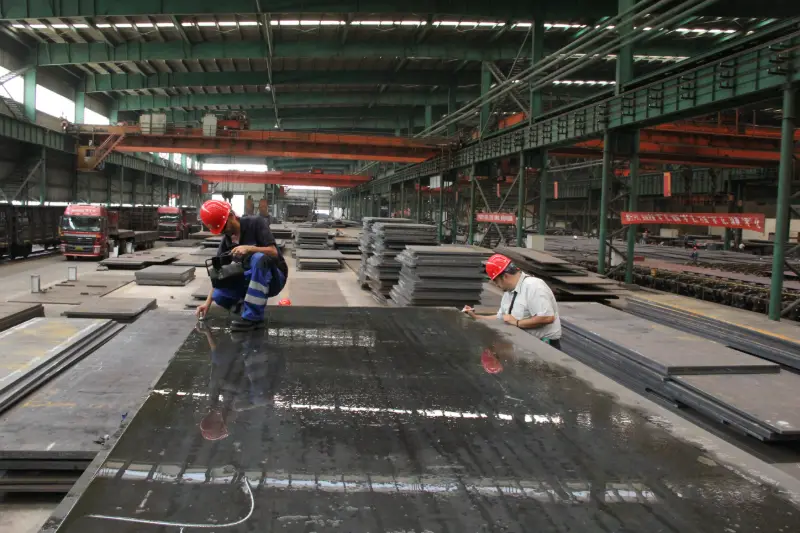
LR Grade FH32 Shipbuilding Steel Plate
LR Grade FH32 Shipbuilding Steel Plate: High-Strength & Arctic-Grade Low Temperature Toughness
LR Grade FH32 is a high-strength shipbuilding steel plate with minimum yield strength of 315 MPa and guaranteed impact toughness at -60°C, meeting Lloyd's Register rules for structural applications in ships and offshore structures.
Hot rolling followed by normalizing (N) or thermo-mechanical controlled process (TMCP); also suitable for cold forming and welding.
- Phone : +8618037372205
- Email : [email protected]
- WhatsApp: Contact via Whtsapp
- WeChat: +8618037372205
LR Grade FH32 Shipbuilding Steel Plate Introduction
LR Grade FH32 is a high-strength hull structural steel plate classified under Lloyd's Register (LR) rules. It belongs to the normalized or TMCP delivery condition group and offers a minimum yield strength of 315 MPa.
- Excellent low-temperature toughness with impact test requirements at -60°C, making it suitable for Arctic and harsh environment vessels.
- Good weldability and formability, typical for fine-grain, fully killed steels.
- Widely used in ship hulls, decks, bulkheads, and offshore structures where high strength and resistance to brittle fracture are critical.
- The grade is a counterpart to other IACS classification society grades such as ABS FH32, DNV FH32, CCS FH32, etc.
LR Grade FH32 Shipbuilding Steel Plate Chemical Composition
The chemical composition requirements for LR Grade FH32 are based on the Lloyd's Register Rules. The values below are the maximum limits (unless a range is specified) for the ladle analysis. Fine-grain practice with sufficient aluminum and/or other grain-refining elements is mandatory.
- Carbon equivalent (CEV) is controlled to ensure weldability, typically calculated as CEV = C + Mn/6 + (Cr+Mo+V)/5 + (Ni+Cu)/15 and usually required below 0.38%.
- For thicknesses >25 mm, grain-refining elements like Nb, V, or Ti are added as indicated.
| Element | Standard Value (mass %) | Remarks |
|---|---|---|
| Carbon (C) | ≤ 0.18 | Ladle analysis |
| Silicon (Si) | ≤ 0.50 | |
| Manganese (Mn) | 0.90 – 1.60 | Higher Mn improves strength and toughness |
| Phosphorus (P) | ≤ 0.035 | Maximum allowed; lower in practice |
| Sulfur (S) | ≤ 0.035 | Maximum allowed; lower for improved cleanliness |
| Aluminum (total Al) | ≥ 0.020 | Or acid soluble Al ≥ 0.015; for fine-grain practice |
| Niobium (Nb) | 0.02 – 0.05 | Optional grain refiner, often used for strength |
| Vanadium (V) | 0.05 – 0.10 | Optional grain refiner |
| Titanium (Ti) | ≤ 0.02 | If added for grain refinement |
| Copper (Cu) | ≤ 0.35 | Residual element limit |
| Chromium (Cr) | ≤ 0.20 | Residual element limit |
| Nickel (Ni) | ≤ 0.40 | Residual element limit |
| Molybdenum (Mo) | ≤ 0.08 | Residual element limit |
| Nitrogen (N) | ≤ 0.012 (if supplied) | When specified |
LR Grade FH32 Shipbuilding Steel Plate Physical Properties
The following physical properties are typical for carbon-manganese structural steels similar to FH32 and are provided for engineering guidance. They are not mandatory requirements of the LR specification.
- Actual values may vary slightly depending on exact composition and heat treatment.
- These data are useful for thermal, structural, and electrical design calculations.
| Property | Typical Value | Unit | Conditions / Remarks |
|---|---|---|---|
| Density (ρ) | 7.85 | g/cm³ | Room temperature |
| Modulus of elasticity (E) | 200 – 210 | GPa | At room temperature |
| Shear modulus (G) | 80 – 85 | GPa | Estimated from E and ν |
| Poisson's ratio (ν) | 0.28 – 0.30 | — | Elastic range |
| Thermal expansion coefficient (α) | 11.5 – 12.0 | ×10⁻⁶/K | 20–100°C |
| Thermal expansion coefficient (α) | 12.5 – 13.0 | ×10⁻⁶/K | 20–200°C |
| Thermal expansion coefficient (α) | 13.5 – 14.0 | ×10⁻⁶/K | 20–300°C |
| Thermal conductivity (λ) | ≈ 50 | W/(m·K) | At 20°C |
| Thermal conductivity (λ) | ≈ 47 | W/(m·K) | At 100°C |
| Specific heat capacity | ≈ 460 | J/(kg·K) | At 20°C |
| Electrical resistivity (ρe) | 0.18 – 0.22 | µΩ·m | At 20°C |
LR Grade FH32 Shipbuilding Steel Plate Mechanical Properties
The mechanical properties below are derived from LR Rules for plates in normalized or TMCP condition. Tensile properties are valid for transverse test pieces. Impact tests are performed on Charpy V-notch specimens at -60°C.
- Minimum impact energy values are for longitudinal specimens (average of 3); transverse impact energy is 70% of the longitudinal value (≥21 J).
- Bend tests: 180° bend over a former with diameter d = 3a (for thickness ≤25 mm) without cracking.
| Property | Requirement | Unit | Test Conditions / Remarks |
|---|---|---|---|
| Yield strength (ReH) | ≥ 315 | MPa | Thickness ≤ 100 mm; transverse direction |
| Tensile strength (Rm) | 440 – 570 | MPa | Transverse direction |
| Elongation (A) | ≥ 22 | % | Gauge length 5.65√S0, thickness ≤ 50 mm, transverse |
| Elongation (A) | ≥ 21 | % | Gauge length 5.65√S0, thickness >50–70 mm, transverse |
| Elongation (A) | ≥ 20 | % | Gauge length 5.65√S0, thickness >70–100 mm, transverse |
| Charpy impact energy (KV) | ≥ 31 (avg), ≥ 22 (single) | J | −60°C, longitudinal; 10×10 mm specimen |
| Charpy impact energy (KV) | ≥ 21 (avg), ≥ 15 (single) | J | −60°C, transverse; 10×10 mm specimen |
| Bend test | 180° no cracks | — | Former diameter d = 3a (thickness ≤ 25 mm); for thicker plates see standard |
LR Grade FH32 Shipbuilding Steel Plate Exactly Equivalent Standards and Replaceable Grades
| Country / Region | Standard / Class Society | Grade | Remarks |
|---|---|---|---|
| International (IACS) | American Bureau of Shipping (ABS) | ABS FH32 | Identical strength level and −60°C impact requirement |
| International (IACS) | DNV (Det Norske Veritas) | DNV FH32 | Identical property requirements |
| International (IACS) | Bureau Veritas (BV) | BV FH32 | Identical property requirements |
| International (IACS) | China Classification Society (CCS) | CCS FH32 | Identical property requirements |
| International (IACS) | Class NK (Nippon Kaiji Kyokai) | NK FH32 | Identical property requirements |
| International (IACS) | RINA (Registro Italiano Navale) | RINA FH32 | Identical property requirements |
| International (IACS) | Korean Register (KR) | KR FH32 | Identical property requirements |
| International (IACS) | Russian Maritime Register of Shipping (RS) | RS FH32 | Identical property requirements |
| International (non-IACS) | Indian Register of Shipping (IRS) | IRS FH32 | Identical property requirements |
LR Grade FH32 Shipbuilding Steel Plate Application Introduction
LR Grade FH32 is extensively utilized in Arctic and cold-climate marine structures where both high strength and reliable low-temperature toughness are mandatory. Its −60°C impact guarantee enables safe service in ice-bound waters.
- Typical applications are ship hulls, icebreakers, and permanently moored offshore platforms.
- The steel can be welded using standard shipyard procedures with low-hydrogen consumables; preheating may be required depending on thickness and carbon equivalent.
- It is also suitable for hot-dip galvanizing and protective coatings without significant loss of mechanical properties.
Product Applications: Hull plating for ice-strengthened vessels, Decks and deckhouses for Arctic service ships, Watertight bulkheads and shell plates, Structural members for offshore modules, Wind turbine foundation plates (marine environment)
Processed into products: Cut and edge-prepared plates for shell, bottom, and side framing, Stiffener plates, brackets, and doubler plates, Built-up girders and beam components, Weld fabrication blocks for ship sections, Machined parts for offshore structural connections
Application industries: Commercial and naval shipbuilding, Offshore oil & gas (jacket platforms, floating production units), Arctic engineering and ice-class vessels, Marine transportation (LNG/LPG carriers, tankers), Port and harbor construction (sheet piles, structural elements)
LR Grade FH32 Shipbuilding Steel Plate Similar / Alternative Materials
| Country / Region | Standard | Grade | Remarks |
|---|---|---|---|
| International (LR) | LR Rules | AH32 | Minimum yield 315 MPa; impact test at 0°C (more economical for non-cold applications) |
| International (LR) | LR Rules | DH32 | Minimum yield 315 MPa; impact test at −20°C |
| International (LR) | LR Rules | EH32 | Minimum yield 315 MPa; impact test at −40°C |
| International (LR) | LR Rules | FH36 | Higher yield strength (≥355 MPa) with −60°C impact; suitable for higher-strength Arctic designs |
| International (LR) | LR Rules | AH36 / DH36 / EH36 | Higher yield 355 MPa series; for high-stress areas where cold toughness is less demanding |
| European | EN 10025-4 | S460ML / S460QL | Comparable structural steel with similar strength and good low-temperature properties, but not class-approved for shipbuilding without additional certification |
Notes:
- Weldability: FH32 possesses good weldability with a CEV typically below 0.38%; low-hydrogen welding processes are recommended to avoid hydrogen-induced cracking. Pre-heat temperatures depend on plate thickness and ambient conditions, usually in the range of 50–150°C.
- Non-Destructive Testing: Plates may be supplied with ultrasonic testing in accordance with EN 10160, SEL 072, or other agreed standards.
- Traceability: All plates are marked with heat number, grade, and class stamp, ensuring full traceability to the mill test certificate (MTC) in accordance with EN 10204 Type 3.1 or 3.2.
- Certification: Final certification by Lloyd's Register surveyor or by authorized accredited body; compliance with IACS UR W11 for weldability is standard.
- Share



