
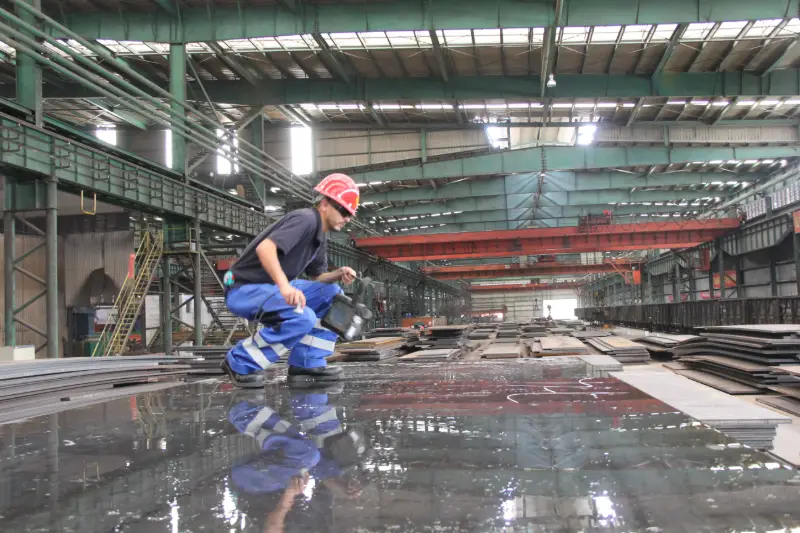
LR Grade EH32 Shipbuilding Steel Plate
LR Grade EH32 Shipbuilding Steel Plate: Chemical, Mechanical & Equivalent Analysis
Detailed material data for LR Grade EH32 shipbuilding steel plate: chemical composition, mechanical properties, physical properties, international equivalents, and application guide.
Hot rolling, normalizing, TMCP, cold forming, welding, cutting, bending
- Phone : +8618037372205
- Email : [email protected]
- WhatsApp: Contact via Whtsapp
- WeChat: +8618037372205
LR Grade EH32 Shipbuilding Steel Plate Introduction
LR Grade EH32 is a higher strength hull structural steel plate certified by Lloyd's Register. It offers a minimum yield strength of 315 MPa, excellent low-temperature notch toughness (Charpy impact tested at -40°C), and reliable weldability using standard shipyard procedures. The steel is designed for critical marine and offshore structures operating in cold environments. Supply condition is typically normalized (N) or thermo-mechanically controlled processed (TMCP). Its balanced combination of strength, ductility, and toughness makes it a preferred choice for hull shells, decks, and stiffening members of vessels and offshore units.
LR Grade EH32 Shipbuilding Steel Plate Chemical Composition
The chemical composition of EH32 is balanced to achieve the required strength level and excellent sub-zero toughness. Grain refinement is ensured through aluminium or other microalloying additions. The carbon equivalent (CEV) is controlled to guarantee good weldability, with typical maximum values depending on plate thickness.
| Element | Content (%) | Remarks |
|---|---|---|
| C | ≤ 0.18 | For all thicknesses |
| Mn | 0.90 - 1.60 | Higher Mn for thicker plates |
| Si | ≤ 0.50 | |
| P | ≤ 0.035 | |
| S | ≤ 0.035 | |
| Al (total) | ≥ 0.020 | For fine grain practice; acid soluble Al ≥ 0.015% |
| Nb | 0.02 - 0.05 | Optional microalloy, if used |
| V | 0.05 - 0.10 | Optional microalloy, if used |
| Ti | ≤ 0.02 | Optional; may be added for grain refinement |
| Cu | ≤ 0.35 | |
| Ni | ≤ 0.40 | |
| Cr | ≤ 0.20 | |
| Mo | ≤ 0.08 | |
| N | ≤ 0.012 | Typical limit |
| Ceq | ≤ 0.40 (t ≤ 50 mm); ≤ 0.42 (50 < t ≤ 100 mm) | Ceq = C + Mn/6 + (Cr + Mo + V)/5 + (Ni + Cu)/15 |
LR Grade EH32 Shipbuilding Steel Plate Thermal and Electrical Physical Properties
The data below represent typical properties for carbon‑manganese structural steels at room temperature. Actual values for a specific heat of EH32 may vary slightly with exact chemical composition and manufacturing route. They are not specified by the classification rule but are useful for engineering calculations.
| Property | Value | Unit | Test Condition |
|---|---|---|---|
| Density (ρ) | 7850 | kg/m³ | At 20°C |
| Modulus of Elasticity (E) | 205 | GPa | At 20°C |
| Shear Modulus (G) | 80 | GPa | Calculated |
| Poisson's Ratio (ν) | 0.30 | - | Elastic range |
| Thermal Expansion Coefficient (α) | 11.0 | 10⁻⁶/K | 20 – 100°C |
| Thermal Expansion Coefficient (α) | 12.0 | 10⁻⁶/K | 20 – 200°C |
| Thermal Conductivity (λ) | 50 | W/(m·K) | At 20°C |
| Specific Heat Capacity | 460 | J/(kg·K) | At 20°C |
| Electrical Resistivity (ρₑ) | 0.20 | μΩ·m | At 20°C |
LR Grade EH32 Shipbuilding Steel Plate Mechanical Properties
Properties are determined on test specimens taken from plates in the delivery condition. Tensile testing is performed perpendicular to the rolling direction unless otherwise agreed. Charpy V-notch impact tests are performed longitudinally at -40°C. A bend test verifies formability. All values refer to the requirements of the LR Rules for higher strength hull structural steels.
| Property | Value | Unit | Test Condition / Remarks |
|---|---|---|---|
| Yield Strength (ReH) | ≥ 315 | MPa | Plate thickness ≤ 100 mm, transverse (or longitudinal if agreed) |
| Tensile Strength (Rm) | 440 - 590 | MPa | Thickness ≤ 100 mm |
| Elongation (A5) | ≥ 22 | % | Gauge length 5.65√So, thickness ≤ 40 mm |
| Elongation (A5) | ≥ 21 | % | Gauge length 5.65√So, thickness 40 – 100 mm |
| Charpy V-notch impact (KV) | ≥ 34 (avg.) / ≥ 24 (indiv.) | J | -40°C, longitudinal, 10×10 mm specimen, t ≤ 50 mm |
| Charpy V-notch impact (KV) | ≥ 27 (avg.) / ≥ 19 (indiv.) | J | -40°C, longitudinal, 10×10 mm specimen, 50 < t ≤ 70 mm |
| Charpy V-notch impact (KV) | ≥ 27 (avg.) / ≥ 19 (indiv.) | J | -40°C, longitudinal, 10×10 mm specimen, 70 < t ≤ 100 mm |
| Bend test (180°) | Mandrel diameter = 3t | - | Thickness ≤ 25 mm |
| Bend test (180°) | Mandrel diameter = 4t | - | 25 < t ≤ 40 mm |
| Bend test (180°) | Mandrel diameter = 5t | - | t > 40 mm |
LR Grade EH32 Shipbuilding Steel Plate Fully Equivalent Material Standards and Replaceable Grades
| Country / Region | Standard | Grade | Remarks |
|---|---|---|---|
| International | IACS UR W11 | EH32 | Unified Requirement for Normal and Higher Strength Hull Structural Steel |
| USA | ABS Rules for Materials and Welding | EH32 | American Bureau of Shipping |
| Norway | DNV Rules for Classification of Ships | E32 | DNV designates as E32 (no H in grade) |
| France | BV Rules for the Classification of Steel Ships | EH32 | Bureau Veritas |
| China | CCS Rules for Materials and Welding | E32 | China Classification Society |
| Japan | NK Rules for the Survey and Construction of Steel Ships | E32 | Nippon Kaiji Kyokai (ClassNK) |
| Italy | RINA Rules for the Classification of Ships | E32 | Registro Italiano Navale |
| Russia | RMRS Rules for the Classification and Construction of Sea-Going Ships | E32 | Russian Maritime Register of Shipping |
| Korea | KR Rules for the Classification of Steel Ships | E32 | Korean Register |
| International | ASTM A131 / A131M | EH32 | Standard Specification for Structural Steel for Ships – equivalent in properties |
LR Grade EH32 Shipbuilding Steel Plate Application Introduction
LR Grade EH32 is intended for primary structural components in ship and offshore constructions that operate at low ambient temperatures and require guaranteed notch toughness. It can be used in thicknesses up to 100 mm for the most demanding elements.
Product Applications: Hull shell plates and stiffeners, Main deck and strength deck plating, Bulkhead plates, Offshore module structural steel, Legs and spudcans of jack‑up rigs, Structural parts of floating production storage and offloading (FPSO) units
Processed into products: Bracket plates and floors, Rudder horns and stern frames, Hatch coamings and corners, Web frames and girders, Cut‑outs with severe stress concentrations, Seatings for deck machinery
Application industries: Shipbuilding (hull and deck structures of tankers, bulkers, containerships, ice-strengthened vessels), Offshore oil and gas (jack‑up rig legs, platform superstructures, flare booms), Polar engineering (icebreakers, Arctic service vessels, winterized equipment), Heavy marine engineering (crane pedestals, mooring brackets)
LR Grade EH32 Shipbuilding Steel Plate Closely Related or Similar Substitute Materials
| Country / Region | Standard | Grade | Remarks |
|---|---|---|---|
| International | IACS UR W11 | AH32 | Same strength, impact test at 0°C (not low temperature) |
| International | IACS UR W11 | DH32 | Same strength, impact test at -20°C |
| International | IACS UR W11 | FH32 | Same strength, impact test at -60°C (higher toughness) |
| USA | ASTM A131 / A131M | DH32 | Similar properties, slightly higher impact temperature requirement |
| EU | EN 10025-3 | S355N | Equivalent strength level, fine grain normalized steel, but not specific for shipbuilding; impact temperature -20°C (subgrade J0/J2 required) |
Notes:
Certification: All plates are supplied with LR inspection certificates and can be stamped with the Society's brand. Additional testing: Ultrasonic testing (according to EN 10160, class S1/E1 or as agreed), through‑thickness tensile test (Z‑quality), and stricter CEV limits are available upon request. Welding: EH32 is weldamable by all conventional arc processes; pre‑heat may not be necessary for thin plates but should be evaluated for higher thicknesses or combined carbon equivalent above 0.42%.
- Share



