
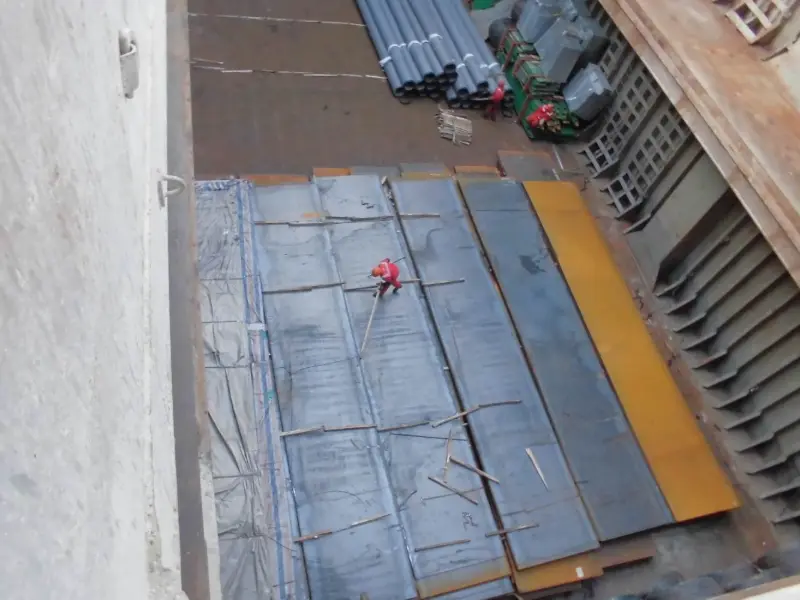
CCS Grade E Shipbuilding Steel Plate
CCS Grade E Shipbuilding Steel Plate – Composition, Properties & Equivalents
Detailed technical data sheet for CCS Grade E shipbuilding steel plate: chemical composition, mechanical and thermal physical properties, international equivalents, similar grades, and application guide.
Hot rolling, normalizing, TMCP, welding (preheating may be required for heavy sections)
- Phone : +8618037372205
- Email : [email protected]
- WhatsApp: Contact via Whtsapp
- WeChat: +8618037372205
CCS Grade E Shipbuilding Steel Plate Introduction
CCS Grade E is a normal-strength hull structural steel grade specified by the China Classification Society (CCS), primarily used in shipbuilding and offshore engineering. It corresponds to GB/T 712 Grade E. The steel is characterized by:
- Minimum yield strength of 235 MPa for plates up to 50 mm thickness
- Good notch toughness at low temperatures (KV₂ ≥ 27 J at -40°C)
- Weldability and formability suitable for major hull structural parts
- Available in normalized or thermomechanically controlled rolled (TMCP) condition
It satisfies requirements for essential ship structures such as shell plating, decks, and stiffeners in general merchant vessels.
CCS Grade E Shipbuilding Steel Plate Chemical Composition
Based on CCS rules and GB/T 712 standard for Grade E shipbuilding steel. Acid-soluble aluminum (Als) is required for grain refinement. Residual elements are controlled to ensure weldability and ductility. Nitrogen is limited when relevant to guarantee low-temperature toughness.
| Element | Standard Value | Remarks |
|---|---|---|
| C | ≤ 0.18 | Ladle analysis |
| Si | ≤ 0.50 | - |
| Mn | 0.70 – 1.40 | - |
| P | ≤ 0.035 | - |
| S | ≤ 0.035 | - |
| Als | ≥ 0.015 (acid soluble) | Or total Al ≥ 0.020; may be omitted if other grain-refining elements are present |
| Cr | ≤ 0.30 | Residual element |
| Ni | ≤ 0.30 | Residual element |
| Cu | ≤ 0.35 | Residual element |
| Mo | ≤ 0.10 | Residual element |
| N | ≤ 0.009 | Applicable when sufficient nitrogen-binding elements are not guaranteed |
CCS Grade E Shipbuilding Steel Plate Thermal and Electrical Physical Properties
These values are typical for carbon-manganese structural steel and are not mandatory requirements. They serve as engineering references for thermal analysis, weight estimation, and electrical applications.
| Property | Typical Value | Unit | Test Condition |
|---|---|---|---|
| Density (ρ) | 7.85 | g/cm³ | At room temperature |
| Modulus of elasticity (E) | 205 | GPa | At room temperature |
| Shear modulus (G) | 80 | GPa | At room temperature |
| Poisson's ratio (ν) | 0.3 | - | At room temperature |
| Thermal expansion coefficient (α) | 11.5 × 10⁻⁶ | /K | 20 – 100°C |
| Thermal conductivity (λ) | 52 | W/(m·K) | At 20°C |
| Specific heat capacity | 460 | J/(kg·K) | At 20°C |
| Electrical resistivity (ρₑ) | 0.16 × 10⁻⁶ | Ω·m | At 20°C |
CCS Grade E Shipbuilding Steel Plate Mechanical Properties
Tensile and impact test requirements are determined according to GB/T 712 and CCS rules. Multiple rows represent thickness-dependent values. Charpy V-notch impact test is carried out at -40°C, with minimum average absorbed energy specified for longitudinal and transverse specimens.
| Property | Standard Value | Unit | Test Condition |
|---|---|---|---|
| Yield Strength (ReH) | ≥ 235 | MPa | Plate thickness ≤ 50 mm (transverse) |
| Yield Strength (ReH) | ≥ 225 | MPa | 50 < thickness ≤ 100 mm |
| Yield Strength (ReH) | ≥ 215 | MPa | 100 < thickness ≤ 150 mm |
| Tensile Strength (Rm) | 400 – 520 | MPa | All thickness, transverse |
| Elongation after fracture (A) | ≥ 22 | % | Thickness ≤ 50 mm, gauge length 5.65√S₀ |
| Elongation after fracture (A) | ≥ 21 | % | 50 < thickness ≤ 70 mm |
| Elongation after fracture (A) | ≥ 20 | % | 70 < thickness ≤ 100 mm |
| Impact absorbed energy (KV₂) | ≥ 27 (longitudinal) | J | -40°C, Charpy V-notch, average of 3 specimens |
| Impact absorbed energy (KV₂) | ≥ 20 (transverse) | J | -40°C, Charpy V-notch |
| Bend test (bend angle 180°) | d = 3a | - | Thickness ≤ 50 mm, a = specimen thickness |
| Bend test (bend angle 180°) | d = 4a | - | 50 < thickness ≤ 100 mm |
CCS Grade E Shipbuilding Steel Plate Fully Equivalent Materials: Standards and Replaceable Grades
| Country / Region | Standard / Society | Grade | Remarks |
|---|---|---|---|
| International | American Bureau of Shipping (ABS) | ABS Grade E | Normal strength, same -40°C toughness level |
| Norway/Germany | DNV GL | DNV E | Identical application, yield 235 MPa |
| UK | Lloyd's Register (LR) | LR Grade E | Equivalent in all hull structural uses |
| France | Bureau Veritas (BV) | BV Grade E | Meets same chemical and mechanical criteria |
| Japan | ClassNK (NK) | NK Grade E | Aluminum-killed fine grain steel, equivalent |
| Korea | Korean Register (KR) | KR Grade E | Recognized as direct substitute |
| Italy | RINA | RINA Grade E | Same specification for shipbuilding |
CCS Grade E Shipbuilding Steel Plate Application Introduction
CCS Grade E steel plate is designed for welded structures in ships and offshore units. It can be formed into heavy and light sections and accepts all standard shipyard fabrication processes.
Key application areas include:
Product Applications: Hull shells and external plating, Main deck and inner bottom plates, Bulkhead and side shell stiffeners, Transverse frames and webs, Superstructure elements
Processed into products: Bottom and side shell plating, Weather and cargo deck plates, Longitudinal girders and stringers, Floor plates and intercostal members, Keel plates, Cofferdam and tank boundary bulkheads
Application industries: Shipbuilding (merchant vessels, tankers, bulk carriers, container ships), Offshore engineering (jack-up rigs, fixed platforms), Marine constructions (docks, locks, gates), Bridge fabrication (secondary structural members where toughness is required), Pressure vessel shells (when approved by relevant codes)
CCS Grade E Shipbuilding Steel Plate Similar / Substitute Materials Recommendations
| Country / Region | Standard | Grade | Remarks |
|---|---|---|---|
| China | CCS Rules / GB 712 | CCS AH32, DH32, EH32 | Higher strength (ReH ≥ 315 MPa), similar toughness; can replace Grade E with increased strength, but design review needed |
| Multiple | IACS unified requirements | UR W11 ordinary-strength grades A, B, D, E | All grades with same yield strength; E offers best low-temperature toughness; other grades (A, B, D) may be allowed depending on thickness and design temperature |
Notes:
Welding: Preheating is generally not required for thicknesses below 30 mm at ambient temperature, but low-hydrogen processes and appropriate heat input are recommended to ensure notch toughness. For thicker sections or low ambient temperatures, a minimum preheat of 50–100°C may be needed.
Supply condition: Plates are supplied with inspection certificates according to EN 10204 3.1 or equivalent CCS requirements. Surface condition and tolerances comply with the relevant standard.
Note on sub-zero service: Grade E is suitable for down to -40°C design temperature, making it a choice for ships operating in cold climates.
- Share



