
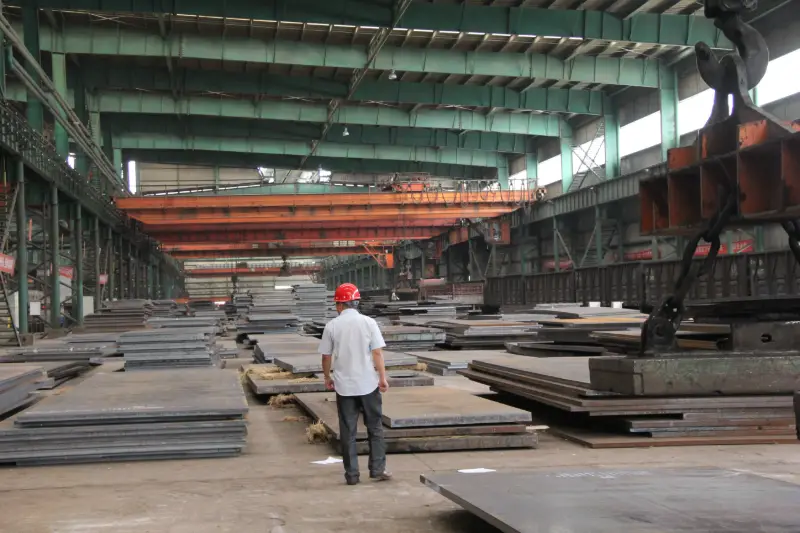
CCS Grade EQ56 Shipbuilding Steel Plate
CCS Grade EQ56 Shipbuilding Steel Plate: High-Strength Quenched & Tempered Marine Steel
Detailed material data for CCS Grade EQ56 shipbuilding steel plate, including chemical composition, mechanical properties, thermal & electrical properties, international equivalents, and application guidance.
Hot rolling, quenching & tempering, cutting (plasma, laser, waterjet), cold and hot forming, welding (SMAW, SAW, GMAW), bending, machining
- Phone : +8618037372205
- Email : [email protected]
- WhatsApp: Contact via Whtsapp
- WeChat: +8618037372205
CCS Grade EQ56 Shipbuilding Steel Plate Introduction
CCS Grade EQ56 is a high-strength quenched and tempered (Q&T) structural steel plate governed by the China Classification Society (CCS) rules for shipbuilding. With a minimum yield strength of 560 MPa, it belongs to the extra-high-strength series intended for critical structural applications in ship hulls and offshore engineering. Its fine-grained microstructure and alloy design provide an excellent combination of strength, toughness at low temperatures (down to -40°C), and good weldability when proper procedures are followed. The EQ56 designation indicates an E-grade (impact tested at -40°C) quenched and tempered steel with 560 MPa minimum yield strength. This grade is widely adopted in large container ships, bulk carriers, and offshore platforms where weight saving and high load-bearing capacity are essential.
CCS Grade EQ56 Shipbuilding Steel Plate Chemical Composition
The chemical composition of CCS EQ56 steel conforms to the requirements for high-strength quenched and tempered shipbuilding steel in the CCS Rules. The values are typical for the grade; precise ranges may be agreed between the steelmaker and the classification society.
- Carbon is kept low to ensure good weldability and toughness.
- Manganese and silicon provide solid-solution strengthening.
- Micro-alloying elements (Nb, V, Ti) refine the grain size, which significantly improves strength and low-temperature toughness.
- Residual elements such as Cu, Cr, Ni, Mo are present in limited amounts.
| Element | Standard Value (wt.%) | Remarks |
|---|---|---|
| C (Carbon) | ≤ 0.20 | Ladle analysis |
| Si (Silicon) | 0.10 – 0.55 | Ladle analysis |
| Mn (Manganese) | 0.90 – 1.70 | Ladle analysis |
| P (Phosphorus) | ≤ 0.025 | Ladle analysis |
| S (Sulfur) | ≤ 0.025 | Ladle analysis |
| Al (acid soluble) | ≥ 0.015 | Fine-grain practice |
| Nb (Niobium) | 0.02 – 0.05 | Optional grain refiner |
| V (Vanadium) | 0.05 – 0.10 | Optional grain refiner |
| Ti (Titanium) | 0.007 – 0.05 | Optional grain refiner |
| Cu (Copper) | ≤ 0.35 | Residual |
| Cr (Chromium) | ≤ 0.20 | Residual |
| Ni (Nickel) | ≤ 0.40 | Residual |
| Mo (Molybdenum) | ≤ 0.08 | Residual |
CCS Grade EQ56 Shipbuilding Steel Plate Thermal & Electrical Physical Properties
The following physical properties are representative for quenched and tempered structural steels similar to EQ56. They are not specified by the CCS Rules but are provided as engineering reference values. The actual properties may vary slightly depending on the exact chemical composition and heat treatment.
- Density is typical for carbon-manganese steel.
- Thermal expansion and conductivity values are given for room temperature to moderate elevated temperatures.
- Electrical resistivity is given at 20°C.
| Property | Typical Value | Unit | Test Conditions |
|---|---|---|---|
| Density (ρ) | 7850 | kg/m³ | 20°C |
| Modulus of Elasticity (E) | 210 | GPa | 20°C |
| Shear Modulus (G) | 80 | GPa | 20°C |
| Poisson's Ratio (ν) | 0.30 | – | 20°C |
| Thermal Expansion Coeff. (α) | 11.7 × 10⁻⁶ | K⁻¹ | 20 – 100°C |
| Thermal Conductivity (λ) | 45 | W/(m·K) | 20°C |
| Specific Heat Capacity (c) | 460 | J/(kg·K) | 20°C |
| Electrical Resistivity (ρ_e) | 0.22 × 10⁻⁶ | Ω·m | 20°C |
CCS Grade EQ56 Shipbuilding Steel Plate Mechanical Properties
The mechanical properties of CCS EQ56 steel plates are determined by tensile and impact tests in accordance with CCS Rules. The values below are for the specified thickness range and test direction. Note: Impact testing is performed at -40°C on Charpy V-notch specimens. The transverse impact energy requirement is 27 J minimum; the longitudinal requirement is 41 J minimum. Bending tests require a mandrel diameter of 3 times the specimen thickness (3a) with a 180° bend without cracking.
| Property | Required Value | Unit | Test Conditions |
|---|---|---|---|
| Yield Strength (ReH) | ≥ 560 | MPa | Thickness ≤ 50 mm, transverse |
| Tensile Strength (Rm) | 610 – 770 | MPa | Thickness ≤ 50 mm, transverse |
| Elongation (A) | ≥ 16 | % | Gauge length 5.65√S₀, transverse |
| Impact Energy (KV) | ≥ 27 | J | Charpy V, -40°C, transverse |
| Impact Energy (KV) | ≥ 41 | J | Charpy V, -40°C, longitudinal |
| Bend Test | 180° bend, no cracks | – | Mandrel diameter = 3 × thickness (3a), transverse |
CCS Grade EQ56 Shipbuilding Steel Plate Fully Equivalent Standards & Replaceable Grades
| Country/Region | Standard | Grade | Remarks |
|---|---|---|---|
| China | CCS | EQ56 | Quenched & tempered, -40°C impact |
| USA | ABS | EH56 | Equivalent to CCS EQ56 |
| Norway/Germany | DNV | E56 | Quenched & tempered, min. 560 MPa YS |
| UK | LR | EH56 | Equivalent grade |
| France | BV | EH56 | Equivalent grade |
| Japan | NK (ClassNK) | KE56 | Equivalent grade |
| Italy | RINA | E56 | Equivalent grade |
| Korea | KR | E56 | Equivalent grade |
CCS Grade EQ56 Shipbuilding Steel Plate Application Introduction
CCS EQ56 steel plate is predominantly used in the shipbuilding and offshore industry for components that require very high strength combined with excellent toughness and weldability. Quenching and tempering produce a fine-grained structure that guarantees reliability even at low temperatures. Common applications include:
Product Applications: Ship hull structural plates, Deck plates and sheer strakes, Hatch coaming and side frames, Crane pedestals and booms, Offshore module support structures
Processed into products: Longitudinal and transverse frames, Bulkheads and stringers, Bottom and bilge plates, Container cell guides, Bearing blocks and high-load brackets
Application industries: Shipbuilding (container vessels, bulk carriers, tankers, LNG carriers), Offshore engineering (jack-up rigs, semi-submersibles, platform decks), Heavy construction (crane booms, bridge girders), Pressure vessels and boilers (when approved by class), Mining and earth-moving equipment
CCS Grade EQ56 Shipbuilding Steel Plate Similar/Comparable Substitute Materials
| Country/Region | Standard | Grade | Remarks |
|---|---|---|---|
| EU | EN 10025-6 | S690QL | Higher strength (YS 690 MPa), similar Q&T concept; may be used where 690 MPa is accepted by class. |
| EU | EN 10025-6 | S620QL | YS 620 MPa, closer to EQ56 but still slightly higher strength. |
| International | API 2Y | Grade 60 | YS 414 MPa, lower strength; not a direct substitute but used in some offshore structures. |
Notes:
Welding: Preheating (typically 100–200°C) and post-weld heat treatment (PWHT) may be required depending on thickness and service conditions. Low-hydrogen welding consumables must be used. Forming: Cold forming of Q&T steels requires careful control of the bend radius to avoid cracking. Hot forming must avoid overheating that could alter the tempered microstructure. Inspection: Ultrasonic testing per CCS requirements is mandatory for EQ56 plates above a certain thickness.
- Share



