
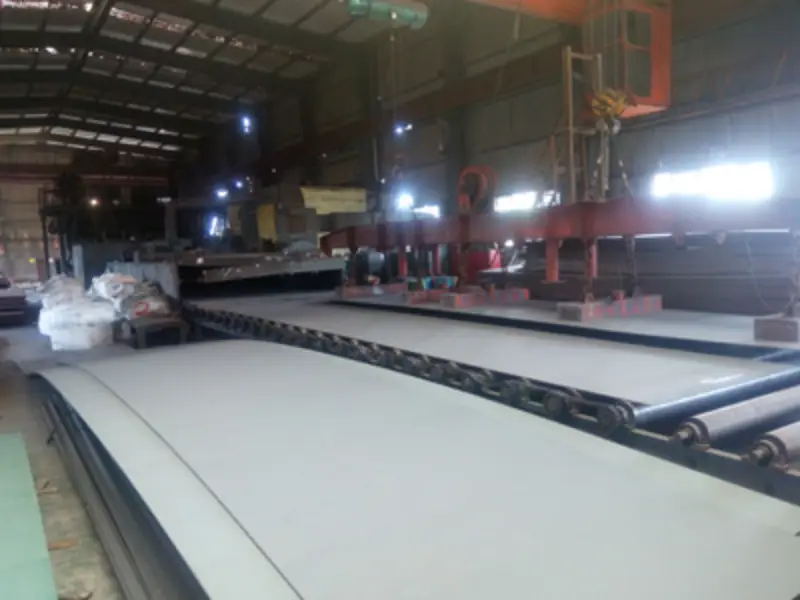
LR Grade D Shipbuilding Steel Plate
LR Grade D Shipbuilding Steel Plate - Material Properties and Equivalents
Complete technical data for LR Grade D shipbuilding steel plate according to Lloyd's Register rules, including chemical composition, mechanical properties, thermal and electrical physical properties, full international equivalents, and application guidance.
Hot rolling, normalizing, normalizing rolling, thermomechanical controlled processing (TMCP), welding, cold forming (limited), cutting
- Phone : +8618037372205
- Email : [email protected]
- WhatsApp: Contact via Whtsapp
- WeChat: +8618037372205
LR Grade D Shipbuilding Steel Plate Introduction
LR Grade D is a normal-strength hull structural steel certified by Lloyd's Register (LR). It is widely used in shipbuilding and offshore engineering due to its good weldability, excellent toughness at low temperatures, and reliable strength. The grade requires Charpy V-notch impact testing at -20°C, ensuring ductile behaviour in cold environments. Typical delivery condition is hot-rolled, normalised, or thermomechanically rolled, depending on thickness and client specification. This carbon-manganese steel complies with the IACS UR W11 requirements and is fully equivalent to Grade D steels of other major classification societies, making it a standard choice for hull plating, decks, bulkheads, and structural members.
LR Grade D Shipbuilding Steel Plate Chemical Composition
The chemical composition of LR Grade D steel complies with Lloyd's Register Rules and IACS UR W11. It is a fully killed, fine-grained steel typically treated with aluminium or other grain-refining elements. Residual elements are controlled to ensure good weldability and toughness. Values are maximum unless a range or minimum is indicated.
| Element | Standard Value | Remarks |
|---|---|---|
| Carbon (C) | ≤ 0.21 | max |
| Silicon (Si) | ≤ 0.50 | max |
| Manganese (Mn) | ≥ 2.5 × C* (typical 0.60 – 1.40) | min. requirement; actual range depends on thickness and mill practice |
| Phosphorus (P) | ≤ 0.035 | max |
| Sulfur (S) | ≤ 0.035 | max |
| Aluminium (acid soluble Al) | ≥ 0.015 | min; when aluminium is used as grain refiner |
| Copper (Cu) | ≤ 0.35 | residual, max |
| Chromium (Cr) | ≤ 0.20 | residual, max |
| Nickel (Ni) | ≤ 0.40 | residual, max |
| Molybdenum (Mo) | ≤ 0.08 | residual, max |
LR Grade D Shipbuilding Steel Plate Thermal and Electrical Physical Properties
The following physical properties are typical for carbon-manganese structural steels and can be used for design calculations. They are not specific requirements of the LR Grade D standard but are representative values at room temperature unless stated otherwise. Variations may occur depending on exact composition and heat treatment condition.
| Property | Standard Value | Unit | Test Condition / Temperature |
|---|---|---|---|
| Density (ρ) | 7.85 | g/cm³ | at 20°C |
| Modulus of Elasticity (E) | 205 – 210 | GPa | at 20°C, static |
| Shear Modulus (G) | ≈ 80 | GPa | at 20°C, calculated from E and ν |
| Poisson's Ratio (ν) | 0.29 – 0.30 | – | at 20°C, elastic range |
| Thermal Expansion Coefficient (α) | 11.5 – 12.5 | 10⁻⁶/K | 20 – 100°C |
| Thermal Conductivity (λ) | 50 – 52 | W/(m·K) | at 20°C |
| Specific Heat Capacity (cp) | 0.46 – 0.48 | kJ/(kg·K) | at 20°C |
| Electrical Resistivity (ρe) | 0.20 – 0.25 | Ω·mm²/m | at 20°C |
LR Grade D Shipbuilding Steel Plate Mechanical Properties
Mechanical properties are determined in accordance with Lloyd's Register testing procedures. Specimens are taken in the longitudinal direction unless otherwise agreed. Impact tests are performed on Charpy V-notch specimens at -20°C. For plates of thickness greater than 100 mm, properties may be specially agreed.
| Property | Standard Requirement | Unit | Test Condition |
|---|---|---|---|
| Yield Strength (ReH) | ≥ 235 | MPa | thickness ≤ 100 mm, transverse or longitudinal |
| Tensile Strength (Rm) | 400 – 520 | MPa | thickness ≤ 100 mm |
| Elongation (A5) | ≥ 22 | % | thickness ≤ 50 mm, gauge length 5.65√So |
| Elongation (A5) | ≥ 21 | % | thickness > 50 mm ≤ 70 mm |
| Elongation (A5) | ≥ 20 | % | thickness > 70 mm ≤ 100 mm |
| Charpy Impact Energy (KV2) | ≥ 27 (average) / ≥ 20 (individual) | J | longitudinal, -20°C, standard 10×10 mm specimen |
| Bend Test | No cracks or defects | – | bend angle 180°, former diameter 3t (t = specimen thickness), for thickness ≤ 100 mm |
LR Grade D Shipbuilding Steel Plate Exact Equivalent Material Standards and Alternative Designations
| Country / Region | Standard / Classification Society | Grade / Designation | Remarks |
|---|---|---|---|
| International | IACS UR W11 | Grade D | Unified Requirement for normal-strength hull structural steel |
| USA | ABS (American Bureau of Shipping) | ABS Grade D | Fully equivalent |
| France | BV (Bureau Veritas) | BV Grade D | Fully equivalent |
| Norway / Germany | DNV (Det Norske Veritas) | DNV Grade D | Fully equivalent |
| China | CCS (China Classification Society) | CCS D | Fully equivalent |
| South Korea | KR (Korean Register) | KR Grade D | Fully equivalent |
| Japan | NK (Nippon Kaiji Kyokai) | NK Grade D | Fully equivalent |
| Italy | RINA (Registro Italiano Navale) | RINA Grade D | Fully equivalent |
| India | IRS (Indian Register of Shipping) | IRS Grade D | Fully equivalent |
| USA | ASTM A131/A131M | Grade D | Standard specification for structural steel for ships, equivalent normal-strength grade |
LR Grade D Shipbuilding Steel Plate Application Introduction
LR Grade D steel plate is primarily designed for marine and offshore structural applications. Its balanced strength, good weldability, and assured low-temperature impact toughness make it a reliable material for hull construction, decks, and critical members. It can be processed with all common fabrication techniques and is readily available from major mills worldwide. Typical components include:
Product Applications: Ship shell plates and stiffeners, Main deck and inner bottom plating, Transverse and longitudinal bulkheads, Web frames, brackets, and floors, Hull girders and stringers, Offshore platform topsides and helideck structures
Processed into products: Hull side and bottom plates, Keel and skeg components, Watertight doors and hatches, Engine room structures and foundations, Mast house and deck house panels, Stiffening ribs and web frames, Transition piece shells for monopile foundations
Application industries: Shipbuilding (merchant vessels, naval ships, tugs, barges), Offshore oil & gas (jack-up rigs, platform structures, FPSO modules), Marine engineering (harbour structures, lock gates, mooring equipment), Bridge construction (where class-approved steel is specified), Renewable energy (offshore wind turbine foundations, transition pieces)
LR Grade D Shipbuilding Steel Plate Similar or Alternative Materials with Comparable Performance
| Country / Region | Standard / Specification | Grade / Designation | Remarks |
|---|---|---|---|
| UK (LR) | Lloyd's Register Rules | LR Grade B | Lower impact toughness (0°C test); otherwise similar strength and weldability; may substitute if cold-temperature toughness is less critical. |
| UK (LR) | Lloyd's Register Rules | LR Grade E | Higher toughness (-40°C test); superior low-temperature performance; often used in critical structures or thicker sections; slight price premium. |
| International | EN 10025-2 | S235J2 | Structural steel with 235 MPa min yield and -20°C impact; not class-approved for shipbuilding; similar mechanical properties but different deoxidation practice and certification. |
| International | ISO 630-2 | S235D | Comparative steel with impact test at -20°C; used in structural fabrication; does not carry marine classification society approval. |
| USA | ASTM A36 | A36 | Common structural steel with 250 MPa yield; impact not guaranteed; may be considered for non-critical structural parts but is not a direct substitute for shipbuilding grade. |
Notes:
Welding: LR Grade D has excellent weldability with all common processes (SMAW, SAW, GMAW, FCAW). Preheating is generally not required for moderate thickness (<50 mm), but low-hydrogen practices and suitable consumables are recommended. Forming: Can be cold bent within limits specified by the class society; hot forming may require subsequent normalising. Corrosion protection: Standard marine coating systems and cathodic protection are compatible. Certification: Products are delivered with Lloyd's Register inspection certificate (3.2 certificate) or equivalent class society documentation as per order requirements.
- Share



