
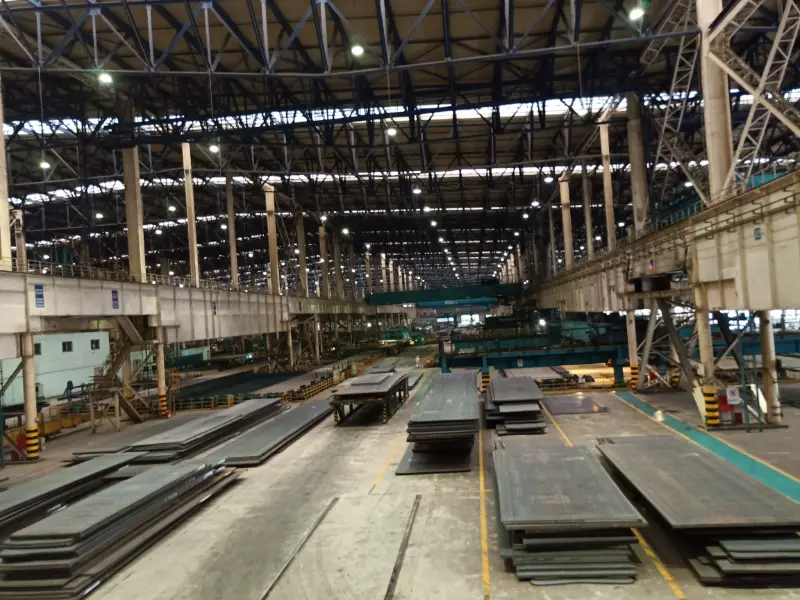
ASTM A131 Grade FH40 Steel
ASTM A131 Grade FH40 Steel: Superior Toughness for Arctic-Class Shipbuilding
ASTM A131 Grade FH40 is a high-strength shipbuilding steel with yield strength ≥390 MPa and excellent Charpy impact toughness at -60°C, ideal for hull structures and offshore platforms in cold regions.
Hot rolling, TMCP (Thermo-Mechanical Control Process), Normalizing
- Phone : +8618037372205
- Email : [email protected]
- WhatsApp: Contact via Whtsapp
- WeChat: +8618037372205
ASTM A131 Grade FH40 Steel Introduction
ASTM A131 Grade FH40 is a normalized or thermo-mechanically control processed (TMCP) high-strength steel plate for shipbuilding and marine applications. It is designed to provide a minimum yield strength of 390 MPa and excellent low-temperature toughness, with Charpy V-notch impact testing performed at -60°C. This grade belongs to the FH series of the ASTM A131/A131M standard, where 'F' indicates the impact test temperature (-60°C) and '40' denotes the minimum yield strength in ksi. The steel offers good weldability and formability, making it suitable for critical structural components in ships, offshore platforms, and Arctic-service vessels. It is typically supplied in plate form with thicknesses up to 100 mm. Typical delivery conditions include TMCP or normalizing, ensuring fine grain structure and consistent mechanical properties.
ASTM A131 Grade FH40 Steel Chemical Composition
Chemical composition limits as per ASTM A131/A131M for Grade FH40. The steel is fully killed and fine-grain treated.
- Carbon equivalent (Ceq) typically ≤ 0.40% to ensure good weldability.
- Aluminium or other grain-refining elements are added to achieve fine austenite grain size.
- Residual elements such as Cr, Ni, Mo, Cu are controlled to maintain toughness.
| Element | Standard Value (max, min) | Remarks |
|---|---|---|
| Carbon (C) | ≤ 0.18 | Ladle analysis |
| Manganese (Mn) | 0.90 – 1.60 | Ladle analysis |
| Silicon (Si) | ≤ 0.50 | Ladle analysis |
| Phosphorus (P) | ≤ 0.035 | Ladle analysis |
| Sulfur (S) | ≤ 0.035 | Ladle analysis |
| Aluminium (Al total) | ≥ 0.015 | Acid soluble or total |
| Chromium (Cr) | ≤ 0.20 | Residual |
| Nickel (Ni) | ≤ 0.40 | Residual |
| Molybdenum (Mo) | ≤ 0.08 | Residual |
| Copper (Cu) | ≤ 0.35 | Residual |
| Niobium (Nb) | 0.02 – 0.05 * | Microalloy (optional) |
| Vanadium (V) | 0.05 – 0.10 * | Microalloy (optional) |
| Titanium (Ti) | 0.007 – 0.05 * | Microalloy (optional) |
| Nb+V+Ti | ≤ 0.12 | If added |
| Carbon Equivalent (Ceq) | ≤ 0.40 ** | Based on IIW formula |
ASTM A131 Grade FH40 Steel Thermal and Electrical Physical Properties
Physical properties are typical for carbon-manganese structural steels and are not specifically mandated by ASTM A131. Values can be used for engineering calculations. Note: Properties may vary slightly with temperature and manufacturing process.
| Property | Typical Value | Unit | Test Condition |
|---|---|---|---|
| Density (ρ) | 7850 | kg/m³ | At 20°C |
| Elastic Modulus (E) | 205 | GPa | At 20°C |
| Shear Modulus (G) | 80 | GPa | At 20°C |
| Poisson's Ratio (ν) | 0.3 | – | At 20°C |
| Thermal Expansion Coefficient (α) | 12.5 × 10⁻⁶ | /K | 20°C – 100°C |
| Thermal Conductivity (λ) | 47 | W/(m·K) | At 20°C |
| Specific Heat Capacity (c) | 480 | J/(kg·K) | At 20°C |
| Electrical Resistivity (ρₑ) | 0.16 × 10⁻⁶ | Ω·m | At 20°C |
ASTM A131 Grade FH40 Steel Mechanical Properties
Mechanical properties according to ASTM A131/A131M. Yield and tensile strengths are valid for transverse test pieces. Elongation is measured on 8 in. (200 mm) or 2 in. (50 mm) gauge length. Impact testing with Charpy V-notch specimens is required at -60°C. Bend test: 180° bending with mandrel diameter = 3t (t = specimen thickness) shall show no cracks.
| Property | Required Value | Unit | Test Condition |
|---|---|---|---|
| Yield Strength (ReH) | ≥ 390 | MPa | Plate thickness ≤ 50 mm |
| Yield Strength (ReH) | ≥ 380 | MPa | 50 mm < thickness ≤ 70 mm |
| Yield Strength (ReH) | ≥ 370 | MPa | 70 mm < thickness ≤ 100 mm |
| Tensile Strength (Rm) | 510 – 650 | MPa | All thicknesses |
| Elongation (A) – 8 in. gauge | ≥ 20 | % | Thickness ≤ 50 mm |
| Elongation (A) – 8 in. gauge | ≥ 19 | % | 50 mm < thickness ≤ 70 mm |
| Elongation (A) – 8 in. gauge | ≥ 18 | % | 70 mm < thickness ≤ 100 mm |
| Elongation (A) – 2 in. gauge | ≥ 23 | % | Thickness ≤ 50 mm |
| Elongation (A) – 2 in. gauge | ≥ 22 | % | 50 mm < thickness ≤ 70 mm |
| Elongation (A) – 2 in. gauge | ≥ 21 | % | 70 mm < thickness ≤ 100 mm |
| Charpy Impact Energy (KV₂, longitudinal) | ≥ 27 | J | -60°C |
| Charpy Impact Energy (KV₂, transverse) | ≥ 20 | J | -60°C |
| Bend Test | 180° no cracks | – | Mandrel diameter = 3t |
ASTM A131 Grade FH40 Steel Exact Equivalent Grades by Other Classification Societies
| Country / Region | Standard | Grade | Remarks |
|---|---|---|---|
| International | IACS UR W11 | FH40 | Same mechanical requirements |
| USA | ASTM A131/A131M | FH40 | Original specification |
| United Kingdom | Lloyd's Register | FH40 | Recognized equivalent |
| Norway/Germany | DNV GL | F40 | Equivalent ship steel grade |
| France | Bureau Veritas | FH40 | Equivalent ship steel grade |
| Italy | RINA | FH40 | Equivalent ship steel grade |
| China | CCS | FH40 | Equivalent ship steel grade |
| Japan | Nippon Kaiji Kyokai (ClassNK) | KFH40 | Equivalent ship steel grade |
| USA | ABS | FH40 | Equivalent ship steel grade |
ASTM A131 Grade FH40 Steel Application Introduction
ASTM A131 FH40 steel is specifically designed for the shipbuilding and offshore industry, especially for structures operating in low-temperature environments. It is extensively used in vessels navigating polar or ice-class waters. The steel can be cut, cold formed, and welded using conventional methods with appropriate preheating and consumables. Its fine grain structure ensures reliable performance under dynamic and static loading. Post-weld heat treatment is generally not required for thicknesses up to 50 mm when proper procedures are followed.
Product Applications: Hull shell plates, Deck plates, Bulkheads and watertight doors, Superstructure frames, Offshore platform primary structural members
Processed into products: Bottom and side shell plates, Strength deck stringers and web frames, Keel and bilge strakes, Stiffeners and longitudinals, Hatch coamings and girders, Column and pontoon structures for semi-submersibles
Application industries: Shipbuilding (Polar-class vessels, tankers, bulk carriers, container ships), Offshore Oil & Gas (Jack-up rigs, semi-submersibles, FPSO hulls), Marine Engineering (Docks, piers, lock gates), Renewable Energy (Offshore wind turbine foundations, transition pieces)
ASTM A131 Grade FH40 Steel Similar and Alternative Materials
| Country / Region | Standard | Grade | Remarks |
|---|---|---|---|
| USA | ASTM A131/A131M | EH40 | Same strength (390 MPa), but impact test at -40°C instead of -60°C; less stringent low-temperature toughness. |
| USA | ASTM A131/A131M | DH40 | Same strength, impact test at -20°C; suitable for less severe cold environments. |
| USA | ASTM A131/A131M | AH40 | Same strength, impact test at 0°C; general shipbuilding grade. |
| USA | ASTM A131/A131M | FH36 | Lower yield strength (355 MPa), but same -60°C toughness; can be used where strength requirements are lower. |
| Europe | EN 10025-6 | S420ML/S420MLO | Quenched and tempered structural steel with similar strength and low-temperature toughness; may require qualification for marine use. |
| International | IACS UR W11 | EH40 | Direct equivalent of EH40; for less critical low-temperature applications. |
Notes:
- All mechanical tests must be witnessed by the classification society surveyor if required for certification.
- Steel plates are usually supplied with mill test certificates (EN 10204 3.1 or 3.2).
- Welding consumables must be matched to achieve equivalent toughness at the design temperature.
- Surface condition and dimensional tolerances comply with ASTM A20/A20M or classification society rules.
- Ultrasonic testing per ASTM A578/A578M can be specified for critical applications.
- Share



