
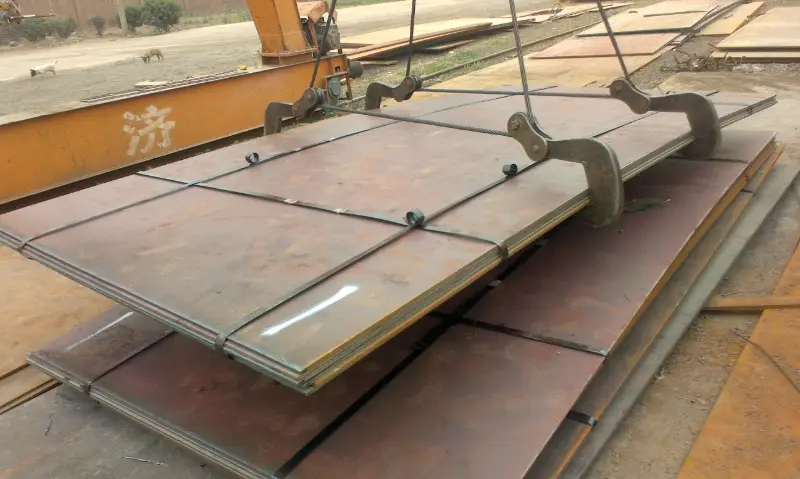
CCS Grade A Shipbuilding Steel Plate
CCS Grade A Shipbuilding Steel Plate – Full Technical Data & Equivalents
Complete technical reference for CCS Grade A shipbuilding steel: chemical composition, mechanical & physical properties, international equivalents, and applications in ship structures.
Hot rolling, controlled rolling, normalizing (optional), cutting, bending, welding
- Phone : +8618037372205
- Email : [email protected]
- WhatsApp: Contact via Whtsapp
- WeChat: +8618037372205
CCS Grade A Shipbuilding Steel Plate Introduction
CCS Grade A is a normal-strength shipbuilding structural steel certified by the China Classification Society (CCS). It is the most widely used grade in marine construction, designed for primary hull structures, decks, and bulkheads. This steel offers reliable weldability, good formability, and adequate toughness at ambient temperatures.
- Minimum yield strength: 235 MPa
- Tensile strength range: 400–520 MPa
- Delivery condition: as-hot-rolled or controlled-rolled, no impact testing mandatory
- Applicable thickness generally up to 50 mm for grade A
It complies with CCS Rules for Materials and Welding, and is equivalent to other major classification society Grade A steels.
CCS Grade A Shipbuilding Steel Plate Chemical Composition
The following table lists the ladle analysis requirements according to CCS Rules. Manganese content must satisfy Mn ≥ 2.5 × C%. In practice, mills typically supply Mn in the range 0.60–1.20% for Grade A. Residual elements such as Cu, Cr, Ni, Mo are not specified but constrained by the carbon equivalent requirement (≤0.38% CE if applicable).
| Element | Specified Value (%) | Remarks |
|---|---|---|
| C (Carbon) | ≤ 0.21 | Maximum |
| Mn (Manganese) | ≥ 2.5 × C | No upper limit; typical supply 0.60–1.20 |
| Si (Silicon) | ≤ 0.50 | Maximum |
| P (Phosphorus) | ≤ 0.035 | Maximum |
| S (Sulfur) | ≤ 0.035 | Maximum |
CCS Grade A Shipbuilding Steel Plate Thermal and Electrical Physical Properties
The values below are typical for carbon‑manganese structural steels similar to CCS Grade A. They are not mandatory but provide useful engineering data for design, welding, and thermal simulation. These properties are valid at room temperature unless otherwise noted.
| Property | Typical Value | Unit | Test Conditions |
|---|---|---|---|
| Density (ρ) | 7.85 | g/cm³ | Room temperature |
| Elastic Modulus (E) | 205 | GPa | Room temperature |
| Shear Modulus (G) | 80 | GPa | Room temperature |
| Poisson's Ratio (ν) | 0.29 – 0.30 | Room temperature | |
| Thermal Expansion (α) | 11.7 × 10⁻⁶ | K⁻¹ | 20–100 ℃ |
| Thermal Conductivity (λ) | 50 – 55 | W/(m·K) | Room temperature |
| Specific Heat Capacity | 0.49 | J/(g·K) | Room temperature |
| Electrical Resistivity (ρ_e) | 0.15 × 10⁻⁶ | Ω·m | Room temperature |
CCS Grade A Shipbuilding Steel Plate Mechanical Properties
Mechanical properties are derived from the CCS Rules for normal-strength Grade A steel plates. No Charpy impact test is mandatory for Grade A, regardless of thickness. The values below apply to plate thickness ≤ 50 mm. For greater thicknesses, slight modifications in yield and tensile requirements may apply; consult the full standard.
| Property | Specified Value | Unit | Test Conditions |
|---|---|---|---|
| Yield Strength (ReH) | ≥ 235 | MPa | Thickness ≤ 50 mm, transverse, room temperature |
| Tensile Strength (Rm) | 400 – 520 | MPa | Thickness ≤ 50 mm, transverse, room temperature |
| Elongation (A) | ≥ 22 | % | Gauge length 5.65√So, thickness ≤ 50 mm |
| Bend Test | 180°, no cracks | Bend diameter d = 2a (a = specimen thickness) | |
| Impact Energy (KV) | No requirement | J | Grade A exempted from impact testing per CCS Rules |
CCS Grade A Shipbuilding Steel Plate Fully Equivalent Standards & Substitutable Grades
| Country / Region | Standard | Grade | Remarks |
|---|---|---|---|
| United Kingdom | LR Rules | Grade A | Identical chemical and mechanical requirements |
| France | BV Rules | Grade A | Identical chemical and mechanical requirements |
| Norway / International | DNV Rules | Grade A | Identical chemical and mechanical requirements |
| USA | ABS Rules | Grade A | Identical chemical and mechanical requirements |
| Japan | NK Rules | Grade A | Identical chemical and mechanical requirements |
| South Korea | KR Rules | Grade A | Identical chemical and mechanical requirements |
| Italy | RINA Rules | Grade A | Identical chemical and mechanical requirements |
CCS Grade A Shipbuilding Steel Plate Application Introduction
CCS Grade A steel is the baseline material for ship hull construction. Its moderate strength and good ductility make it suitable for a wide range of structural components that are not subjected to low-temperature impact or high cyclic loads. It is easily formed, welded, and machined using standard shipyard practices.
Product Applications: Hull plates (side shell, bottom, deck plating), Ship frames, stiffeners, and beams, Bulkheads and transverse watertight divisions, Deckhouses and superstructure plating, Offshore container frames and module supports
Processed into products: Cut-to-size plates for shell and deck sections, Longitudinal and transverse stiffeners (flat bars, bulb profiles), Welded H-beams and T-beams for ship frames, Bracket and gusset plates, Masts and rudder stock supports (where toughness not critical)
Application industries: Marine shipbuilding (commercial vessels, naval auxiliary ships), Offshore engineering (platform superstructures, living quarters), Port machinery (crane booms, gantry frames), Infrastructure (bridges, lock gates), General structural engineering (non-critical welded structures)
CCS Grade A Shipbuilding Steel Plate Similar / Nearby Substitute Materials
| Country / Region | Standard | Grade | Remarks |
|---|---|---|---|
| China | GB 712 | Q235B (ship use) | Yield strength 235 MPa; may require additional impact testing; not fully equivalent for marine classification unless certified |
| All IACS members | IACS UR W11 | Grade B | Higher Mn and C limits; mandatory impact testing at 0 ℃, otherwise close mechanical properties |
Notes:
- When ordering, the thickness tolerance and surface quality should conform to CCS Rules or an agreed standard (e.g., EN 10029, ASTM A6).
- For cold-forming applications, a bending radius of at least 2t is recommended to avoid cracking.
- Welding consumables should match the base steel: E4313/E7016 for SMAW, ER70S-6 for GMAW. Preheat is normally not required for thicknesses below 30 mm at room temperature.
- If improved toughness or through-thickness properties are required, consider upgrading to Grade B or D steel, or specify Z-grade (Z25, Z35).
- Share



