
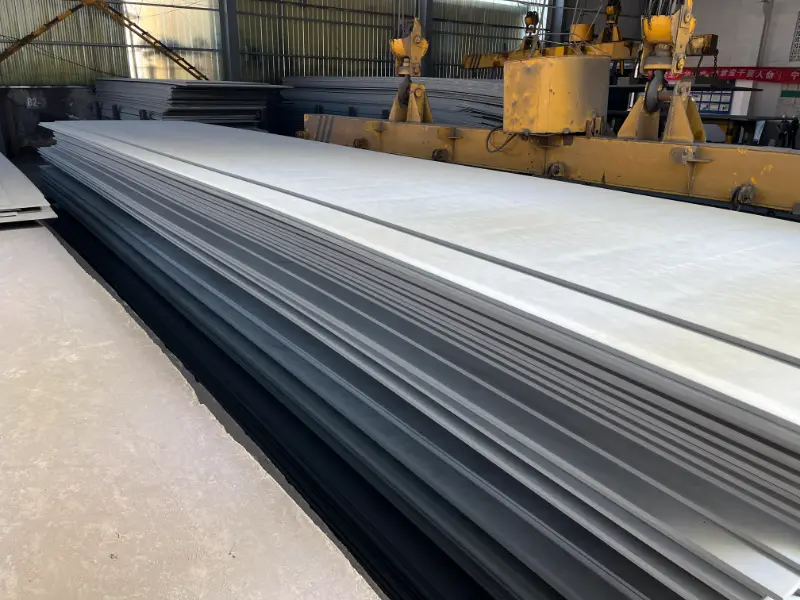
CCS Grade B Shipbuilding Steel Plate
CCS Grade B Shipbuilding Steel Plate - Properties, Equivalents & Applications
Detailed data for CCS Grade B shipbuilding steel plate covering chemical composition, mechanical and physical properties, international equivalents, and application guidance.
Hot rolling, normalising, thermo-mechanical controlled processing (TMCP); suitable for cold forming, bending, and welding
- Phone : +8618037372205
- Email : [email protected]
- WhatsApp: Contact via Whtsapp
- WeChat: +8618037372205
CCS Grade B Shipbuilding Steel Plate Introduction
CCS Grade B is a general-strength hull structural steel plate certified by the China Classification Society (CCS). It is a mild carbon steel with a minimum yield strength of 235 MPa and is widely used for ship hulls, decks, and structural components. Key features:
- Good weldability and toughness at 0°C
- Delivered in normalised or thermo-mechanically rolled condition
- Complies with CCS Rules and equivalent to GB 712 Grade B and other IACS classification society grades
This steel grade is suitable for moderate-temperature marine environments and is produced with controlled chemistry to ensure consistent mechanical properties.
CCS Grade B Shipbuilding Steel Plate Chemical Composition
The chemical composition conforms to CCS Rules and GB 712-2011 for general-strength hull structural steel Grade B. The steel is fully killed with aluminium as grain refiner. Residual elements are controlled to ensure weldability. Note: For thicknesses ≤50 mm, Mn may be adjusted to maintain strength.
- Als (acid soluble aluminium)≥0.015% is required for grain refinement.
- Carbon equivalent (CEV) is typically ≤0.38% for good weldability.
| Element | Standard Value (%) | Remarks |
|---|---|---|
| Carbon (C) | ≤0.21 | Ladle analysis; CEV typically ≤0.38 |
| Manganese (Mn) | 0.60 – 1.00 | For thickness ≤50 mm; Mn ≥2.5×C is maintained |
| Silicon (Si) | ≤0.35 | Deoxidation element |
| Phosphorus (P) | ≤0.035 | Maximum |
| Sulfur (S) | ≤0.035 | Maximum |
| Aluminium (Al, acid soluble) | ≥0.015 | Or total Al ≥0.020 for fine grain practice |
| Chromium (Cr) | ≤0.20 | Residual element |
| Nickel (Ni) | ≤0.40 | Residual element |
| Copper (Cu) | ≤0.35 | Residual element |
| Molybdenum (Mo) | ≤0.08 | Residual element |
| Nitrogen (N) | ≤0.012 | Maximum for fully killed steel |
| Others (V, Nb, Ti) | Trace (optional) | May be added for grain refinement; not mandatory for Grade B |
CCS Grade B Shipbuilding Steel Plate Thermal and Electrical Physical Properties
These physical properties are typical for carbon steel similar to CCS Grade B and are provided for design calculations. They may vary slightly depending on exact composition and heat treatment.
- Density is based on standard construction steel.
- Thermal conductivity decreases with increasing alloy content.
| Property | Typical Value | Unit | Test Conditions |
|---|---|---|---|
| Density (ρ) | 7.85 | g/cm³ | Room temperature |
| Modulus of Elasticity (E) | 205 – 210 | GPa | Room temperature |
| Shear Modulus (G) | ~80 | GPa | Room temperature |
| Poisson's Ratio (ν) | 0.30 | – | Room temperature |
| Thermal Expansion Coefficient (α) | 11.5 × 10⁻⁶ | /K | 20 – 100°C |
| Thermal Conductivity (λ) | ~52 | W/(m·K) | At 100°C |
| Specific Heat Capacity | ~460 | J/(kg·K) | Room temperature |
| Electrical Resistivity (ρₑ) | ~0.15 × 10⁻⁶ | Ω·m | Room temperature |
CCS Grade B Shipbuilding Steel Plate Mechanical Properties
These values are obtained from tensile and impact testing as per CCS Rules and GB 712. The properties apply to plate thicknesses ≤50 mm. Impact testing is performed on longitudinal Charpy V-notch specimens at 0°C.
- Yield strength (ReH) minimum 235 MPa for all thicknesses.
- Bend tests are performed without cracking.
| Property | Standard Requirement | Unit | Test Conditions |
|---|---|---|---|
| Yield Strength (ReH) | ≥235 | MPa | Ambient temperature, all thicknesses ≤50 mm |
| Tensile Strength (Rm) | 400 – 520 | MPa | Ambient temperature |
| Elongation (A) | ≥22 | % | Gauge length 5.65√S₀ |
| Charpy Impact (KV₂) | ≥27 | J | Longitudinal, 0°C; min individual value 20 J |
| Bend Test (d=2a) | No cracks | – | Thickness ≤20 mm, 180° bending, d = 2a |
| Bend Test (d=3a) | No cracks | – | Thickness >20 mm, 180° bending, d = 3a |
CCS Grade B Shipbuilding Steel Plate Fully Equivalent Material Standards and Substitution Grades
| Country / Region | Standard | Grade | Remarks |
|---|---|---|---|
| China | GB 712-2011 | B | Identical to CCS Grade B |
| International (IACS) | IACS UR W11 | B | Common grade recognised by all IACS members |
| USA | ABS Rules | ABS Grade B | Same chemical and mechanical requirements |
| France | BV Rules | BV Grade B | Interchangeable |
| Norway/Germany | DNV Rules | DNV Grade B | Interchangeable |
| Germany | GL Rules | GL Grade B | Interchangeable; now part of DNV |
| UK | LR Rules | LR Grade B | Interchangeable |
| Japan | NK Rules | NK Grade B | Interchangeable |
| Italy | RINA Rules | RINA Grade B | Interchangeable |
| South Korea | KR Rules | KR Grade B | Interchangeable |
| Russia | RS Rules | RS Grade B | Interchangeable |
CCS Grade B Shipbuilding Steel Plate Application Introduction
CCS Grade B is designed for marine and offshore applications requiring good toughness at 0°C. It is commonly used in the following industries and products. Welding is performed with low-hydrogen electrodes or processes; preheating may be required for thicker sections. Forming and machining are similar to other mild steels.
Product Applications: Hull side shells and bottom plates, Deck plates and hatch coamings, Bulkheads and watertight doors, Superstructure panels, Offshore structural modules
Processed into products: Ship hull plates (longitudinal and transverse framing), Stiffeners and brackets, Deck girders and beams, Bulkhead stiffeners and girders, Keel plates
Application industries: Shipbuilding and repair, Offshore oil & gas platforms, Port and harbour construction, Barge and floating crane manufacturing, Marine renewable energy (wind turbine foundations)
CCS Grade B Shipbuilding Steel Plate Similar or Closely Matching Substitute Materials
| Country / Region | Standard | Grade | Remarks |
|---|---|---|---|
| USA | ASTM A131/A131M | Grade B | Chemistry slightly different but similar mechanical properties; also a hull steel |
| EU | EN 10025-2 | S235JR | Structural carbon steel with comparable yield (235 MPa) but no marine certification |
| China | GB/T 700 | Q235B | Similar strength but lacks mandatory impact at 0°C and marine approval |
| Japan | JIS G 3101 | SS400 | Approximate strength; not specifically for shipbuilding |
| International | ISO 630-2 | S235B | Structural steel with similar yield but no ship classification |
Notes:
- Material must be supplied with a CCS surveyor's certificate or a manufacturer's release note endorsed by CCS.
- Ultrasonic testing (UT) can be specified according to CCS requirements for critical applications.
- Steel may be delivered in normalised condition (N) or thermo-mechanically rolled (M). TMCP plates offer better weldability and toughness.
- The CEV (carbon equivalent) should be ≤0.38% for plates ≤50 mm to ensure good weldability without cracking.
- Share



