
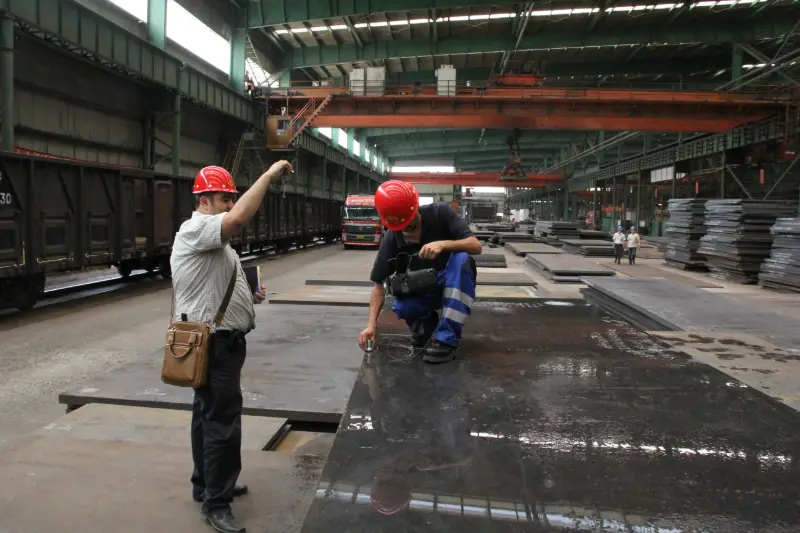
ABS Grade EQ63 Shipbuilding Steel Plate
ABS Grade EQ63 Shipbuilding Steel Plate - High-Strength Quenched & Tempered Steel
Complete material data for ABS Grade EQ63 shipbuilding steel plate: chemical composition, mechanical and physical properties, international equivalent grades, and application guide.
Hot rolling, controlled rolling, normalizing, quenching and tempering, welding
- Phone : +8618037372205
- Email : [email protected]
- WhatsApp: Contact via Whtsapp
- WeChat: +8618037372205
ABS Grade EQ63 Shipbuilding Steel Plate Introduction
ABS Grade EQ63 is a high-strength quenched and tempered steel plate specified by the American Bureau of Shipping (ABS) for shipbuilding and offshore constructions. With a minimum yield strength of 620 MPa and good low-temperature toughness, it is designed for critical structural members subjected to high stress. Typical delivery condition is quenched and tempered (Q&T). The steel offers excellent weldability when proper procedures are followed and is widely used in hulls, decks, and offshore platforms operating in harsh environments.
ABS Grade EQ63 Shipbuilding Steel Plate Chemical Composition
Chemical requirements according to ABS Rules, 2024. All values in weight percent. The steel is fully killed and fine grain treated. Aluminum is required as a grain refiner. Carbon equivalent (CEV) is controlled to ensure weldability.
| Element | Standard Value (max unless range) | Remarks |
|---|---|---|
| Carbon (C) | ≤ 0.20 | |
| Silicon (Si) | 0.10 – 0.55 | |
| Manganese (Mn) | 0.90 – 1.60 | Higher Mn possible for thickness >50 mm |
| Phosphorus (P) | ≤ 0.025 | |
| Sulfur (S) | ≤ 0.025 | |
| Chromium (Cr) | ≤ 0.25 | |
| Nickel (Ni) | ≤ 0.40 | |
| Molybdenum (Mo) | ≤ 0.08 | |
| Copper (Cu) | ≤ 0.35 | |
| Vanadium (V) | ≤ 0.08 | |
| Titanium (Ti) | ≤ 0.02 | |
| Aluminum (Al, acid soluble) | ≥ 0.015 | Minimum for fine grain practice |
| Niobium (Nb) | ≤ 0.05 | |
| Nitrogen (N) | ≤ 0.012 | |
| Carbon Equivalent (CEV) | ≤ 0.47 | CEV = C+Mn/6+(Cr+Mo+V)/5+(Ni+Cu)/15 |
ABS Grade EQ63 Shipbuilding Steel Plate Thermal and Electrical Physical Properties
Physical properties at room temperature, typical for quenched and tempered high-strength low-alloy steel. Actual values may vary slightly with composition and heat treatment condition.
| Property | Typical Value | Unit | Test Condition |
|---|---|---|---|
| Density (ρ) | 7.85 | g/cm³ | 20 °C |
| Elastic modulus (E) | 205 | GPa | Room temperature |
| Shear modulus (G) | 80 | GPa | Estimated at 20 °C |
| Poisson's ratio (ν) | 0.3 | – | |
| Thermal expansion coefficient (α) | 11.7 | ×10⁻⁶/K | 20–100 °C |
| Thermal expansion coefficient (α) | 12.5 | ×10⁻⁶/K | 20–200 °C |
| Thermal expansion coefficient (α) | 13.2 | ×10⁻⁶/K | 20–400 °C |
| Thermal conductivity (λ) | 45 | W/(m·K) | At 20 °C |
| Specific heat capacity (cp) | 460 | J/(kg·K) | At 20 °C |
| Electrical resistivity (ρ_e) | 0.25 | μΩ·m | At 20 °C |
ABS Grade EQ63 Shipbuilding Steel Plate Mechanical Properties
Mechanical properties for thicknesses ≤ 50 mm unless noted. Tests are performed on quenched and tempered condition. Longitudinal or transverse specimens as required. Impact test temperature is -40 °C for EQ63.
| Property | Standard Requirement | Unit | Test Conditions |
|---|---|---|---|
| Yield strength (ReH) | ≥ 620 | MPa | Room temperature |
| Tensile strength (Rm) | 720 – 890 | MPa | Room temperature |
| Elongation (A5) | ≥ 15 | % | Gauge length 5.65√So (t ≤ 50 mm) |
| Elongation (A5) | ≥ 14 | % | 50 < t ≤ 70 mm |
| Elongation (A5) | ≥ 14 | % | 70 < t ≤ 100 mm (values may vary) |
| Charpy-V impact energy (KV2, longitudinal) | ≥ 46 | J | At -40 °C |
| Charpy-V impact energy (KV2, transverse) | ≥ 31 | J | At -40 °C |
| Bend test (180°) (t ≤ 25 mm) | d = 3t | – | No cracks, diameter of former 3 × thickness |
| Bend test (180°) (t > 25 mm) | d = 4t | – | Diameter of former 4 × thickness |
ABS Grade EQ63 Shipbuilding Steel Plate Exact Equivalent Material Standards and Substitutable Grades
| Country / Region | Standard | Grade | Remarks |
|---|---|---|---|
| International | DNV (Det Norske Veritas) | E620 | Quenched and tempered, equivalent strength level |
| United Kingdom | LR (Lloyd's Register) | EH63 | High strength shipbuilding plate |
| France | BV (Bureau Veritas) | E620 | Marine steel equivalent |
| China | CCS (China Classification Society) | E620 | Chinese marine standard |
| Japan | NK (Nippon Kaiji Kyokai) | KE63 | Japanese equivalent |
| Italy | RINA (Registro Italiano Navale) | E620 | Grade with comparable properties |
| South Korea | KR (Korean Register) | REH63 | Korean shipbuilding standard |
ABS Grade EQ63 Shipbuilding Steel Plate Application Introduction
ABS EQ63 steel is designed for demanding marine and offshore applications where high strength, toughness, and weldability are essential. It is suitable for welded structures under dynamic loading and low-temperature service. Common processing includes flame cutting, cold forming, and welding with appropriate preheat and interpass temperature control.
Product Applications: Hull plates and stiffeners, Deck plating and superstructure components, Offshore platform substructures and topside modules, Jack-up rig legs and spud cans, Pressure vessels for marine service
Processed into products: Longitudinal and transverse frames, Girders, beams, and brackets, Bulkheads and watertight doors, Ship rudders and stern frames, Crane pedestals and foundations
Application industries: Shipbuilding (container ships, bulk carriers, naval vessels), Offshore oil and gas platforms, FPSO modules, Marine and coastal infrastructure, Heavy engineering and bridge construction
ABS Grade EQ63 Shipbuilding Steel Plate Similar or Close Alternative Materials
| Country / Region | Standard | Grade | Remarks |
|---|---|---|---|
| United States | ABS | EQ70 | Higher strength grade, min yield 690 MPa |
| United States | ABS | EQ56 | Slightly lower strength, min yield 550 MPa |
| Europe | EN 10025-6 | S690Q/S690QL | Offshore structural steel, quenched and tempered |
| International | API | 2Y-60 | Offshore platform steel with similar strength |
Notes:
Welding must follow ABS approved procedures. Preheat (typically 100-150°C) and controlled heat input are recommended to avoid cold cracking. Post-weld heat treatment is generally not required for thicknesses up to 50 mm. The steel is supplied in normalized, quenched and tempered, or TMCP condition as agreed between purchaser and manufacturer. All inspections and tests (tensile, impact, bend) are carried out in accordance with ABS Rules.
- Share



