
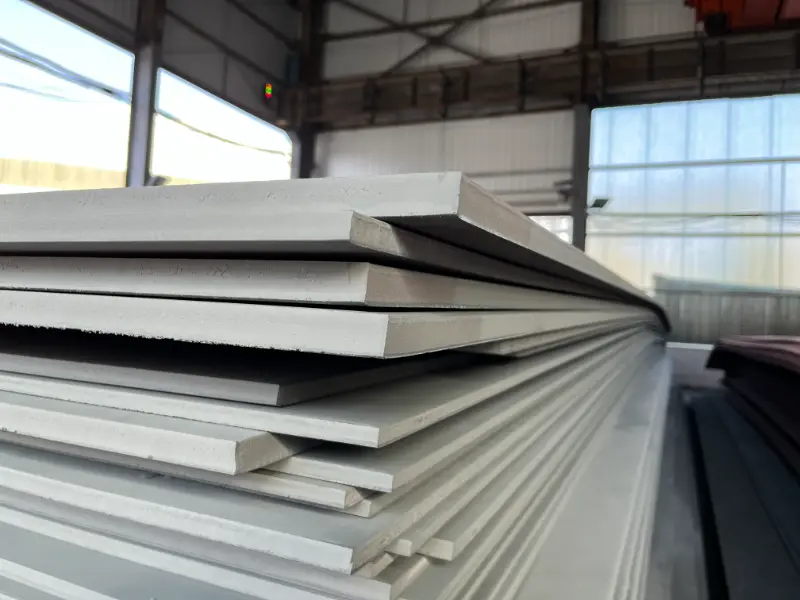
ABS Grade FQ63
ABS Grade FQ63 - High Strength Quenched & Tempered Ship Steel
ABS FQ63 is a high-strength quenched and tempered steel for marine and offshore structural applications, featuring minimum yield strength of 435 MPa and excellent low-temperature toughness.
Quenching and Tempering, Welding (with preheat/heat input control), Hot/Cold Forming
- Phone : +8618037372205
- Email : [email protected]
- WhatsApp: Contact via Whtsapp
- WeChat: +8618037372205
ABS Grade FQ63 Introduction
ABS Grade FQ63 is a high-strength quenched and tempered (Q&T) steel plate regulated by the American Bureau of Shipping (ABS) for shipbuilding and offshore structures. This grade belongs to the ABS extra-high strength series, with a minimum yield strength of 63 ksi (435 MPa). It offers a superior combination of high tensile strength, excellent notch toughness at low temperatures, and good weldability when proper procedures are followed. The fine-grain microstructure achieved through controlled rolling and subsequent quenching and tempering provides enhanced resistance to brittle fracture and fatigue, making it suitable for critical structural members in harsh marine environments. Typical applications include hull girders, deck plating, bulkheads, and offshore platform components where weight savings and reliability are essential.
ABS Grade FQ63 Chemical Composition as per ABS Requirements
The chemical composition is strictly controlled to ensure the required mechanical properties and weldability. Carbon equivalent (CE IIW) is limited to a maximum of 0.45% for thicknesses ≤ 50 mm to prevent cold cracking. Fine grain practice is mandatory, and aluminium is usually added as a grain refiner. Residual elements are kept low.
| Element | Typical/Max. Value (%) | Remarks |
|---|---|---|
| Carbon (C) | ≤ 0.20 | Max. limit for strength & weldability |
| Manganese (Mn) | 0.80 - 1.65 | Contributes to strength & toughness |
| Silicon (Si) | 0.10 - 0.55 | Deoxidation & strength |
| Phosphorus (P) | ≤ 0.030 | Max. limit to avoid embrittlement |
| Sulfur (S) | ≤ 0.030 | Max. limit for ductility & weldability |
| Nickel (Ni) | ≤ 1.0 | Optional for toughness, max. allowed |
| Chromium (Cr) | ≤ 0.30 | Residual element limit |
| Molybdenum (Mo) | ≤ 0.10 | Residual element limit |
| Copper (Cu) | ≤ 0.35 | Residual element limit |
| Vanadium (V) | ≤ 0.10 | Microalloying, grain refinement |
| Titanium (Ti) | ≤ 0.02 | Grain refinement & nitrogen binding |
| Niobium (Nb) | ≤ 0.05 | Microalloying, grain refinement |
| Aluminium (Al) total | ≥ 0.015 | Minimum for fine grain practice |
| Nitrogen (N) | ≤ 0.012 | Max. limit to avoid strain aging |
| Carbon Equivalent (CE IIW) | ≤ 0.45 | For thickness ≤ 50 mm; formula: C + Mn/6 + (Cr+Mo+V)/5 + (Ni+Cu)/15 |
ABS Grade FQ63 Thermal and Electrical Physical Properties
These values are typical for low-alloy quenched and tempered steels and are provided for design guidance only. They are not mandatory requirements of the ABS specification and may vary slightly with actual composition and heat treatment.
| Property | Typical Value | Unit | Condition / Reference |
|---|---|---|---|
| Density (ρ) | 7.85 | g/cm³ | At room temperature |
| Modulus of Elasticity (E) | 205 | GPa | At room temperature |
| Shear Modulus (G) | 80 | GPa | At room temperature |
| Poisson's Ratio (ν) | 0.3 | - | At room temperature |
| Coefficient of Thermal Expansion (α) | 11.1 | 10⁻⁶/K | 20 °C to 100 °C |
| Coefficient of Thermal Expansion (α) | 12.2 | 10⁻⁶/K | 20 °C to 200°C |
| Thermal Conductivity (λ) | 42 | W/(m·K) | At 20 °C |
| Specific Heat Capacity | 460 | J/(kg·K) | At 20°C |
| Electrical Resistivity (ρe) | 0.20 | µΩ·m | At 20°C |
ABS Grade FQ63 Mechanical Properties
Mechanical properties are dependent on plate thickness. Tensile testing is performed on transverse specimens. Charpy V-notch impact tests are carried out at -60 °C for class 'F' material. The bend test specimen shall withstand 180° bending without cracking.
| Property | Required Value | Unit | Thickness / Test Condition |
|---|---|---|---|
| Yield Strength (ReH) | ≥ 435 | MPa | t ≤ 50 mm |
| Yield Strength (ReH) | ≥ 420 | MPa | 50 < t ≤ 100 mm |
| Yield Strength (ReH) | ≥ 390 | MPa | 100 < t ≤ 150 mm |
| Tensile Strength (Rm) | 570 - 720 | MPa | t ≤ 50 mm |
| Tensile Strength (Rm) | 550 - 700 | MPa | 50 < t ≤ 100 mm |
| Tensile Strength (Rm) | 530 - 680 | MPa | 100 < t ≤ 150 mm |
| Elongation (A5) | ≥ 17 | % | t ≤ 50 mm |
| Elongation (A5) | ≥ 16 | % | 50 < t ≤ 100 mm |
| Elongation (A5) | ≥ 16 | % | 100 < t ≤ 150 mm |
| Charpy Impact (KV2, longitudinal) | ≥ 27 (average) | J | -60 °C, specimen 10×10 mm |
| Charpy Impact (KV2, transverse) | ≥ 20 (average) | J | -60 °C, specimen 10×10 mm |
| Bend Test (180°) | No cracks | - | Mandrel diameter = 3a (a = thickness) |
ABS Grade FQ63 Direct Equivalent Standards and Replaceable Grades
| Country/Region | Standard | Grade | Remarks |
|---|---|---|---|
| International (ABS) | ABS Rules Part 2 | FQ63 | Original designation, Q&T, YS ≥ 435 MPa |
| Norway/Germany (DNV GL) | DNVGL Rules Pt.2 Ch.2 | VL F420 | Yirld 420 MPa; nearest Q&T grade, may require engineering assessment |
| UK (Lloyd's Register) | LR Rules | FH420 | Yirld 420 MPa; similar Q&T marine steel |
| France (Bureau Veritas) | BV Rules NR216 | FH420 | 420 MPa class Q&T steel for shipbuilding |
| China (CCS) | CCS Rules Part 1 | F420 | 420 MPa class with -60°C impact property |
ABS Grade FQ63 Application Introduction
ABS FQ63 steel is primarily designed for marine and offshore applications where a combination of high strength, low-temperature toughness, and weldability is critical. It can be shaped into various structural members and is compatible with standard fabrication techniques, provided adequate heat control is observed.
Product Applications: Hull plating and stiffeners, Decks and bulkheads, Offshore platform primary structures, Tubular trusses and node cans, Pressure hulls for submersibles, Wind turbine foundation transition pieces
Processed into products: Longitudinal and transverse frames, Rudder horns and propeller shaft brackets, Crane pedestals and slewing rings, Lifting lugs and padeyes, Mooring winch foundations, Fatigue-sensitive welded joints
Application industries: Shipbuilding (hull structures, deck framing, hatch coamings), Offshore oil & gas (jacket legs, helidecks, flare booms), Offshore renewable energy (wind turbine monopiles, transition pieces), Heavy lifting and transportation (crane booms, heavy-duty trailers), Bridge engineering (structural plates subjected to dynamic loads), Defence (naval vessel hulls, armour components)
ABS Grade FQ63 Similar Materials with Close Mechanical Properties
| Country/Region | Standard | Grade | Remarks |
|---|---|---|---|
| European Union | EN 10025-6 | S420Q / 1.8940 | Q&T steel, yield ≥ 420 MPa, good low-temperature toughness |
| European Union | EN 10225 | S420G2+Q | Weldable structural steel for offshore structures, Q&T |
| Japan | JIS G 3128 | SHY685N | Similar high-strength Q&T plate, yield ≥ 685 MPa (may be overmatched) |
| USA | ASTM A514/A514M | Grade Q | Q&T plate, yield ≥ 690 MPa; higher strength, but may be considered for replacement |
| ISO | ISO 4950-2 | S420QL | High yield strength flat steel products, Q&T |
Notes:
Welding: Preheat and interpass temperature control are essential (typically 100–200°C) to avoid cold cracking. Low-hydrogen welding consumables should be used. Forming: Hot or cold forming may be applied; hot forming above the tempering temperature requires re-tempering. Inspection: Plates are normally supplied with ultrasonic testing (UT) according to ABS rules or purchaser's specification. Certification: Each plate is stamped with the ABS mark and delivered with a 3.2 certificate.
- Share



