
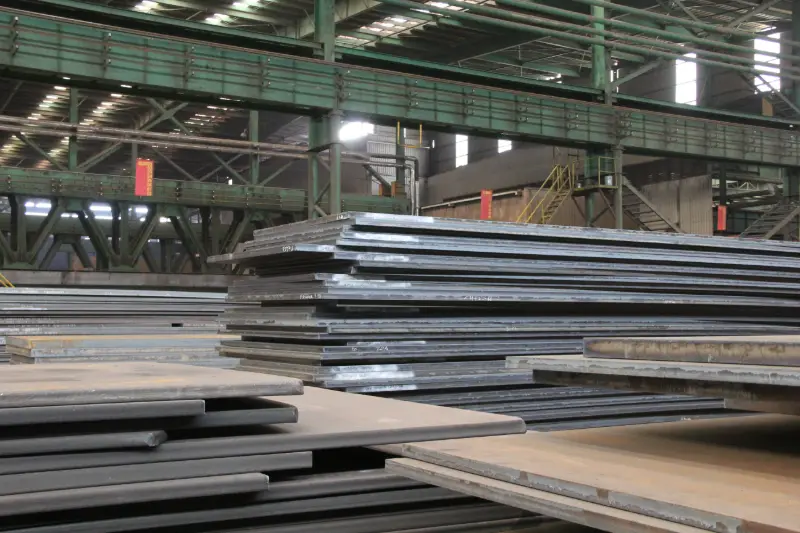
ABS Grade DQ56 Shipbuilding Steel Plate
ABS Grade DQ56 Shipbuilding Steel Plate: High-Strength Quenched & Tempered Steel for Marine Structures
Explore the properties, chemical composition, mechanical and thermal performance of ABS Grade DQ56 shipbuilding steel plate. Find equivalent grades, application guidance, and processing insights.
Hot rolling, quenching and tempering, cutting, bending, welding (with preheat and post-weld treatment)
- Phone : +8618037372205
- Email : [email protected]
- WhatsApp: Contact via Whtsapp
- WeChat: +8618037372205
ABS Grade DQ56 Shipbuilding Steel Plate Introduction
ABS Grade DQ56 is a high-strength, quenched and tempered (Q&T) structural steel plate specifically designed for shipbuilding and offshore applications under the American Bureau of Shipping (ABS) rules. It belongs to the higher-strength hull structural steel category with a specified minimum yield strength of 560 MPa. The 'D' designation indicates a Charpy V-notch impact test temperature of -20°C, ensuring reliable toughness in low-temperature marine environments. The 'Q' denotes the quenching and tempering heat treatment process, which imparts superior strength, ductility, and weldability. This grade is widely used for critical structural members in ships, offshore platforms, and other marine constructions where weight savings and high load-bearing capacity are essential. Typical applications include hull girders, deck plating, longitudinal stiffeners, and heavy-lift crane structures. It is supplied in normalized or quenched and tempered condition with strict control over internal defects and surface quality. The steel exhibits good formability and weldability when proper preheating and welding consumables are used, making it suitable for complex fabrication processes. ABS DQ56 complies with the ABS Rules for Materials and Welding (Part 2) and is internationally recognized, with equivalent grades found in other classification societies.
ABS Grade DQ56 Shipbuilding Steel Plate Chemical Composition
The chemical composition of ABS DQ56 is controlled to achieve the required mechanical properties after quenching and tempering. Carbon and carbon equivalent (CEV) are limited to ensure weldability.Microalloying elements such as Nb, V, and Ti are added for grain refinement and precipitation strengthening. The maximum phosphorus and sulfur contents are strictly limited to guarantee toughness and resistance to brittle fracture.
- All values comply with ABS Rules Part 2, Chapter 1-1, Table 1A for grade DQ56.
- Ladle analysis is representative; product analysis may have slight deviations within allowable limits.
| Element | Standard Value (wt%) | Remarks |
|---|---|---|
| Carbon (C) | ≤0.18 | CEV typically ≤0.43 |
| Manganese (Mn) | 0.90 – 1.60 | High Mn for strength and hardenability |
| Silicon (Si) | ≤0.50 | Deoxidizer |
| Phosphorus (P) | ≤0.035 | Low P for toughness |
| Sulfur (S) | ≤0.035 | Low S for ductility |
| Aluminium (Al, total) | ≥0.015 | Fine grain practice; acid-soluble Al |
| Niobium (Nb) | ≤0.05 | Microalloy, grain refiner |
| Vanadium (V) | ≤0.10 | Precipitation strengthening |
| Titanium (Ti) | ≤0.02 | Grain refinement and deoxidation |
| Copper (Cu) | ≤0.35 | May be specified for atmospheric corrosion resistance |
| Chromium (Cr) | ≤0.20 | Residual / hardenability |
| Nickel (Ni) | ≤0.40 | Toughness enhancer |
| Molybdenum (Mo) | ≤0.08 | Hardenability |
ABS Grade DQ56 Shipbuilding Steel Plate Physical Properties
Physical properties are representative for low-alloy high-strength structural steel and may vary slightly depending on exact chemistry and heat treatment. These values are for engineering reference and not mandatory by the standard. Thermal conductivity decreases with increasing temperature, while thermal expansion increases.
- Density ~7850 kg/m³ typical for steel.
- Elastic modulus ~205 GPa at ambient.
| Property | Standard Requirement Value | Unit | Test Condition |
|---|---|---|---|
| Density (ρ) | 7850 | kg/m³ | Ambient temperature |
| Elastic Modulus (E) | 205 | GPa | Ambient |
| Shear Modulus (G) | 80 | GPa | Ambient (calculated, E/(2(1+ν))) |
| Poisson's Ratio (ν) | 0.3 | — | Elastic range |
| Thermal Expansion Coefficient (α) | 12.0 × 10⁻⁶ | /K | 20–100°C, typical |
| Thermal Expansion Coefficient (α) | 12.5 × 10⁻⁶ | /K | 20–200°C |
| Thermal Expansion Coefficient (α) | 13.0 × 10⁻⁶ | /K | 20–300°C |
| Thermal Conductivity (λ) | 50 | W/(m·K) | 20°C |
| Thermal Conductivity (λ) | 45 | W/(m·K) | 100°C |
| Specific Heat Capacity | 460 | J/(kg·K) | Ambient |
| Electrical Resistivity (ρ_e) | 0.22 × 10⁻⁶ | Ω·m | 20°C |
ABS Grade DQ56 Shipbuilding Steel Plate Mechanical Properties
Mechanical testing is performed on quenched and tempered specimens in accordance with ABS Rules. The values below apply to plate thickness ≤50 mm; for thicker sections, slight reductions in minimum elongation and impact values may apply. Bending tests are performed to assess formability without cracking. Impact testing is carried out at -20°C on Charpy V-notch specimens in the longitudinal direction.
- Yield strength (ReH) minimum 560 MPa.
- Tensile strength range 670-830 MPa.
- Elongation based on gauge length 5.65√So (proportional sample).
| Property | Standard Requirement | Unit | Test Condition |
|---|---|---|---|
| Yield Strength (ReH) | ≥560 | MPa | Ambient, transverse or longitudinal, according to standard |
| Tensile Strength (Rm) | 670 – 830 | MPa | Ambient |
| Elongation (A) | ≥16 | % | Gauge length 5.65√So, longitudinal (thickness ≤50 mm) |
| Elongation (A) | ≥15 | % | Gauge length 5.65√So, longitudinal (thickness >50 mm ≤70 mm) |
| Elongation (A) | ≥14 | % | Gauge length 5.65√So, longitudinal (thickness >70 mm ≤85 mm) |
| Bending Test (Bend Diameter) | 4t (t = plate thickness) | — | 180° bend, no cracks |
| Charpy Impact Energy (KV, longitudinal) | ≥31 | J | -20°C, thickness ≤50 mm |
| Charpy Impact Energy (KV, longitudinal) | ≥27 | J | -20°C, thickness >50 mm ≤70 mm |
| Charpy Impact Energy (KV, longitudinal) | ≥24 | J | -20°C, thickness >70 mm ≤85 mm |
ABS Grade DQ56 Shipbuilding Steel Plate Directly Equivalent Material Standards and Substitution Grades
| Country / Region | Standard / Classification Society | Grade | Remarks |
|---|---|---|---|
| International | ABS | DQ56 | Quenched and tempered high-strength ship steel, impact -20°C |
| Norway/Germany | DNV GL | NVE56 (now VL E56) | Same strength and toughness class, Q&T condition |
| France | BV | EH56 | Equivalent grade, -20°C impact |
| United Kingdom | LR | EH56 | Equivalent, minimum 560 MPa yield |
| China | CCS | EH56 | Equivalent shipbuilding steel |
| Korea | KR | EH56 | Equivalent, Q&T |
| Japan | NK (ClassNK) | KE56 | Equivalent, -20°C impact test |
| Italy | RINA | EH56 | Equivalent |
| Europe (structural steel) | EN 10025-6 | S550Q / S620Q | S550Q yield ≥550 MPa, S620Q ≥620 MPa; DQ56 falls within this band. Impact testing temperature and testing requirements must be agreed. Not a direct match but can substitute under engineering approval. |
| API (offshore) | API 2W | Grade 60 | Yield ≥415 MPa, lower than DQ56, often used for tubular joints but not a full equivalent. |
ABS Grade DQ56 Shipbuilding Steel Plate Application Introduction
ABS DQ56 is tailored for structural applications where high strength, toughness, and weldability are critical under low-temperature service conditions. Its primary use is in the hulls of large vessels and offshore structures. The steel is also found in heavy construction and mining equipment. Welding must follow qualified procedures with low-hydrogen consumables and appropriate preheat/interpass temperatures to prevent cracking. Post-weld heat treatment is generally not required for thicknesses up to 50 mm.
Product Applications: Hull plates for container ships, bulk carriers, tankers, and LNG carriers, Deck and bottom plating for ice-class vessels, Stiffeners and longitudinal girders, Jacket legs and braces for offshore platforms, Boom and crane structures, Transition pieces and monopile foundations for offshore wind turbines, Armor components and blast-resistant structures
Processed into products: Hull shell plates, Transverse and longitudinal frames, Bulkhead stiffeners, Rudder horns and shafts (forged equivalent), Crane pedestals and slewing rings, Heavy-duty flanges and bearing plates, Cutter heads and buckets for dredging
Application industries: Shipbuilding and ship repair, Offshore oil and gas (platforms, FPSOs, rigs), Marine engineering (docks, breakwaters, lock gates), Renewable energy (offshore wind turbine foundations, transition pieces), Heavy machinery and mining equipment, Bridges and structural engineering (with special approval)
ABS Grade DQ56 Shipbuilding Steel Plate Similar / Near-Equivalent Materials
| Country / Region | Standard | Grade | Remarks |
|---|---|---|---|
| Europe | EN 10025-6 | S550Q | Quenched and tempered, min yield 550 MPa, impact testing optional at -20°C (L). Suitable for substitution with reduced strength margin. |
| Europe | EN 10025-6 | S620Q | Higher strength (yield ≥620 MPa) could replace DQ56 in weight-sensitive designs, but weldability and toughness must be verified. |
| USA (ASTM) | ASTM A514/A517 | Grade Q / A517 Gr. Q | Quenched and tempered alloy steel plate with min yield 620–690 MPa. Can serve as replacement for thicker sections, but impact temperature and CEV differ. |
| USA (ASTM) | ASTM A709 | Grade 100 (A709 Gr. 100) | High-strength low-alloy structural steel (yield 690 MPa). Similar in use but not specifically for shipbuilding; needs ABS approval. |
| Japan | JIS G 3128 | SHY 685 | High yield strength steel plate for welded structures (yield ≥685 MPa). Can be considered a higher strength alternative. |
Notes:
All technical data conforms to ABS Rules for Materials and Welding 2024 edition (Part 2, Chapter 1). For thicknesses above 85 mm or for specific design temperatures below -20°C, additional testing and supplementary requirements may apply. Always consult the latest ABS Rules and material certificates for final compliance. The content provided is for informational purposes only and should be verified by a qualified engineer for critical applications.
- Share



