
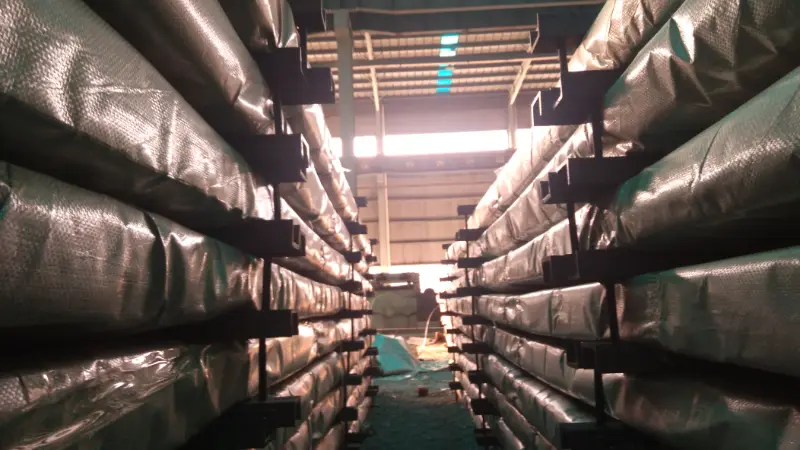
ABS Grade AQ56 Shipbuilding Steel Plate
ABS Grade AQ56 Shipbuilding Steel Plate - High Strength Quenched & Tempered Structural Steel
Comprehensive material data for ABS AQ56 shipbuilding steel including chemical composition, mechanical properties, physical properties, international equivalents, and applications.
Welding, cutting, cold forming (limited), machining (preheating may be required), with strict adherence to low-hydrogen welding and post-weld heat treatment considerations for Q&T steel.
- Phone : +8618037372205
- Email : [email protected]
- WhatsApp: Contact via Whtsapp
- WeChat: +8618037372205
ABS Grade AQ56 Shipbuilding Steel Plate Introduction
ABS Grade AQ56 is a high-strength quenched and tempered (Q&T) structural steel primarily used in shipbuilding and offshore engineering. It is classified under the American Bureau of Shipping (ABS) Rules for Materials and Welding, offering a minimum yield strength of 560 MPa and excellent toughness at 0°C. The steel is designed to provide weight savings while maintaining superior weldability and resistance to brittle fracture. Its fine-grained microstructure, achieved through controlled rolling and subsequent heat treatment, ensures consistent mechanical properties across plate thicknesses up to 100 mm.
- High yield and tensile strength for reduced section thickness
- Good low-temperature impact toughness (Grade A, 0°C)
- Excellent weldability with low-hydrogen processes and controlled carbon equivalent
- Uniform properties through quench and temper processing
- Compliant with ABS and IACS unified requirements
Typical applications include ship hulls, decks, hatch covers, and offshore platform structures where high strength-to-weight ratio and reliability are critical.
ABS Grade AQ56 Shipbuilding Steel Plate Chemical Composition
Chemical composition according to ABS Rules for Materials and Welding, Part 2, Chapter 1, Section 2, Table 2 for Grade AQ56. The limits apply to ladle analysis. Fine grain practice is required, and carbon equivalent (Ceq) must be controlled to ensure weldability (typically ≤0.43% for thickness ≤50 mm, ≤0.45% for 50–100 mm).
| Element | Standard Value | Remarks |
|---|---|---|
| Carbon (C) | ≤0.21 | Maximum |
| Manganese (Mn) | 0.90 – 1.60 | Range |
| Silicon (Si) | 0.10 – 0.50 | Range |
| Phosphorus (P) | ≤0.035 | Maximum |
| Sulfur (S) | ≤0.035 | Maximum |
| Aluminum (Al, acid soluble) | ≥0.015 | Minimum for grain refinement |
| Niobium (Nb) | 0.02 – 0.05 | Microalloying element |
| Vanadium (V) | 0.05 – 0.10 | Microalloying element |
| Titanium (Ti) | ≤0.02 | Maximum |
| Copper (Cu) | ≤0.35 | Maximum |
| Chromium (Cr) | ≤0.25 | Maximum |
| Nickel (Ni) | ≤0.40 | Maximum |
| Molybdenum (Mo) | ≤0.08 | Maximum |
| Nitrogen (N) | ≤0.012 | Maximum |
ABS Grade AQ56 Shipbuilding Steel Plate Thermal and Electrical Physical Properties
Typical physical properties for quenched and tempered steel of grade AQ56. These values are not specified in ABS rules but are provided for design and engineering reference. Properties may vary slightly with actual chemical composition and heat treatment condition.
| Property | Typical Value | Unit | Test Condition / Temperature |
|---|---|---|---|
| Density (ρ) | 7.85 | g/cm³ | At 20°C |
| Elastic modulus (E) | 205 | GPa | At 20°C |
| Shear modulus (G) | 80 | GPa | At 20°C |
| Poisson's ratio (ν) | 0.3 | — | At 20°C |
| Thermal expansion coefficient (α) | 11.5 | 10ʽ/K | 20–100°C |
| Thermal expansion coefficient (α) | 12.2 | 10ʽ/K | 20–200°C |
| Thermal conductivity (λ) | 45 | W/(m·K) | At 20°C |
| Specific heat capacity (c) | 475 | J/(kg·K) | At 20°C |
| Electrical resistivity (ρe) | 0.22 | µΩ·m | At 20°C |
ABS Grade AQ56 Shipbuilding Steel Plate Mechanical Properties
Mechanical properties in accordance with ABS Rules, Part 2, Chapter 1, Section 6 for quenched and tempered steels of Grade AQ56, thickness up to 100 mm. Tensile tests are performed in the longitudinal direction; Charpy V-notch impact tests at 0°C (Grade A). Bending tests with 180° angle and specified mandrel diameter.
| Property | Standard Value | Unit | Test Condition |
|---|---|---|---|
| Upper yield strength (ReH) | ≥560 | MPa | Transverse or longitudinal; thickness ≤100 mm |
| Tensile strength (Rm) | 650 – 835 | MPa | Longitudinal; at ambient temperature |
| Elongation after fracture (A) | ≥16 | % | Gauge length 200 mm; longitudinal |
| Bend test (180°) | d = 3a | — | No cracks; mandrel diameter 3 times specimen thickness (a) |
| Charpy impact energy (KV) | ≥31 (longitudinal) | J | At 0°C; V-notch; single value minimum (average of 3 ≥41 J for acceptance) |
| Charpy impact energy (KV) | ≥22 (transverse) | J | At 0°C; optional; minimum single value |
ABS Grade AQ56 Shipbuilding Steel Plate Identical Material Standards and Replaceable Grades
| Country / Region | Standard | Grade / Designation | Remarks |
|---|---|---|---|
| International (IACS) | DNV Rules | NV A560 (A560) | Quenched and tempered, yield ≥560 MPa, impact 0°C |
| International (IACS) | LR Rules | AH56 | Equivalent high-strength Q&T steel |
| International (IACS) | CCS Rules | AH560 | Same requirements as AQ56 |
| International (IACS) | BV Rules | AH56 | Identical grade and condition |
| International (IACS) | NK Rules | KA56 | KA56 corresponds to AQ56; similar toughness |
| International (IACS) | RINA Rules | A560 | Equivalent quenching and tempering grade |
ABS Grade AQ56 Shipbuilding Steel Plate Application Introduction
ABS AQ56 is engineered for weight-critical marine and offshore structures. Its high strength permits thinner sections, reducing structural weight and fabrication costs while maintaining safety. The steel is readily weldable using low-hydrogen practices, and preheating is typically not required for thicknesses up to 30 mm when using proper consumables. Common processing includes plasma/oxyfuel cutting, bending (with generous radii to prevent cracking), and light machining. Post-weld heat treatment is generally unnecessary if approved welding procedures are followed, preserving the tempered martensitic microstructure.
Product Applications: Ship hull plates, Deck stringers, Bulkheads, Hatch covers, Offshore platform legs, Jack-up rig chords, Crane booms and pedestals
Processed into products: Longitudinal stiffeners, Transverse webs & frames, Bottom shell plates, Main deck plates, Integral beams, Connection brackets, Structural nodes and heavy weldments
Application industries: Shipbuilding, Offshore engineering, Marine construction, Heavy machinery
ABS Grade AQ56 Shipbuilding Steel Plate Similar or Alternative Materials Recommendation
| Country / Region | Standard | Grade / Designation | Remarks |
|---|---|---|---|
| International | ABS Rules | EQ56 / FH56 | Similar strength but with lower impact test temperatures (E: -40°C, F: -60°C); can replace AQ56 where higher toughness is required |
| International | ABS Rules | AQ63 | Higher yield strength (≥620 MPa); quenched and tempered; for higher stress applications |
| European | EN 10025-6 | S690Q (1.8928) | Structural steel, Q&T, yield min 690 MPa; may be used as alternative if re-qualified for marine service |
Notes:
For optimal weldability, the carbon equivalent (Ceq) is controlled: ≤0.43% for thickness ≤50 mm, ≤0.45% for 50–100 mm. Use low-hydrogen electrodes (e.g., AWS E11018-M) or flux-cored wires. Cold forming should be limited to a bending ratio r/t ≥ 3; hot forming above 600°C requires subsequent re-tempering. The steel is not intended for temperatures above 250°C in service. Always refer to the latest ABS Rules and the manufacturer's material certificate for exact properties.
- Share



