
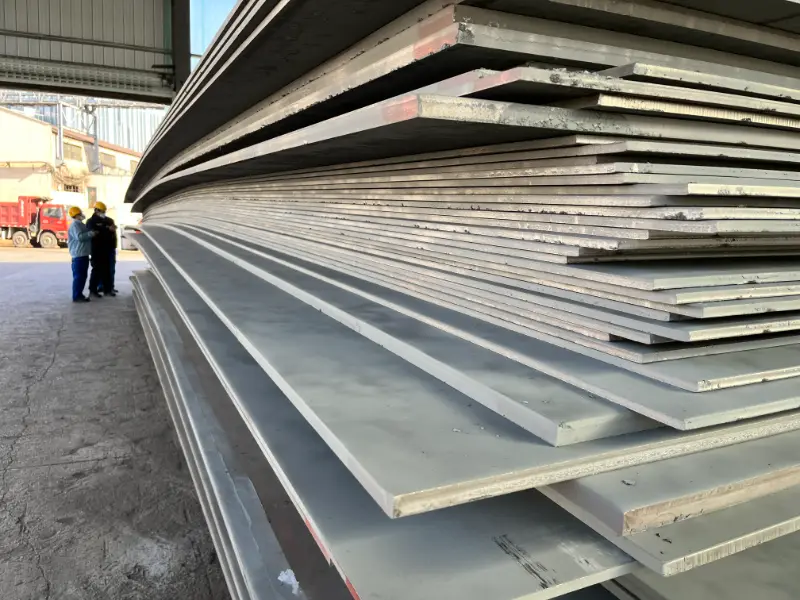
CCS Grade EH36 Shipbuilding Steel Plate
CCS Grade EH36 Shipbuilding Steel Plate: High Strength & -40°C Toughness for Marine Engineering
Detailed material data for China Classification Society (CCS) Grade EH36 steel plate, a normalized high-strength hull structural steel with minimum 355 MPa yield and guaranteed impact properties at -40°C, widely used in shipbuilding and offshore structures.
Hot rolling, normalizing, thermo-mechanical controlled rolling (TMCP), cold forming, welding (SAW, SMAW, GMAW, FCAW), cutting (oxy-fuel, plasma, laser)
- Phone : +8618037372205
- Email : [email protected]
- WhatsApp: Contact via Whtsapp
- WeChat: +8618037372205
CCS Grade EH36 Shipbuilding Steel Plate Introduction
CCS Grade EH36 is a high-strength hull structural steel certified by the China Classification Society (CCS) in accordance with the CCS Rules for Materials and Welding. It belongs to the 355 MPa yield strength category with a minimum impact energy of 34 J at -40°C (longitudinal), making it suitable for critical structural components in ice-going vessels and Arctic offshore platforms. The steel is supplied in normalized or thermo-mechanically controlled rolled (TMCP) condition, ensuring fine-grained microstructure, excellent weldability, and consistent through-thickness properties. Typical thickness ranges up to 100 mm with guaranteed tensile and toughness requirements. It is widely equivalent to EH36 grades under IACS members such as ABS, DNV, LR, and BV, facilitating global procurement and construction.
CCS Grade EH36 Shipbuilding Steel Plate Chemical Composition
Typical chemical analysis limits for CCS Grade EH36 as per CCS Rules, generally referencing GB/T 712. Fine grain practice is applied; aluminium content is required for normalizing steels. Niobium, vanadium, and titanium may be added singly or in combination. Carbon equivalent (CEV) is often restricted to ensure weldability, usually ≤0.38–0.40 depending on thickness.
- Aluminium (acid-soluble) ≥0.015% when normalizing is used.
- When TMCP is applied, CEV ≤0.38% for thickness ≤50 mm and ≤0.40% for 50–100 mm.
| Element | Standard Value (max unless range) | Remarks |
|---|---|---|
| Carbon (C) | ≤0.18% | |
| Manganese (Mn) | 0.90–1.60% | |
| Silicon (Si) | ≤0.50% | |
| Phosphorus (P) | ≤0.035% | |
| Sulfur (S) | ≤0.035% | |
| Chromium (Cr) | ≤0.20% | |
| Nickel (Ni) | ≤0.40% | |
| Copper (Cu) | ≤0.35% | |
| Molybdenum (Mo) | ≤0.08% | |
| Aluminium (Al acid-soluble) | ≥0.015% | Required for normalizing; optional for TMCP |
| Niobium (Nb) | 0.02–0.05% | May be added |
| Vanadium (V) | 0.05–0.10% | |
| Titanium (Ti) | 0.007–0.02% | |
| Carbon Equivalent (CEV) | ≤0.38% (t ≤50 mm) ; ≤0.40% (50 < t ≤100 mm) | CEV = C + Mn/6 + (Cr+Mo+V)/5 + (Ni+Cu)/15 |
CCS Grade EH36 Shipbuilding Steel Plate Physical and Thermal Properties
Physical properties are not directly mandated by classification society standards but are provided as general engineering reference for EH36 steel. Values are typical for normalized or TMCP condition at room temperature unless otherwise noted. These are useful for structural design, welding simulation, and thermal analysis. Actual values may vary slightly with heat treatment and composition within the specification range.
- Density is typical for low-alloy steel.
- Elastic modulus and shear modulus are standard for HSLA steel.
- Thermal expansion and conductivity are average values between 0°C and 100°C.
- Poisson's ratio is valid in elastic range.
- Resistivity applies at ambient temperature.
| Property | Typical Value | Unit | Test Condition |
|---|---|---|---|
| Density (ρ) | 7.85 | g/cm³ | 20°C |
| Elastic Modulus (E) | 205 | GPa | Room temperature |
| Shear Modulus (G) | 80 | GPa | Calculated from E and ν |
| Poisson's Ratio (ν) | 0.30 | - | Elastic range |
| Thermal Expansion Coefficient (α) | 12.0 | ×10⁻⁶/K | 0–100°C, average linear expansion |
| Thermal Conductivity (λ) | 45 | W/(m·K) | 20°C |
| Specific Heat Capacity (c) | 480 | J/(kg·K) | 20°C |
| Electrical Resistivity (ρ_e) | 0.25 | ×10⁻⁶ Ω·m | 20°C |
CCS Grade EH36 Shipbuilding Steel Plate Mechanical Properties
Mechanical properties according to CCS Rules for EH36 steel plates. The values apply to products in normalized or TMCP condition. For thicknesses above 50 mm, elongation may be reduced slightly; see specific standard. Impact test is performed at -40°C using Charpy V-notch specimens, minimum average absorbed energy 34 J longitudinal, 24 J transverse. Bend test to 180° over a former diameter (d) as function of thickness.
- Tensile test on transverse specimens; ASTM A370/EN ISO 6892-1 equivalent methods accepted.
- Impact test per EN ISO 148-1 or ASTM E23.
| Property | Standard Required Value | Unit | Test Condition |
|---|---|---|---|
| Yield Strength (ReH) | ≥355 | MPa | Transverse, room temperature, all thicknesses |
| Tensile Strength (Rm) | 490–630 | MPa | Transverse, room temperature |
| Elongation (A5) | ≥21 | % | Transverse, gauge length 5.65√So; thickness ≤50 mm |
| Elongation (A5) | ≥20 | % | Thickness >50 mm to ≤70 mm |
| Elongation (A5) | ≥19 | % | Thickness >70 mm to ≤100 mm |
| Impact Toughness (KV2) | ≥34 (average), min 24 (single) | J | Longitudinal, -40°C, Charpy V-notch 2 mm striker |
| Impact Toughness (KV2) | ≥24 (average), min 17 (single) | J | Transverse, -40°C (when specified) |
| Bend Test, 180° | d=2a (t ≤35 mm) | - | No cracks; d = mandrel diameter, a = plate thickness |
| Bend Test, 180° | d=3a (35 < t ≤100 mm) | - | No cracks |
CCS Grade EH36 Shipbuilding Steel Plate Fully Equivalent Standards and Substitute Grades
| Country/Region | Standard | Grade | Remarks |
|---|---|---|---|
| China | CCS Rules / GB/T 712 | EH36 | Original classification society standard |
| International (IACS) | UR W11 | EH36 | IACS unified requirement, basis for all members |
| USA | ABS | EH36 | Full equivalence, same Charpy -40°C |
| Norway/Germany | DNV | EH36 | DNV/GL rules, -40°C |
| UK | LR | EH36 | Lloyd's Register, -40°C |
| France | BV | EH36 | Bureau Veritas, -40°C |
| Japan | NK | EH36 | ClassNK (Nippon Kaiji Kyokai), -40°C |
| Italy | RINA | EH36 | Registro Italiano Navale, -40°C |
| Korea | KR | EH36 | Korean Register, -40°C |
| Russia | RS | E36 | Russian Maritime Register; often considered equivalent, impact at -40°C |
CCS Grade EH36 Shipbuilding Steel Plate Application Introduction
CCS Grade EH36 is specifically designed for harsh marine environments requiring high strength and excellent resistance to brittle fracture at low temperatures. It is the preferred material for ice-strengthened vessels, winterization equipment, and Arctic offshore structures. Due to its balanced alloy design, it offers good formability and weldability, enabling efficient construction with minimal preheat. Typical applications include but are not limited to:
Product Applications: Deck plates, bottom plates, side shell framing for ice-class vessels (Icebreakers, Arctic tankers, LNG carriers), Legs, chords, and rack plates for self-elevating platforms (jack-up rigs), Transition piece cans and tower flanges for offshore wind monopiles, Heavy-lift crane pedestals and booms, Structural modules for Arctic production facilities, Bulb flats and angles for longitudinal stiffeners
Processed into products: Outer hull and inner hull panels of vessels navigating in low-temperature regions, Helipad structures and helicopter deck supports, Truss joints and node cans for offshore jackets, Ice belt strake plates and bow plates, Cargo tank boundaries in liquefied gas carriers where low-temperature boundary steel is required, Welded tubular joints (K, T, Y) in jacket structures, Elevating rack chock and pinion plates for jack-ups, Anchor brackets and chain stopper seats, Heavy plate girders in bridge constructions (subject to local authority approval)
Application industries: Shipbuilding and ship repair (commercial and naval), Offshore oil & gas (fixed platforms, FPSOs, jack-up rigs), Renewable energy (offshore wind turbine substructures), Heavy civil engineering (bridge girders, lock gates), Port and harbor machinery (crane booms, container handling equipment), Pressure vessel fabrication (with supplementary impact testing)
CCS Grade EH36 Shipbuilding Steel Plate Similar/Nearest Alternative Materials with Higher or Slightly Different Requirements
| Country/Region | Standard | Grade | Remarks/Suitability |
|---|---|---|---|
| China | CCS/GB 712 | DH36 | Same strength but impact test at -20°C; suitable for less severe cold environments, lower cost |
| China | CCS/GB 712 | AH36 | Minimum impact at 0°C; used in unrestricted service but not for low-temperature structures |
| China | CCS/GB 712 | FH36 | Impact at -60°C; better toughness for extreme Arctic applications, higher alloy cost |
| China | CCS/GB 712 | EH40 | Higher yield ≥390 MPa, same -40°C impact; for heavier loading or weight saving design |
| Europe | EN 10025-4 | S355ML/S355MLO | Thermo-mechanically rolled structural steel with minimum 355 MPa yield and LV impact -50°C; not ship classification but close in chemistry; requires separate approval |
| Russia | GOST 5520 | 09G2S (09Г2С) | Similar strength, limited to -40°C or -60°C variants depending on specification; widely used in CIS shipbuilding |
Notes:
For thicknesses exceeding 100 mm, agreement with the classification society is necessary; through-thickness (Z-direction) properties per CCS may be required for critical applications. Supplementary requirements such as CTOD (Crack Tip Opening Displacement) testing, ultrasonic testing per ASTM A578/A435 or EN 10160, and corrosion protection aspects should be specified at the time of order. Weld consumables must be selected to match the strength and toughness level (e.g., E7018-M, AWS A5.1 or equivalent). Charpy impact test temperature of -40°C is mandatory; specimens are taken transverse to the final rolling direction unless longitudinal orientation is specifically agreed.
- Share



