
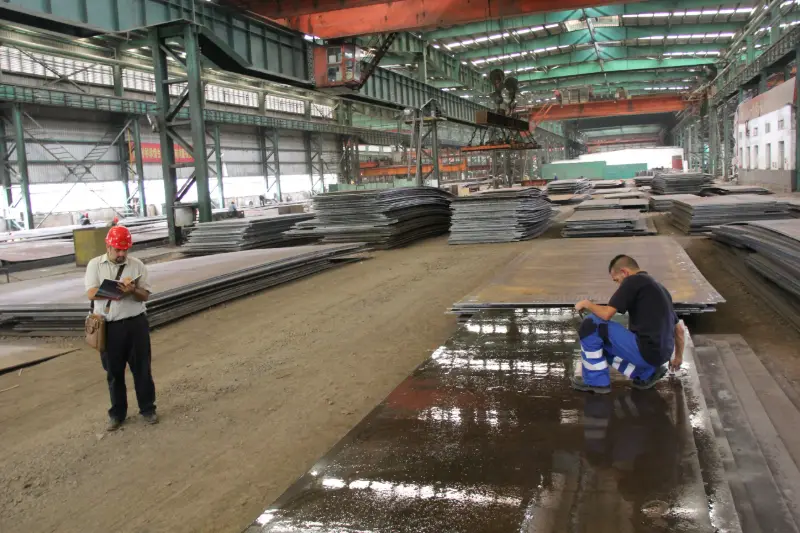
CCS Grade DH36 Shipbuilding Steel
CCS Grade DH36 Shipbuilding Steel: High-Strength Hull Plate with Superior Low-Temperature Toughness
Explore the comprehensive property profile of CCS Grade DH36 shipbuilding steel, including chemical composition, mechanical and thermal properties, international equivalents, and application guidance for marine and offshore structures.
Hot rolling, controlled rolling, normalizing, thermo-mechanical controlled processing (TMCP), welding, cutting, forming, machining
- Phone : +8618037372205
- Email : [email protected]
- WhatsApp: Contact via Whtsapp
- WeChat: +8618037372205
CCS Grade DH36 Shipbuilding Steel Introduction
CCS Grade DH36 is a high-strength hull structural steel certified by the China Classification Society (CCS). It belongs to the higher-strength shipbuilding steel category with a minimum yield strength of 355 MPa. The 'D' designation indicates guaranteed impact toughness at -20°C, while 'H36' specifies the strength level. Manufactured through controlled rolling, normalizing, or thermomechanical control processes, DH36 exhibits an excellent combination of strength, weldability, and notch toughness, making it ideal for critical structural components in ships and offshore platforms. Its fine-grain microstructure and controlled chemical composition ensure reliable low-temperature performance in harsh marine environments. Typical applications include hull plates, decks, bottom shells, and structural members such as stiffeners and bulkheads. Delivery condition is usually as-rolled, normalized, or TMCP with strict compliance to CCS Rules and Regulations for Materials and Welding.
CCS Grade DH36 Shipbuilding Steel Chemical Composition
The chemical composition of CCS DH36 is strictly controlled to ensure superior weldability and low-temperature toughness. Carbon equivalent (Ceq) limits are enforced based on thickness to prevent cold cracking. Grain-refining elements such as Nb, V, Ti may be added individually or in combination. Aluminum is used as a deoxidizer and grain refiner. Residual elements like Cu, Cr, Ni are present only as incidental impurities unless otherwise agreed. All values comply with CCS Rules.
| Element | Specification (max, unless range) | Remarks |
|---|---|---|
| C | ≤0.18% | For thickness ≤50 mm |
| Si | ≤0.50% | |
| Mn | 0.90–1.60% | |
| P | ≤0.035% | |
| S | ≤0.035% | |
| Al (acid soluble) | ≥0.015% | Or total Al ≥0.020% |
| Nb | 0.02–0.05% | Optional; if added |
| V | 0.05–0.10% | Optional; if added |
| Ti | ≤0.02% | Optional; if added |
| Ceq (IIW) | ≤0.38% | For thickness ≤50 mm; Ceq = C+Mn/6+(Cr+Mo+V)/5+(Ni+Cu)/15 |
| Others | Ni ≤0.40%, Cr ≤0.20%, Mo ≤0.08%, Cu ≤0.35%, if specified | Residual elements limited |
CCS Grade DH36 Shipbuilding Steel Thermal and Electrical Physical Properties
Physical properties are representative for low-carbon structural steel and are given as typical engineering values. These properties are essential for design analysis, heat transfer calculations, and electromagnetic compatibility. Variations may occur depending on exact composition and heat treatment. All values are for reference at approximately 20°C unless otherwise stated.
- Density: Determines weight and mass for structural design.
- Thermal expansion: Critical for assessing thermal stresses in welded assemblies.
- Thermal conductivity: Influences heat dissipation during welding and service.
- Electrical resistivity: Important for corrosion protection and induction heating applications.
| Property | Typical Value | Unit | Test Conditions |
|---|---|---|---|
| Density (ρ) | 7850 | kg/m³ | At 20°C |
| Elastic Modulus (E) | 205 | GPa | Tension, at 20°C |
| Shear Modulus (G) | 80 | GPa | At 20°C |
| Poisson's Ratio (ν) | 0.30 | – | Elastic range |
| Thermal Expansion Coefficient (α) | 11.7×10⁻⁶ | /K | 20–100°C |
| Thermal Expansion Coefficient (α) | 12.5×10⁻⁶ | /K | 20–200°C |
| Thermal Conductivity (λ) | 50 | W/(m·K) | At 20°C |
| Specific Heat Capacity (cp) | 460 | J/(kg·K) | At 20°C |
| Electrical Resistivity (ρe) | 0.13×10⁻⁶ | Ω·m | At 20°C |
CCS Grade DH36 Shipbuilding Steel Mechanical Properties
Mechanical testing is performed on representative samples in accordance with CCS rules. Tensile and impact specimens are taken in the longitudinal direction unless otherwise specified. Bend test is required to verify formability. Impact test temperature for DH36 is -20°C with a minimum average absorbed energy of 34 J (longitudinal) and 24 J (transverse) for standard Charpy V-notch specimens. Values depend on product thickness; the table lists requirements for common gauge ranges.
- Yield strength (ReH): ≥355 MPa up to 50 mm thickness
- Tensile strength (Rm): 490–630 MPa
- Elongation (A5): ≥21% for thickness ≤50 mm
| Property | Required Value | Unit | Test Conditions |
|---|---|---|---|
| Yield Strength (ReH) | ≥355 | MPa | Thickness ≤50 mm |
| Yield Strength (ReH) | ≥355 | MPa | Thickness >50–70 mm |
| Yield Strength (ReH) | ≥345 | MPa | Thickness >70–100 mm |
| Tensile Strength (Rm) | 490–630 | MPa | All thicknesses |
| Elongation (A5) | ≥21 | % | Gauge length 5.65√So; thickness ≤50 mm, longitudinal |
| Elongation (A5) | ≥21 | % | Thickness >50–70 mm, longitudinal |
| Elongation (A5) | ≥20 | % | Thickness >70–100 mm, longitudinal; value indicated is common practice but verify with standard |
| Charpy Impact (KV, -20°C, longitudinal) | ≥34 (average) | J | Full-size 10×10 mm specimen; individual min 24 J |
| Charpy Impact (KV, -20°C, transverse) | ≥24 (average) | J | Full-size 10×10 mm specimen; individual min 17 J |
| Bend Test (180°) | d=3a | – | Where a = specimen thickness; up to 25 mm thickness |
CCS Grade DH36 Shipbuilding Steel Fully Equivalent International Standards and Designations
| Country/Region | Standard / Classification Society | Grade | Remarks |
|---|---|---|---|
| USA | ABS Rules | DH36 | Same strength and -20°C impact requirement |
| Norway/Germany | DNV Rules (now DNV-GL) | DH36 | Direct equivalent |
| UK | Lloyd's Register (LR) | DH36 | Direct equivalent |
| France | Bureau Veritas (BV) | DH36 | Direct equivalent |
| Japan | Nippon Kaiji Kyokai (NK) | DH36 | Direct equivalent |
| Korea | Korean Register (KR) | DH36 | Direct equivalent |
| Italy | RINA | DH36 | Direct equivalent |
| Russia | Russian Maritime Register (RMRS) | D36 | Equivalent strength grade; check Charpy temperature requirements |
| International | IACS W27 | DH36 | Unified requirement for higher-strength structural steel |
CCS Grade DH36 Shipbuilding Steel Application Introduction
CCS Grade DH36 is specifically designed for welded marine and offshore structures where moderate low-temperature toughness is required. Its combination of high strength, good weldability, and notch toughness makes it suitable for both primary and secondary structural components. It can be fabricated using standard shipyard methods such as gas cutting, cold forming, and multi-pass welding. Use in dynamic loading conditions is permitted under classification rules. All forming and welding procedures should be qualified according to the relevant shipbuilding specifications.
Product Applications: Commercial ships: bulk carriers, tankers, container ships, Naval and auxiliary vessels, Jack-up rig legs and spudcans, Floating production storage and offloading (FPSO) units, Offshore platform topside modules, Bridge structural elements in marine environment
Processed into products: Hull plates, sheer strakes, bilge strakes, Deck plates and strength decks, Transverse and longitudinal bulkheads, Bottom shell and inner bottom plating, Web frames, stiffeners, and brackets, Rudder horns and stern frames, Bollards and mooring foundations, Transition pieces for offshore wind towers
Application industries: Shipbuilding and repair, Offshore oil and gas exploration, Marine engineering and vessel construction, Renewable energy (offshore wind turbine foundations), Port infrastructure and heavy lifting equipment
CCS Grade DH36 Shipbuilding Steel Similar or Comparable Materials for Alternative Selection
| Country/Region | Standard / Classification Society | Grade | Remarks |
|---|---|---|---|
| Common international | All IACS societies | AH36 | Same strength but Charpy test at 0°C instead of -20°C |
| Common international | All IACS societies | EH36 | Same strength, superior toughness at -40°C |
| Common international | All IACS societies | DH40 | Higher yield strength (≥390 MPa), -20°C toughness |
| China | GB 712-2011 | DH36 | National standard equivalent to CCS DH36 |
| Europe | EN 10025-4 | S355G2+M (marine structural) | Comparable strength and toughness; check acceptance criteria for specific standards |
Notes:
- The material is predominantly supplied in a normalized or TMCP condition with surface preparation and shop primer to prevent atmospheric corrosion during construction.
- For thicknesses beyond 50 mm or when additional toughness requirements apply, the carbon equivalent may be restricted further; supplementary testing (e.g., ultrasonic inspection) is recommended as per classification rules.
- Welding consumables should match the steel grade to maintain the overall structural integrity; preheating and interpass temperature control are essential when ambient temperature is low or when the carbon equivalent is near the upper limit.
- Additional specifications such as Z-direction properties (through-thickness tensile) can be specified for critical joints to avoid lamellar tearing.
- Always refer to the latest edition of the CCS Rules and the specific material certificate for the exact property values valid for the supplied product.
- Share



