
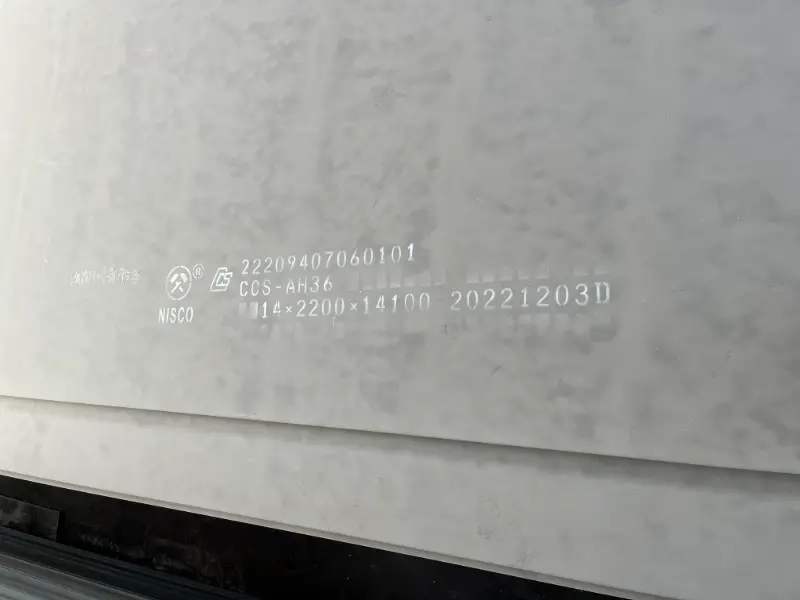
CCS Grade AH36 Shipbuilding Steel Plate
CCS Grade AH36 Shipbuilding Steel Plate: High-Strength Hull Structural Steel for Marine Engineering
Explore the properties and applications of CCS Grade AH36 shipbuilding steel plate, a high-strength hull structural steel compliant with the China Classification Society standards, widely used in ship hulls and offshore structures.
Hot Rolling, Normalizing, Controlled Rolling (TMCP), Welding, Cutting, Forming
- Phone : +8618037372205
- Email : [email protected]
- WhatsApp: Contact via Whtsapp
- WeChat: +8618037372205
CCS Grade AH36 Shipbuilding Steel Plate Introduction
CCS Grade AH36 is a high-strength hull structural steel governed by the China Classification Society (CCS) standards, aligning with GB/T 712. It is characterized by a minimum yield strength of 355 MPa and excellent weldability. The 'A' denotes its superior impact toughness at 0°C, making it ideal for critical ship structures. This steel grade is widely adopted in shipbuilding for decks, hulls, and bottom plates, as well as in offshore engineering for platforms and marine components. Its balanced composition ensures high resistance to brittle fracture and good machinability for large-scale marine constructions.
CCS Grade AH36 Shipbuilding Steel Plate Chemical Composition of CCS Grade AH36
The chemical composition of CCS Grade AH36 is strictly controlled to balance high strength and excellent weldability. The addition of grain-refining elements such as niobium (Nb), vanadium (V), and titanium (Ti) is allowed to improve the steel's toughness and strength. The low carbon content ensures good weldability for shipbuilding applications.
| Element | Standard Value | Remarks |
|---|---|---|
| Carbon (C) | ≤ 0.18% | Ensures weldability and toughness |
| Silicon (Si) | ≤ 0.50% | Deoxidizer and strength contributor |
| Manganese (Mn) | 0.90 ~ 1.60% | Improves hardenability and tensile strength |
| Phosphorus (P) | ≤ 0.035% | Impurity, restricted for toughness |
| Sulfur (S) | ≤ 0.035% | Impurity, restricted for ductility |
| Aluminium (Al, Acid-Soluble) | ≥ 0.015% (or equivalent deoxidation) | Fine grain practice |
| Niobium (Nb) | 0.02 ~ 0.05% | Optional grain refiner |
| Vanadium (V) | 0.05 ~ 0.10% | Optional grain refiner |
| Titanium (Ti) | ≤ 0.02% | Optional grain refiner |
| Copper (Cu) | ≤ 0.35% | Residual element, limited for hot shortness resistance |
| Chromium (Cr) | ≤ 0.20% | Residual element |
| Nickel (Ni) | ≤ 0.40% | Residual element |
| Molybdenum (Mo) | ≤ 0.08% | Residual element |
CCS Grade AH36 Shipbuilding Steel Plate Physical Properties of CCS Grade AH36
The physical properties represent typical ambient temperature values for high-strength low-alloy structural steels similar to AH36. These values are crucial for design calculations involving thermal expansion, heat transfer, and structural deformation analysis. Thermal conductivity and specific heat capacity support thermal analysis during welding processes.
| Property | Typical Value | Unit | Test Conditions / Remarks |
|---|---|---|---|
| Density (ρ) | 7.85 | g/cm³ | At 20°C |
| Modulus of Elasticity (E) | 205 | GPa | At 20°C |
| Shear Modulus (G) | 79 ~ 81 | GPa | At 20°C |
| Poisson's Ratio (ν) | 0.29 | - | At 20°C |
| Thermal Expansion Coefficient (α) | 11.8 | 10⁻⁶/K | Range: 20°C ~ 200°C |
| Thermal Expansion Coefficient (α) | 12.8 | 10⁻⁶/K | Range: 20°C ~ 400°C |
| Thermal Expansion Coefficient (α) | 13.5 | 10⁻⁶/K | Range: 20°C ~ 600°C |
| Thermal Conductivity (λ) | 46 ~ 52 | W/(m·K) | At 20°C |
| Specific Heat Capacity (c) | 460 ~ 480 | J/(kg·K) | At 20°C ~ 100°C |
| Electrical Resistivity (ρ_e) | 0.15 ~ 0.25 | Ω·mm²/m | At 20°C |
CCS Grade AH36 Shipbuilding Steel Plate Mechanical Properties of CCS Grade AH36
The mechanical properties of CCS Grade AH36 are evaluated via tensile and impact testing. The minimum yield strength is 355 MPa, ensuring high structural integrity. Impact testing at 0°C provides 34 J minimum longitudinal energy absorption. Different plate thickness ranges have distinct requirements for elongation and yield strength.
| Property | Standard Requirement Value | Unit | Test Conditions / Remarks |
|---|---|---|---|
| Yield Strength (ReH, min.) | 355 | MPa | Plate thickness (t) ≤ 50 mm |
| Yield Strength (ReH, min.) | 345 | MPa | 50 mm < t ≤ 70 mm |
| Yield Strength (ReH, min.) | 335 | MPa | 70 mm < t ≤ 100 mm |
| Tensile Strength (Rm) | 490 ~ 620 | MPa | All thicknesses |
| Elongation (A, min.) | 21 | % | Plate thickness (t) ≤ 50 mm, gauge length L₀=5.65√S₀ |
| Charpy V-Notch Impact Energy (KV, min., Longitudinal) | 34 | J | Test temperature: 0°C |
| Charpy V-Notch Impact Energy (KV, min., Transverse) | 24 | J | Test temperature: 0°C |
| Bend Test, 180° (Ratio of mandrel diameter to thickness) | d=3a | - | Up to thickness ≤ 25 mm; no cracks or fissures allowed |
CCS Grade AH36 Shipbuilding Steel Plate Exact Equivalent Material Standards and Replaceable Grades
| Country/Region | Standard / Classification Society | Grade | Remarks |
|---|---|---|---|
| International | IACS (International Association of Classification Societies) | AH36 | Unified Requirement UR W11, Equivalent strength and impact toughness class |
| China | CCS (China Classification Society) | AH36 | Base standard, 0°C impact test |
| China | GB/T 712 | AH36 | Equivalent Chinese national standard |
| USA | ABS (American Bureau of Shipping) | AH36 | Identical requirements for chemical and mechanical properties |
| Norway / Germany | DNV (Det Norske Veritas) | AH36 | Identical requirements per DNV rules |
| UK | LR (Lloyd's Register) | AH36 | Identical requirements per LR rules |
| France | BV (Bureau Veritas) | AH36 | Identical requirements per BV rules |
| Japan | NK (Nippon Kaiji Kyokai) | AH36 | Identical requirements per NK rules |
| Italy | RINA (Registro Italiano Navale) | AH36 | Identical requirements per RINA rules |
| South Korea | KR (Korean Register) | AH36 | Identical requirements per KR rules |
| Russia | RS (Russian Maritime Register of Shipping) | AH36 | Identical requirements per RS rules |
CCS Grade AH36 Shipbuilding Steel Plate Application Introduction
CCS AH36 steel is engineered for marine structures requiring high strength, excellent weldability, and reliable low-temperature toughness. It is primarily used in the shipbuilding industry for constructing hulls, decks, and structural members, as well as in offshore engineering for jack-up rigs and platforms. Its good formability and flatness make it ideal for automated welding and cutting processes.
Product Applications: Cargo ship hulls (Bulk carriers, Container ships), Oil tankers and chemical tankers, Offshore platform decks and jackets, Naval auxiliary vessels, Barge structures, FPSO (Floating Production, Storage, and Offloading) units
Processed into products: Main deck plates, Bottom shell plates, Side shell plates, Bulkhead plates, Hull stiffeners and frames, Transverse bulkheads, Hatch coamings, Offshore platform legs and bracings, Bracket plates, Keel plates
Application industries: Shipbuilding (commercial and naval vessels), Offshore Oil and Gas (platforms, rigs, FPSOs), Marine Engineering (docks, harbor constructions, barges), Bridge Construction (marine and river bridges), Structural Engineering (offshore wind turbine foundations), Heavy Transport (large vessels, crane structures)
CCS Grade AH36 Shipbuilding Steel Plate Similar and Alternative Materials Recommendation
| Country/Region | Standard / Classification Society | Grade | Remarks / Differences |
|---|---|---|---|
| China / International | CCS / IACS | AH32 | Lower minimum yield strength (315 MPa), same impact temperature class |
| China / International | CCS / IACS | AH40 | Higher minimum yield strength (390 MPa), suitable for heavier load structures but requires stricter welding procedures |
| China / International | CCS / IACS | DH36 | Same strength (355 MPa), but higher impact toughness grade (-20°C), better for colder environments |
| China / International | CCS / IACS | EH36 | Same strength (355 MPa), but even higher impact toughness grade (-40°C), for extreme cold regions |
| European Union | EN 10025-2 / EN 10025-3 | S355J2+N, S355N | Similar yield strength (355 MPa), impact at -20°C, non-marine certified structural steel. Surface quality and ultrasound requirements differ. |
| Japan | JIS G 3106 | SM490YA | Yields 365 MPa minimum, impact tested at 0°C. Used in welded structures but lacks mandatory classification society marine approval. |
Notes:
CCS AH36 plates can be delivered with additional requirements per the buyer's specifications, including Z-direction tensile properties (Z25/Z35) for improved through-thickness ductility, Ultrasonic Testing (UT) according to ASTM A578 or EN 10160, and endorsement by multiple classification societies (Dual Certification). For thicknesses above 20 mm, normalizing or TMCP delivery condition is highly recommended to ensure homogenized microstructure and toughness.
- Share



