
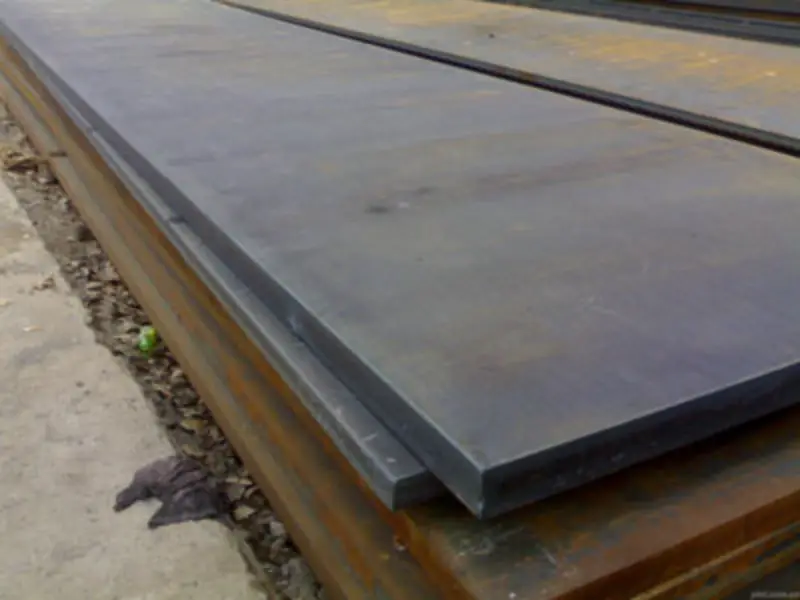
CCS FH32 Shipbuilding Steel Plate
CCS FH32 Shipbuilding Steel Plate: Low-Temperature High-Strength Marine Structural Steel
CCS FH32 is a high-strength hull structural steel plate with guaranteed low-temperature toughness down to -60°C, approved by China Classification Society.
Hot rolling, controlled rolling (TMCP), normalizing, cutting, welding, cold forming
- Phone : +8618037372205
- Email : [email protected]
- WhatsApp: Contact via Whtsapp
- WeChat: +8618037372205
CCS FH32 Shipbuilding Steel Plate Introduction
CCS FH32 is a high-strength, low-temperature shipbuilding steel grade certified by the China Classification Society (CCS). Designed for critical structural components in ships and offshore platforms operating in extremely cold environments, FH32 exhibits minimum yield strength of 315 MPa and excellent notch toughness at -60°C. The steel is produced through controlled rolling or normalizing, ensuring fine grain structure and reliable weldability. Its chemical composition is strictly controlled, with microalloying elements such as niobium and vanadium added for grain refinement and precipitation strengthening. FH32 meets the requirements of IACS UR W for hull structural steels and is fully equivalent to FH32 grades recognized by other major classification societies. Typical applications include shell plates, decks, and stiffeners for ice-class vessels, LNG carriers, and Arctic offshore structures where resistance to brittle fracture is paramount.
CCS FH32 Shipbuilding Steel Plate Chemical Composition
Chemical composition limits for CCS FH32 steel as specified in CCS Rules for Classification of Sea-going Steel Ships. The values represent ladle analysis limits. Microalloying elements (Nb, V, Ti, etc.) may be added singly or in combination to achieve specified mechanical properties. Aluminum is added as a grain refiner; the total aluminum content is reported, with acid-soluble aluminum (Als) ≥ 0.015% typically required.
| Element | Standard Value | Remarks |
|---|---|---|
| Carbon (C) | ≤ 0.18% | Ladle analysis |
| Silicon (Si) | ≤ 0.50% | |
| Manganese (Mn) | 0.90 - 1.60% | Higher Mn may be agreed for thickness > 25 mm |
| Phosphorus (P) | ≤ 0.025% | |
| Sulfur (S) | ≤ 0.025% | |
| Aluminum (Al, total) | ≥ 0.020% | Typically 0.020 - 0.050%; acid-soluble Al ≥ 0.015% |
| Niobium (Nb)* | 0.02 - 0.05% | Optional grain-refining element |
| Vanadium (V)* | 0.05 - 0.10% | Optional grain-refining element |
| Titanium (Ti)* | ≤ 0.02% | Optional grain-refining element |
| Copper (Cu) | ≤ 0.35% | Residual element limit |
| Chromium (Cr) | ≤ 0.20% | Residual element limit |
| Nickel (Ni) | ≤ 0.40% | Residual element limit |
| Molybdenum (Mo) | ≤ 0.08% | Residual element limit |
| Ceq (Carbon Equivalent) | ≤ 0.38% | Ceq = C + Mn/6 + (Cr+Mo+V)/5 + (Ni+Cu)/15; typically controlled for weldability |
CCS FH32 Shipbuilding Steel Plate Physical and Thermal Properties
The following physical and thermal properties are typical values for normalized or TMCP processed FH32 steel at room temperature unless specified otherwise. These values are provided for engineering calculations and are not mandatory requirements in the CCS specification. Actual values may vary slightly depending on the specific mill and processing route.
| Property | Typical Value | Unit | Test Condition / Remarks |
|---|---|---|---|
| Density (ρ) | 7.85 | g/cm³ | 20°C |
| Modulus of elasticity (E) | 205 | GPa | 20°C |
| Shear modulus (G) | 79.3 | GPa | Calculated from E and Poisson's ratio |
| Poisson's ratio (ν) | 0.3 | — | 20°C |
| Thermal expansion coefficient (α) | 11.5 | 10&supminus;&sup6;/K | 20 - 100°C |
| Thermal expansion coefficient (α) | 12.0 | 10&supminus;&sup6;/K | 20 - 200°C |
| Thermal expansion coefficient (α) | 13.0 | 10&supminus;&sup6;/K | 20 - 400°C |
| Thermal conductivity (λ) | 50 | W/(m·K) | 20°C |
| Specific heat capacity (cp) | 460 | J/(kg·K) | 20°C |
| Electrical resistivity (ρe) | 0.20 | μΩ·m | 20°C |
CCS FH32 Shipbuilding Steel Plate Mechanical Properties
Mechanical property requirements for CCS FH32 steel plates ≤ 50 mm thickness, tested in transverse direction (tensile) and longitudinal (impact) unless otherwise agreed. The specified values are minimum unless a range is given. Impact test temperature is -60°C. For thicknesses > 50 mm, requirements may be subject to agreement or reduced according to CCS rules. Longitudinal impact energy values apply to standard Charpy V-notch specimens.
| Property | Standard Required Value | Unit | Test Condition |
|---|---|---|---|
| Upper yield strength (ReH) or proof strength (Rp0.2) | ≥ 315 | MPa | t ≤ 50 mm, transverse |
| Tensile strength (Rm) | 440 - 590 | MPa | t ≤ 50 mm, transverse |
| Elongation after fracture (A5) | ≥ 22 | % | Gauge length 5.65√S0; t ≤ 50 mm, transverse |
| Bend test (180°) | No cracks or rupture | — | Mandrel diameter = 2a (a = specimen thickness); t ≤ 50 mm |
| Impact absorbed energy (KV2) | ≥ 34 (average) | J | Charpy V-notch, longitudinal, -60°C; single value min. 24 J |
| Impact absorbed energy (KV2), transverse | ≥ 24 (average) | J | Charpy V-notch, transverse, -60°C (if required) |
CCS FH32 Shipbuilding Steel Plate Full Equivalent Material Standards and Grades
| Country/Region | Standard | Grade | Remarks |
|---|---|---|---|
| International Association of Classification Societies (IACS) | IACS UR W | FH32 | Common requirement; individual society specifications are based on this |
| American Bureau of Shipping | ABS Rules | FH32 | Identical grade for low-temperature hull structures |
| Bureau Veritas | BV Rules | FH32 | Same impact test temperature (-60°C) |
| DNV GL (now DNV) | DNV Rules | FH32 (formerly NV FH32) | Merged DNV and GL grade; -60°C impact |
| Lloyd's Register | LR Rules | FH32 | Full equivalence; also covered by LR FH32 |
| ClassNK | NK Rules | FH32 | Japanese ship classification equivalent |
| Registro Italiano Navale | RINA Rules | FH32 | Italian classification society grade |
| Korean Register | KR Rules | FH32 | Korean classification society grade |
| Russian Maritime Register of Shipping | RS Rules | FH32 | Russian classification; -60°C grade |
CCS FH32 Shipbuilding Steel Plate Application Introduction
CCS FH32 steel is engineered for ship and offshore structures that must endure extremely low temperatures without brittle fracture. Its excellent notch toughness at -60°C makes it suitable for
- Ice-strengthened hulls and icebreakers operating in Arctic and Antarctic waters
- Liquefied gas carrier cargo tanks (LPG, LEG, LNG) where low-temperature stress demands F-grade material
- Offshore platform columns, legs, and nodes in cold climate regions
- Large container ship strength decks and hatch coamings
The steel can be efficiently welded using low-hydrogen processes and pre-qualified welding procedures, with no post-weld heat treatment generally required for plates up to moderate thicknesses. It is also suitable for cold forming and bending operations when proper radii are observed.
Product Applications: Hull shell plates for ice-class vessels (Polar Class PC1-PC7), Deck stringer and sheer strake plates, Longitudinal stiffeners and web frames, Bottom and side shell plates of crude oil tankers, Legs of jack-up offshore platforms, Piles and transition pieces for offshore wind turbines in cold seas
Processed into products: Ice belt plates and ice knife structures, Bow and stern frames for icebreakers, Independent cargo tank type-B and membrane tank supports for LNG carriers, Heavy-lift crane pedestal base plates, Riser supports and conductor guides on drilling platforms, Deck girders and hatch corners on large ore carriers
Application industries: Shipbuilding (commercial and naval), Offshore oil and gas exploration, LNG/LPG carrier construction, Port and harbor machinery, Arctic engineering
CCS FH32 Shipbuilding Steel Plate Similar Alternative Materials
| Country/Region | Standard/Grade | Grade | Remarks |
|---|---|---|---|
| IACS | UR W | DH32 | Lower toughness grade; impact test at -20°C instead of -60°C |
| IACS | UR W | EH32 | Intermediate toughness; impact test at -40°C |
| IACS | UR W | FH36 | Higher strength grade (min. yield 355 MPa) with same -60°C impact requirement |
| China | CCS Rules | FH36 | Higher strength alternative if greater load-bearing capacity is needed |
| International (EN) | EN 10025-3 | S355NL | Structural steel with min. yield 355 MPa and impact down to -50°C; slightly lower toughness temperature than FH32 |
| International (EN) | EN 10225 | S355G10+N | Offshore structural steel with guaranteed properties down to -40°C; comparable strength but higher toughness class recommended for -60°C |
Notes:
- CCS FH32 may be ordered with supplementary requirements such as through-thickness properties (Z35), ultrasonic testing (UT) per SEL, and CTOD testing for critical offshore applications.
- Welding consumables must be matched to achieve equivalent low-temperature toughness in the heat-affected zone; preheating is typically not required for thicknesses below 50 mm if combined thickness and heat input are controlled.
- For thicknesses above 25 mm, step cooling or static cooling tests may be invoked to guarantee freedom from temper embrittlement.
- Carbon equivalent (Ceq) is routinely reported to ensure weldability and compliance with the specified limits.
- Plates are usually marked with the CCS stamp, heat number, grade, and thickness.
- Share



