
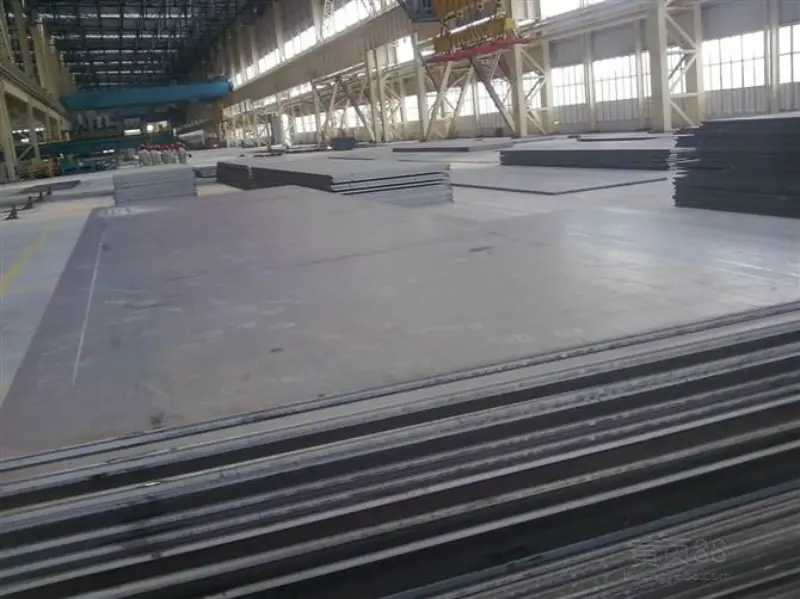
CCS Grade EH32 Shipbuilding Steel Plate
CCS Grade EH32 Shipbuilding Steel Plate - High-Strength Low-Temperature Hull Structural Material
Detailed material data for CCS Grade EH32 shipbuilding steel plate including chemical composition, mechanical and physical properties, international equivalents, and application guidance.
Hot rolling followed by normalizing or thermo-mechanical controlled processing (TMCP); suitable for cutting, cold forming, and welding
- Phone : +8618037372205
- Email : [email protected]
- WhatsApp: Contact via Whtsapp
- WeChat: +8618037372205
CCS Grade EH32 Shipbuilding Steel Plate Introduction
CCS Grade EH32 is a high-strength shipbuilding structural steel plate certified by the China Classification Society (CCS) in accordance with the IACS UR W11 unified requirement. It belongs to the 315 MPa minimum yield strength category and is specifically designed for welded hull structures requiring guaranteed notch toughness at -40°C. Key characteristics:
- Minimum yield strength of 315 MPa for thicknesses ≤50 mm
- Excellent low-temperature impact toughness (longitudinal KV ≥31 J at -40°C)
- Good weldability with controlled carbon equivalent (typically ≤0.38%)
- Suitable for highly stressed parts of sea-going vessels operating in cold environments
- Supplied in normalized or thermo-mechanically controlled processed (TMCP) condition
This steel grade ensures reliable performance in critical structural applications such as hull plating, decks, and stiffeners.
CCS Grade EH32 Shipbuilding Steel Plate Chemical Composition
Chemical composition limits as per CCS Rules for Materials and Welding, aligning with IACS UR W11 for EH32 grade. All values are in weight percent. Grain-refining elements (Nb, V, Ti, Al) may be added individually or in combination. The carbon equivalent (Ceq) is typically controlled to ≤0.38% for weldability.
- Ladle analysis values are given; product analysis tolerances apply per standard.
- Residual elements such as Cu, Cr, Ni, and Mo are limited as shown but may be higher if specifically agreed.
| Element | Standard Value (max unless range) | Remarks |
|---|---|---|
| C (Carbon) | 0.18 | Mandatory element |
| Si (Silicon) | 0.50 | Deoxidizer and strength contributor |
| Mn (Manganese) | 0.90 – 1.60 | Primary solid-solution strengthening element |
| P (Phosphorus) | 0.035 | Maximum limit to avoid embrittlement |
| S (Sulfur) | 0.035 | Maximum limit for toughness and weldability |
| Al (Acid-soluble Al) | ≥ 0.015 | Required when grain refinement is achieved with aluminium |
| Nb (Niobium) | 0.02 – 0.05 | Optional microalloy; sum Nb+V+Ti ≤ 0.12% |
| V (Vanadium) | 0.05 – 0.10 | Optional microalloy; sum Nb+V+Ti ≤ 0.12% |
| Ti (Titanium) | ≤ 0.02 | Optional microalloy; sum Nb+V+Ti ≤ 0.12% |
| Cu (Copper) | ≤ 0.35 | Residual element limit |
| Cr (Chromium) | ≤ 0.20 | Residual element limit |
| Ni (Nickel) | ≤ 0.40 | Residual element limit |
| Mo (Molybdenum) | ≤ 0.08 | Residual element limit |
| Ceq (Carbon Equivalent) | ≤ 0.38 (typical) | Based on IIW formula, may be specified to ensure weldability |
CCS Grade EH32 Shipbuilding Steel Plate Thermal and Electrical Physical Properties
The following physical properties are typical for normalized or TMCP carbon-manganese shipbuilding steels of the EH32 category at ambient temperature unless indicated otherwise. These values are provided for engineering guidance and are not mandatory per classification rules.
- Density is consistent with low-alloy steels.
- Thermal expansion, conductivity, and specific heat are average values over common service temperature ranges.
- Electrical resistivity is suitable for welding and corrosion protection calculations.
| Property | Typical Value | Unit | Test Condition / Remarks |
|---|---|---|---|
| Density (ρ) | 7.85 | g/cm³ | At 20°C |
| Modulus of Elasticity (E) | 200 – 210 | GPa | At room temperature |
| Shear Modulus (G) | 80 – 84 | GPa | Calculated from E and Poisson's ratio |
| Poisson's Ratio (ν) | 0.3 | - | Elastic range |
| Thermal Expansion Coefficient (α) | 12.0 (20–100°C) / 13.5 (20–200°C) | 10⁻⁶/K | Average linear expansion |
| Thermal Conductivity (λ) | 45 – 50 | W/(m·K) | At 20°C, decreases with temperature |
| Specific Heat Capacity (cp) | 460 – 500 | J/(kg·K) | At 20–100°C |
| Electrical Resistivity (ρe) | 0.20 – 0.25 | μΩ·m | At 20°C |
CCS Grade EH32 Shipbuilding Steel Plate Mechanical Properties
Mechanical properties for CCS EH32 steel plate as required by the CCS Rules, valid for plate thickness ≤50 mm unless otherwise stated. Tensile testing is performed on transverse specimens, while impact testing is on longitudinal specimens.
- Bend test: specimens must withstand 180° bending without cracking around a former of diameter 3 times the specimen thickness.
- Impact energy values are for standard 10x10 mm Charpy-V specimens; sub-size specimen values are prorated.
- Properties for thicknesses >50 mm shall be agreed between the manufacturer and the classification society.
| Property | Required Value | Unit | Test Condition |
|---|---|---|---|
| Yield Strength (ReH) | ≥ 315 | MPa | Transverse, room temperature, t ≤ 50 mm |
| Tensile Strength (Rm) | 440 – 570 | MPa | Transverse, room temperature, t ≤ 50 mm |
| Elongation (A) | ≥ 22 | % | Transverse, gauge length 5.65√So, t ≤ 50 mm |
| Bend Test (Bend diameter) | d = 3a | - | 180° bend, a = specimen thickness, no cracks |
| Charpy Impact Energy (KV) | ≥ 31 | J | Longitudinal, -40°C, average of 3 tests (min single value ≥ 22 J) |
CCS Grade EH32 Shipbuilding Steel Plate Exact Equivalent Material Standards and Substitutable Grades
| Country / Region | Standard / Classification Society | Grade | Remarks |
|---|---|---|---|
| International | IACS UR W11 | EH32 | Unified requirement for all IACS members |
| USA | ABS (American Bureau of Shipping) | EH32 | Identical requirements under ABS Rules |
| UK | LR (Lloyd's Register) | EH32 | Equivalent grade, same -40°C toughness |
| Norway / Germany | DNV (Det Norske Veritas) | EH32 | Now DNV GL, identical EH32 category |
| France | BV (Bureau Veritas) | EH32 | Fully compatible with CCS EH32 |
| Germany | GL (Germanischer Lloyd) | EH32 | Legacy grade, now integrated into DNV |
| Japan | NK (ClassNK) | EH32 | Equivalent per Nippon Kaiji Kyokai rules |
| South Korea | KR (Korean Register) | EH32 | Same chemical and mechanical requirements |
| Italy | RINA (Registro Italiano Navale) | EH32 | Fully recognized equivalent |
| China | CCS (China Classification Society) | EH32 | Original specification per CCS Rules |
CCS Grade EH32 Shipbuilding Steel Plate Application Introduction
CCS EH32 steel is primarily engineered for critical structural components in shipbuilding and offshore engineering. Its combination of high strength and guaranteed low-temperature toughness makes it ideal for vessels operating in cold climates or ice-class ships. Typical processing includes:
- Thermal cutting (plasma/laser) and edge machining
- Cold forming (with caution regarding minimum bending radii)
- Welding by all common arc processes (SMAW, SAW, GMAW, FCAW) using low-hydrogen consumables
- Post-weld heat treatment is generally not required for thicknesses ≤50 mm when proper preheat and interpass temperature controls are applied
Product Applications: Ocean-going cargo ships (container, bulk carrier, tanker), LNG/LPG carriers and FPSO hulls, Ro-Ro ferries and passenger ships, Offshore wind turbine foundation transition pieces, Heavy-duty floating cranes and dredgers
Processed into products: Main deck plates and stringer plates, Side shell and bottom shell strakes, Transverse and longitudinal bulkheads, Web frames and floor plates, Hatch coaming and crane pedestal structures, Bracket plates and stiffener profiles (angle, bulb flat, T-bar), Ice belt plating (when supplemented by higher-strength grades)
Application industries: Shipbuilding (hull, decks, bulkheads, superstructures), Offshore oil & gas platforms (jacket legs, deck plates, modules), Marine engineering (docks, floating cranes, barges), Ice-breaking vessels and Arctic service ships, Naval and coast guard vessel construction
CCS Grade EH32 Shipbuilding Steel Plate Similar or Functionally Analogous Material Alternatives
| Country / Region | Standard / Classification Society | Grade | Remarks |
|---|---|---|---|
| International | IACS UR W11 | EH36 | Higher strength variant (yield 355 MPa) with similar low-temperature toughness; may be used where thickness reduction is acceptable |
| International | IACS UR W11 | DH32 | Identical strength but impact test at -20°C instead of -40°C; suitable for less severe cold environments |
| EU | EN 10025-4 | S355ML | Thermo-mechanically rolled weldable fine-grain structural steel with minimum yield 355 MPa and impact down to -50°C; not classed for marine but chemically close |
| China | GB/T 712 | EH32 | Chinese national standard for shipbuilding steel, equivalent to CCS EH32; same requirements |
| USA | ASTM A131 / A131M | EH32 | ASTM shipbuilding steel specification also recognizes EH32 with same properties; limited availability compared to ABS |
| Japan | JIS G 3106 | SM490YB / SM490YB | High-tensile strength steel for welded structures with similar strength level but different toughness requirements; not directly classed for marine unless agreed |
Notes:
- Welding considerations: Preheating (75–125°C) is recommended for carbon equivalent near the upper limit or thicker sections; low-hydrogen electrodes are essential to prevent cold cracking.
- Certification: All plates must be stamped with the classification society's mark, steel grade, heat number, and manufacturer's identification. Impact test reports at -40°C are mandatory.
- Dimensional tolerances: As per CCS rules or EN 10029 for plate flatness and thickness; specific tighter tolerances may be required for automated welding processes.
- Corrosion protection: Standard hull painting systems are compatible; thorough surface preparation (Sa 2½) is necessary before coating.
- Further processing: EH32 is not intended for post-delivery heat treatment; if stress relieving is required (e.g., after severe forming), the mechanical properties should be reverified.
- Share



