
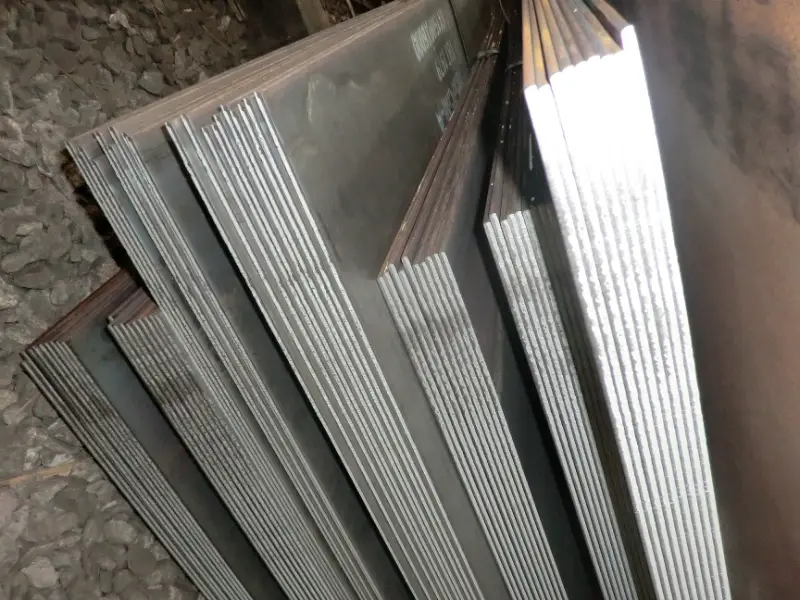
CCS DH32 Shipbuilding Steel Plate
CCS DH32 Shipbuilding Steel Plate: High-Strength Hull Structural Steel with Exceptional Low-Temperature Toughness
Explore the full datasheet of CCS Grade DH32 shipbuilding steel plate: chemical composition, mechanical and thermal properties, international equivalents, and application guide for marine and offshore structures.
Hot rolling, controlled rolling (TMCP), normalizing, cutting, forming, welding, machining
- Phone : +8618037372205
- Email : [email protected]
- WhatsApp: Contact via Whtsapp
- WeChat: +8618037372205
CCS DH32 Shipbuilding Steel Plate Introduction
CCS Grade DH32 is a high-strength shipbuilding steel plate certified by the China Classification Society (CCS) for use in hull and offshore structures. It belongs to the higher-strength hull structural steel group, offering a minimum yield strength of 315 MPa and excellent toughness at -20°C. This grade is produced through controlled rolling or normalizing processes, ensuring fine grain structure and good weldability. Typical thicknesses range from 6 mm to 100 mm, making it suitable for critical structural components such as decks, bottom shells, and bulkheads. DH32 steel meets the requirements of IACS UR W11 and can be equivalently supplied under other classification societies like ABS, DNV, LR, and BV, facilitating global shipbuilding projects.
CCS DH32 Shipbuilding Steel Plate Chemical Composition
The chemical composition of CCS DH32 is designed to ensure adequate strength, weldability, and low-temperature toughness. Carbon is limited to maintain good weldability, while manganese and silicon contribute to solid solution strengthening. Fine grain practice is ensured by the presence of sufficient acid-soluble aluminium or other grain-refining elements such as niobium, vanadium, or titanium. Residual elements (Cr, Ni, Mo, Cu) are not intentionally added but may be present from scrap; their combined effect is controlled via carbon equivalent (Ceq) to prevent hardness in the heat-affected zone. The table below lists the required ranges as per CCS Rules.
| Element | Standard Value (%) | Remarks |
|---|---|---|
| C | ≤ 0.18 | Ladle analysis |
| Mn | 0.90 – 1.60 | Corresponds to strength level |
| Si | 0.10 – 0.50 | Ensures deoxidation |
| P | ≤ 0.035 | Maximum |
| S | ≤ 0.035 | Maximum |
| Als | ≥ 0.015 | Acid-soluble aluminium, if grain refinement by Al |
| Nb | 0.02 – 0.05 (optional) | May be added for grain refinement |
| V | 0.05 – 0.10 (optional) | May be added for grain refinement |
| Ti | ≤ 0.02 (optional) | May be added for grain refinement |
| Cr | ≤ 0.20 | Residual |
| Ni | ≤ 0.40 | Residual |
| Mo | ≤ 0.08 | Residual |
| Cu | ≤ 0.35 | Residual |
| Ceq | ≤ 0.38 | Carbon equivalent = C+Mn/6+(Cr+Mo+V)/5+(Ni+Cu)/15 |
CCS DH32 Shipbuilding Steel Plate Thermal and Electrical Physical Properties
The following physical properties are typical for DH32 grade steel at room temperature unless otherwise indicated. These values are not mandatory specification requirements but serve as reference for engineering design, thermal stress analysis, and processing. Slight variations may occur depending on exact composition and manufacturing route.
| Property | Typical Value | Unit | Test Condition |
|---|---|---|---|
| Density (ρ) | 7.85 | g/cm³ | 20 °C |
| Elastic Modulus (E) | 200 | GPa | Ambient temperature |
| Shear Modulus (G) | 80 | GPa | Ambient temperature |
| Poisson's Ratio (ν) | 0.3 | – | Ambient temperature |
| Thermal Expansion Coefficient (α) | 12.5 x 10⁻⁶ | /K | 20 – 100 °C |
| Thermal Expansion Coefficient (α) | 13.0 x 10⁻⁶ | /K | 20 – 200 °C |
| Thermal Conductivity (λ) | 50 | W/(m·K) | 20 °C |
| Specific Heat Capacity (c) | 460 | J/(kg·K) | 20 °C |
| Electrical Resistivity (ρₑ) | 0.20 – 0.25 | µΩ·m | 20 °C |
CCS DH32 Shipbuilding Steel Plate Mechanical Properties
Mechanical properties are verified on test specimens taken from the delivered plate in normalized or TMCP condition. The requirements depend on plate thickness. Tensile testing is performed on transverse specimens in accordance with CCS rules. Impact tests are carried out at -20 °C, which is designated by the letter D in the grade name. Values below are minimum requirements unless a range is given.
| Property | Required Value | Unit | Test Condition / Thickness |
|---|---|---|---|
| Yield Strength (ReH) | ≥ 315 | MPa | t ≤ 100 mm; transverse |
| Tensile Strength (Rm) | 440 – 590 | MPa | t ≤ 100 mm; transverse |
| Elongation (A) | ≥ 22 | % | t ≤ 50 mm; gauge length 5.65√S₀; transverse |
| Elongation (A) | ≥ 21 | % | 50 < t ≤ 100 mm; transverse |
| Bend Test | d = 3a | – | 180° bend; t ≤ 25 mm; no cracks or ruptures |
| Bend Test | d = 4a | – | 180° bend; 25 < t ≤ 50 mm |
| Bend Test | d = 5a | – | 180° bend; 50 < t ≤ 100 mm |
| Impact Energy (KV2) | ≥ 31 (longitudinal) | J | -20 °C; average of 3 specimens; t ≤ 50 mm |
| Impact Energy (KV2) | ≥ 22 (transverse) | J | -20 °C; average of 3 specimens; t ≤ 50 mm |
CCS DH32 Shipbuilding Steel Plate Fully Equivalent Material Designations and Standards
| Country / Region | Standard / Classification Society | Grade | Remarks |
|---|---|---|---|
| International (IACS) | IACS UR W11 | DH32 | Base unified requirement |
| China | CCS Rules | DH32 | China Classification Society |
| USA | ABS Rules | DH32 | American Bureau of Shipping |
| France | BV Rules | DH32 | Bureau Veritas |
| Norway/Germany | DNV GL Rules | DH32 | DNV GL classification |
| UK | LR Rules | DH32 | Lloyd's Register |
| Japan | NK Rules | DH32 | ClassNK (Nippon Kaiji Kyokai) |
| South Korea | KR Rules | DH32 | Korean Register |
| Italy | RINA Rules | DH32 | Registro Italiano Navale |
| India | IRS Rules | DH32 | Indian Register of Shipping |
| Russia | RMRS Rules | DH32 | Russian Maritime Register of Shipping |
CCS DH32 Shipbuilding Steel Plate Application Introduction
CCS DH32 steel plate is extensively used in shipbuilding and marine engineering due to its balanced strength, ductility, and excellent weldability. It can be fabricated into various structural components, both flat and curved, using conventional hot-working and cold-forming processes. Designers should consider the guaranteed impact energy at -20 °C when selecting this grade for low-temperature service environments. The steel is readily weldable with appropriate preheating for thicker sections and using low-hydrogen welding consumables.
Product Applications: Merchant ships (bulk carriers, tankers, container vessels), Passenger ships and ferries, Naval vessels, Floating production storage and offloading (FPSO) units, Offshore jackets, topsides, and substructures, Ship deckhouses and hatches, Dockside and port cranes
Processed into products: Hull plating (bottom shell, side shell, sheer strake), Weather decks and strength decks, Longitudinal and transverse bulkheads, Stiffeners, girders, and floors, Rudder plates and horn structures, Hatch coamings and covers, Foundations for heavy machinery and engines, Structures in ice-strengthened vessels
Application industries: Shipbuilding and ship repair, Offshore oil and gas platform construction, Marine engineering, Port and harbor machinery, Renewable energy (offshore wind turbine substructures), Military and coast guard vessel construction
CCS DH32 Shipbuilding Steel Plate Similar Material Grades with Comparable Performance
| Country / Region | Standard | Grade | Remarks |
|---|---|---|---|
| All CCS/IACS | CCS Rules | AH32 | Same strength level, impact test at 0 °C instead of -20 °C |
| All CCS/IACS | CCS Rules | EH32 | Same strength level, impact test at -40 °C; higher toughness |
| All CCS/IACS | CCS Rules | DH36 | Higher yield strength (≥ 355 MPa), same impact temperature -20 °C |
| China | GB/T 712 | DH32 | Chinese national standard for shipbuilding steel, identical technical requirements |
| Japan | JIS G 3106 | SM490B | Similar strength, but toughness requirements and certification differ (not a direct substitute without class approval) |
| International | API Spec 2W / 2H | Gr.50 (Zones) | For offshore structures; requires supplementary testing to meet ship classification rules |
Notes:
For thicknesses above 50 mm, supplementary impact testing and ultrasonic inspection may be required by classification rules. When ordering, specify normalized or TMCP condition, and whether through-thickness properties (Z-grade) are needed. Welding should follow approved procedures with low-hydrogen electrodes; preheat may be applied for sections thicker than 30 mm. This grade is compatible with high-heat-input welding processes when microalloyed with Nb, V, or Ti. The information provided is based on CCS Rules typical specification; for critical applications, verify with the latest edition of the relevant classification society rules.
- Share



