
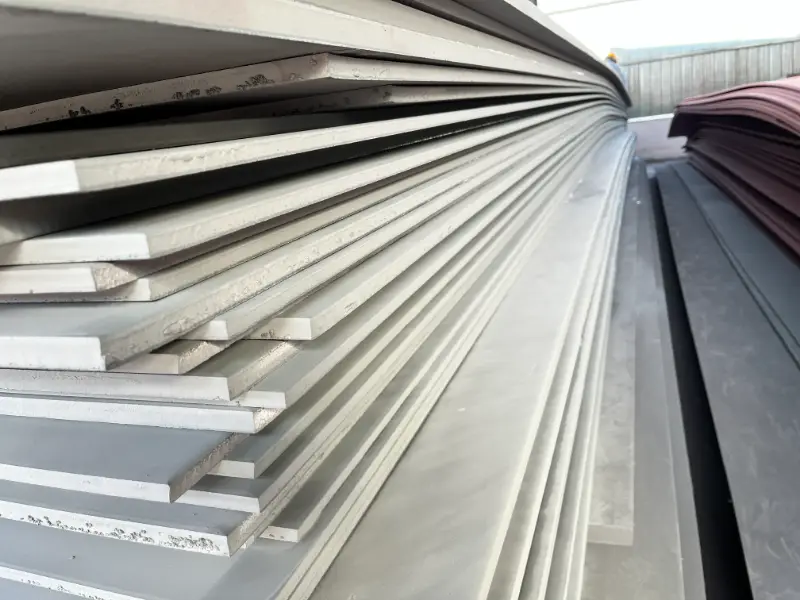
CCS AH32 Shipbuilding Steel Plate
CCS Grade AH32 Shipbuilding Steel Plate: Comprehensive Material Properties, Equivalents & Application Data
Detailed material data for CCS Grade AH32 shipbuilding steel, including chemical composition, mechanical and thermal properties, international equivalents, and application guidelines for marine engineering.
Hot rolling, normalizing (N), controlled rolling (CR), thermomechanical control process (TMCP), welding, bending, forming
- Phone : +8618037372205
- Email : [email protected]
- WhatsApp: Contact via Whtsapp
- WeChat: +8618037372205
CCS AH32 Shipbuilding Steel Plate Introduction
CCS Grade AH32 is a high-strength hull structural steel plate certified by the China Classification Society (CCS). As part of the AH32 series, it is designed for marine and offshore applications requiring excellent weldability, moderate strength, and guaranteed impact toughness at 0°C. This steel provides a balanced combination of yield strength (minimum 315 MPa) and tensile strength (440–590 MPa), making it suitable for constructing critical hull components, decks, and superstructures. Its controlled chemical composition, including micro-alloying elements like niobium and vanadium, ensures fine grain structure and enhanced mechanical properties. The material stands out for its reliable low-temperature toughness, facilitating safe operation in cold marine environments without brittle fracture concerns.
CCS AH32 Shipbuilding Steel Plate Chemical Composition
The following chemical composition requirements apply to heat analysis. The steel is micro-alloyed with grain-refining elements such as Niobium (Nb) and/or Vanadium (V) to achieve the desired strength and toughness. Carbon Equivalent (Ceq) is controlled to guarantee excellent weldability, and its formula is typically Ceq = C + Mn/6 + (Cr+Mo+V)/5 + (Ni+Cu)/15.
| Element | Standard Value (%) | Remarks |
|---|---|---|
| Carbon (C) | ≤ 0.18 | Not exceeding the indicated value |
| Silicon (Si) | ≤ 0.50 | Not exceeding the indicated value |
| Manganese (Mn) | 0.90–1.60 | - |
| Phosphorus (P) | ≤ 0.035 | Not exceeding the indicated value |
| Sulfur (S) | ≤ 0.035 | Not exceeding the indicated value |
| Chromium (Cr) | ≤ 0.20 | Not exceeding the indicated value |
| Nickel (Ni) | ≤ 0.40 | Not exceeding the indicated value |
| Molybdenum (Mo) | ≤ 0.08 | Not exceeding the indicated value |
| Copper (Cu) | ≤ 0.35 | Not exceeding the indicated value |
| Aluminum (Al, acid-soluble) | ≥ 0.015 | Minimum value for fine grain practice; may be partly replaced by other grain refiners. |
| Niobium (Nb) | 0.02–0.05 | Grain refining element, may be used singly or in combination |
| Vanadium (V) | 0.05–0.10 | Grain refining element, may be used singly or in combination |
| Titanium (Ti) | ≤ 0.02 | Not exceeding the indicated value |
| Carbon Equivalent (Ceq) | ≤ 0.38 | Additional requirement for weldability and for thicknesses >25mm. Formula: C+Mn/6+(Cr+Mo+V)/5+(Ni+Cu)/15 |
CCS AH32 Shipbuilding Steel Plate Thermal and Electrical Physical Properties
The following physical properties are typical for AH32 steel at ambient and elevated temperatures. Thermal properties like specific heat capacity and thermal expansion are crucial for assessing fire resistance and welding-induced distortion. Density is critical for weight calculations in ship design, while elastic modulus governs structural stiffness.
| Property | Typical Value | Unit | Test Condition |
|---|---|---|---|
| Density (ρ) | 7.85 | g/cm³ | At 20°C |
| Elastic Modulus (E) | 206 | GPa | At 20°C |
| Shear Modulus (G) | 79.3 | GPa | At 20°C |
| Poisson's Ratio (ν) | 0.28 | - | At 20°C |
| Thermal Expansion Coefficient (α) | 11.8 | 10⁻⁶/K | Temperature range: 20–100°C |
| Thermal Expansion Coefficient (α) | 12.5 | 10⁻⁶/K | Temperature range: 20–200°C |
| Thermal Expansion Coefficient (α) | 13.1 | 10⁻⁶/K | Temperature range: 20–400°C |
| Thermal Conductivity (λ) | 51 | W/(m·K) | At 100°C |
| Thermal Conductivity (λ) | 47 | W/(m·K) | At 200°C |
| Thermal Conductivity (λ) | 41 | W/(m·K) | At 400°C |
| Specific Heat Capacity | 460 | J/(kg·K) | At 20°C |
| Specific Heat Capacity | 495 | J/(kg·K) | At 100°C |
| Specific Heat Capacity | 530 | J/(kg·K) | At 200°C |
| Electrical Resistivity (ρ_e) | 0.23 | μΩ·m | At 20°C |
CCS AH32 Shipbuilding Steel Plate Mechanical Properties
Mechanical properties are verified by tensile and impact tests on specimens with specified gauge length and orientation. Impact tests are performed on Charpy V-notch specimens at 0°C. The yield strength is usually measured as the upper yield point (ReH) or 0.2% proof strength (Rp0.2).
| Property | Required Value | Unit | Test Condition |
|---|---|---|---|
| Tensile Strength (Rm) | 440–590 | MPa | Room Temperature (Transverse specimens) |
| Yield Strength (ReH) | ≥ 315 | MPa | Room Temperature (Transverse specimens) |
| Elongation (A) | ≥ 22 | % | Gauge length: 5.65√So, Transverse specimens |
| Minimum Charpy V-notch Impact Energy (KV2) | ≥ 31 | J | Longitudinal direction, 0°C |
| Minimum Charpy V-notch Impact Energy (KV2) | ≥ 22 | J | Transverse direction, 0°C |
| Minimum Charpy V-notch Impact Energy (KV2) | ≥ 31 | J | Longitudinal direction, 0°C, for thicknesses ≤50mm (Standard Specimen) |
| Bend Test (Diameter of former/thickness ratio) | No cracks | - | 180° bend, D=3t (t = thickness) for T≤50mm |
CCS AH32 Shipbuilding Steel Plate Completely Equivalent Material Standards & Substitutable Grades
| Country/Region | Standard | Grade | Remarks |
|---|---|---|---|
| International | IACS (International Association of Classification Societies) | AH32 | Unified Requirement W11, represents the baseline standard for AH32. |
| United Kingdom | Lloyd's Register (LR) | AH32 | LR Rule finder: AH32 grade, fully equivalent. |
| USA | American Bureau of Shipping (ABS) | AH32 | ABS approved equivalent grade with identical chemical and mechanical requirements. |
| Norway/Germany | DNV (Det Norske Veritas) | AH32 | DNV equivalent per DNV Rules for Ships. NVAH32 designation. |
| France | Bureau Veritas (BV) | AH32 | BVAH32 grade. Identical toughness at 0°C and strength requirements. |
| Japan | Nippon Kaiji Kyokai (ClassNK) | AH32 | NK Rule KAH32. Same criteria for impact test temperature and mechanical values. |
| South Korea | Korean Register (KR) | AH32 | KR equivalent grade. Full compliance with KR Rules for hull structural steel. |
| Italy | RINA (Registro Italiano Navale) | AH32 | RINA equivalent grade. Same delivery conditions and test requirements apply. |
CCS AH32 Shipbuilding Steel Plate Application Introduction
CCS AH32 steel is purpose-built for the marine industry, offering an optimal balance of strength, weight, and fabrication ease. Its primary characteristic is guaranteed low-temperature impact toughness at 0°C, which prevents brittle fracture in cold water environments. The material's superior weldability reduces preheating requirements and increases shipyard productivity. It is selected for large, continuously welded ship structures where reliability and safety are paramount.
Product Applications: Ship hull plates (bottom, side, deck plating), Longitudinal and transverse bulkheads, Main deck and superstructure structural elements, Floating Production Storage and Offloading (FPSO) unit structures, Barge construction, Torsion boxes and hatch coamings on large container vessels
Processed into products: Stiffened plate panels, Bracket plates, Welded beam sections and frames, Web frames and girders, Stringer plates, Reinforcing pad plates for deck openings
Application industries: Commercial Shipbuilding (Bulk Carriers, Container Ships, Tankers), Naval Shipbuilding (Auxiliary Vessels), Offshore Oil & Gas (Jack-up Rig Legs, Accommodation Modules), Marine Dredging Equipment, Port & Harbor Engineering (Lock Gates, Caissons), Renewable Energy (Offshore Wind Turbine Substructure components)
CCS AH32 Shipbuilding Steel Plate Similar / Comparable Substitute Material Recommendations
| Country/Region | Standard | Grade | Remarks |
|---|---|---|---|
| China | GB/T 712 | AH32 (also known as A32) | Direct domestic equivalent standard for AH32. Sometimes specified with the designation CAH32. |
| European Union | EN 10025-4 | S355ML | TMCP structural steel with yield of 355 MPa, tensile 470-630 MPa, and LV test at -50°C. Higher strength but requires verification of impact toughness temperature for marine application. |
| European Union | EN 10025-3 | S355N/NL | Normalized steel with similar yield (355 MPa). S355NL has guaranteed impact properties at -50°C which exceeds AH32 requirements, providing a safe but more expensive substitute. |
| Russia | GOST 5521 | A32 | Russian Maritime Register of Shipping (RMRS) specification equivalent to IACS AH32. Strength and toughness match. |
| Japan | JIS G 3106 | SM490A | Higher strength steel. SM490A has a minimum yield of 325 MPa and tensile 490-610 MPa. Does not have the specific 0°C impact guarantee without supplementary requirements; check supplier certification. |
| USA | ASTM A131 / A131M | Grade AH32 | ASTM standard for structural steel for ships. Directly aligns with the IACS AH32 specification. Ready substitute in marine work. |
Notes:
Weldability: AH32 has a controlled Carbon Equivalent (Ceq ≤ 0.38) ensuring good weldability without significant preheating under normal shipyard conditions. Consumables like low-hydrogen electrodes (e.g., AWS E7018, E7016) or submerged arc welding wires (F7A0-EM12K) are recommended to prevent cold cracking. Special Certifications: CCS, as a member of IACS, grants certificates confirming that the steel plates have been rigidly tested and stamped in accordance with the agreed-upon rules. Nondestructive testing (ultrasonic testing per ASTM A578/A578M) is often a supplementary requirement for critical structural applications. Corrosion: As with all structural steels, AH32 is susceptible to atmospheric and seawater corrosion; thus, protective coatings and cathodic protection systems are standard requirements for the final product.
- Share



