
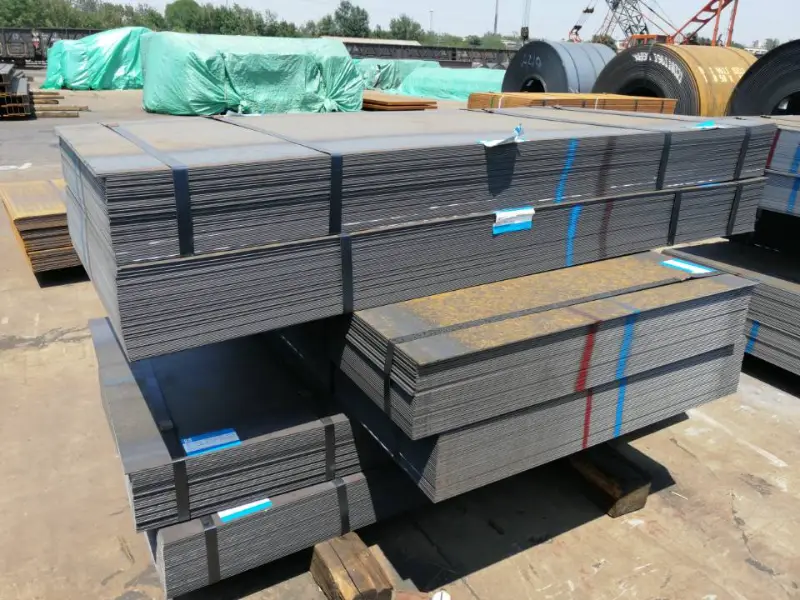
ABS Grade FH40 Shipbuilding Steel Plate
ABS Grade FH40 Shipbuilding Steel Plate - High Strength, Low-Temperature Toughness for Marine Applications
Explore ABS Grade FH40 shipbuilding steel – a high-strength, low-temperature toughness plate for hull structures and offshore platforms, meeting ABS standards with -60°C impact testing.
Cutting (plasma, laser, waterjet), forming (bending, rolling), welding (all common arc processes), machining
- Phone : +8618037372205
- Email : [email protected]
- WhatsApp: Contact via Whtsapp
- WeChat: +8618037372205
ABS Grade FH40 Shipbuilding Steel Plate Introduction
ABS Grade FH40 is a high-strength hull structural steel plate governed by the American Bureau of Shipping (ABS) rules. It belongs to the FH series of high-strength steels with a minimum yield strength of 390 MPa (40 ksi). The letter 'F' designates an impact test temperature of -60°C, ensuring excellent notch toughness at extreme low temperatures, while 'H' indicates high strength, and '40' refers to the yield strength grade.
Main characteristics:
- Superior weldability and cold formability, thanks to fine-grain processing via normalizing or thermomechanical controlled rolling (TMCP).
- Excellent resistance to brittle fracture in Arctic and harsh marine environments.
- Controlled chemical composition with low carbon equivalent values for good weldability without preheating in moderate thicknesses.
- High tensile strength (510–650 MPa) combined with good elongation (≥20%) and reliable impact toughness at -60°C.
- Compliance with stringent international ship classification society standards, making it globally accepted for shipbuilding and offshore structures.
Typical thicknesses range from 6 mm to 150 mm, and the steel is delivered in normalized, TMCP, or quenched and tempered conditions as required. It is widely applied in critical hull members, deck plating, bottom shells, and offshore platform components where strength and low-temperature service are essential.
ABS Grade FH40 Shipbuilding Steel Plate Chemical Composition
The following table lists the typical chemical composition limits for ABS Grade FH40 as per ABS Rules. The steel is fully killed with aluminum and may contain microalloying elements such as Nb, V, or Ti to achieve the required strength and toughness. The carbon equivalent (CE), calculated as C+Mn/6+(Cr+Mo+V)/5+(Ni+Cu)/15, is usually max 0.43% for thicknesses ≤ 50 mm and 0.45% for thicker plates, ensuring good weldability.
| Chemical Element | Standard Value | Remarks |
|---|---|---|
| Carbon (C) | ≤ 0.18% | Lower carbon improves weldability and toughness |
| Silicon (Si) | 0.10–0.50% | Deoxidation and strength |
| Manganese (Mn) | 0.90–1.60% | Key contributor to strength and hardenability |
| Phosphorus (P) | ≤ 0.025% | Controlled for toughness |
| Sulfur (S) | ≤ 0.025% | Minimized for ductility and impact properties |
| Aluminum (Al) | ≥ 0.015% (acid-soluble) | Fine grain practice; grain refinement |
| Niobium (Nb) | ≤ 0.05% (optional) | Microalloying for grain refinement and strength |
| Vanadium (V) | ≤ 0.10% (optional) | Precipitation strengthening |
| Titanium (Ti) | ≤ 0.02% (optional) | Grain refinement and sulfide shape control |
| Nitrogen (N) | ≤ 0.012% (typical) | Controlled for aging behavior |
| Copper (Cu) | ≤ 0.35% (optional) | Improves corrosion resistance (weathering) |
| Chromium (Cr) | ≤ 0.20% (optional) | Hardenability and strength |
| Nickel (Ni) | ≤ 0.40% (optional) | Toughness at low temperature |
| Molybdenum (Mo) | ≤ 0.08% (optional) | Strength in thicker plates |
| Carbon Equivalent (CE) | ≤ 0.43 (thk ≤ 50 mm) / ≤ 0.45 (thk > 50 mm) | Welding guideline value |
ABS Grade FH40 Shipbuilding Steel Plate Thermal and Electrical Physical Properties
The following physical properties are typical for quenched and tempered or normalized carbon-manganese high-strength steel and are not part of the ABS specification. They are provided for design calculations. Values are at room temperature unless noted. Slight variations may occur depending on exact composition and heat treatment.
| Property | Standard Requirement | Unit | Test Condition |
|---|---|---|---|
| Density (ρ) | 7850 | kg/m³ | At 20°C |
| Elastic Modulus (E) | 210 | GPa | Ambient temperature |
| Shear Modulus (G) | 80 | GPa | Calculated from E and ν |
| Poisson's Ratio (ν) | 0.3 | – | Within elastic range |
| Thermal Expansion Coefficient (α) | 12 × 10⁻⁶ | 1/°C | 20°C to 100°C |
| Thermal Conductivity (λ) | 50 | W/(m·K) | At 20°C |
| Specific Heat Capacity (c) | 460 | J/(kg·K) | At 20°C |
| Electrical Resistivity (ρₑ) | 0.15–0.20 | µΩ·m | At 20°C, typical range |
ABS Grade FH40 Shipbuilding Steel Plate Mechanical Properties
The mechanical properties of ABS FH40 are guaranteed by the manufacturer and verified by classification surveyors. The tensile and impact tests are performed on specimens taken in the transverse direction unless otherwise specified. The Charpy V-notch impact test temperature is -60°C. Bend tests are conducted to 180° without cracking. All properties are for the delivery condition (N, M, or Q+T).
| Property | Standard Requirement | Unit | Test Condition |
|---|---|---|---|
| Yield Strength (ReH) | ≥ 390 | MPa | Thickness ≤ 100 mm |
| Yield Strength (ReH) | ≥ 380 | MPa | Thickness > 100 mm ≤ 150 mm |
| Tensile Strength (Rm) | 510–650 | MPa | Thickness ≤ 100 mm |
| Tensile Strength (Rm) | 490–610 | MPa | Thickness > 100 mm ≤ 150 mm |
| Elongation (A5) | ≥ 20 | % | Gauge length 5.65√S0, thickness ≤ 50 mm |
| Elongation (A5) | ≥ 19 | % | Thickness > 50 mm ≤ 100 mm |
| Elongation (A5) | ≥ 18 | % | Thickness > 100 mm ≤ 150 mm |
| Charpy V-Notch Impact (KV2) | ≥ 31 (longitudinal) / ≥ 27 (transverse) | J | At -60°C |
| Bending Test (Mandrel Diameter) | d = 3t (for t ≤ 25 mm); d = 4t (for t > 25 mm) | – | 180° bend, no cracks |
ABS Grade FH40 Shipbuilding Steel Plate Fully Equivalent Standards and Replaceable Grades
| Country/Region | Standard | Grade | Remarks |
|---|---|---|---|
| International (IACS) | IACS UR W11 | FH40 | Unified requirement, same impact temp -60°C |
| USA | ABS | FH40 | Original specification |
| Norway/Germany | DNV | NV F40 | Now DNV GL; same strength and toughness |
| UK | Lloyd's Register (LR) | FH40 | Identical grade designation |
| France | Bureau Veritas (BV) | FH40 | Identical grade |
| China | CCS | FH40 | Identical grade |
| Japan | ClassNK | KFH40 | K indicates high strength for NK |
| Italy | RINA | FH40 | Identical grade |
| South Korea | KR | FH40 | Identical grade |
ABS Grade FH40 Shipbuilding Steel Plate Application Introduction
ABS FH40 steel is specifically engineered for structural applications in ships and offshore installations that require high strength and excellent toughness at very low temperatures. Its typical uses include:
Product Applications: Hull plating (deck, bottom, side shell), Longitudinal and transverse frames, Bulkheads and watertight doors, Offshore platform structural members (legs, bracings)
Processed into products: Ice-strengthened hull sections, Foundation plates for heavy machinery, Stiffeners and brackets in low-temperature service, Pressure hulls for submersibles
Application industries: Shipbuilding (commercial and naval vessels), Offshore oil & gas (platforms, rigs, FPSO), Marine engineering (icebreakers, Arctic ships), Wind energy (offshore wind turbine foundations)
ABS Grade FH40 Shipbuilding Steel Plate Similar / Alternative Materials with Close Properties
| Country/Region | Standard | Grade | Remarks |
|---|---|---|---|
| USA | ASTM A131 | EH40 | Impact at -40°C, otherwise similar strength; lower toughness temp. |
| Europe | EN 10025-4 | S460M/ML | Structural steel with min 460 MPa yield, but not ship class certified |
| USA | API 2H | Grade 50 (TMCP) | Offshore structural plate with 345–517 MPa yield, but different toughness requirements |
| Russia | GOST 5521 | D40 | Shipbuilding steel with 390 MPa yield, impact at -20°C; not directly equivalent |
| Japan | JIS G 3106 | SM520C | Welding structural steel, yield 355–390 MPa; not for low temp |
Notes:
Welding recommendations: Use low-hydrogen processes (SMAW, SAW, FCAW) with appropriate preheating for thickness >50 mm. Post-weld heat treatment (PWHT) is not mandatory but may be used for stress relief. The steel is highly weldable with proper consumables matching the strength level.
Certification: Each plate is stamped with the ABS approval mark, grade, heat number, and must be accompanied by a mill test certificate in compliance with ABS Rules.
Note: For sub-zero service down to -60°C, FH40 is the preferred choice. For service at -40°C, EH40 may be a more economical alternative.
- Share



