
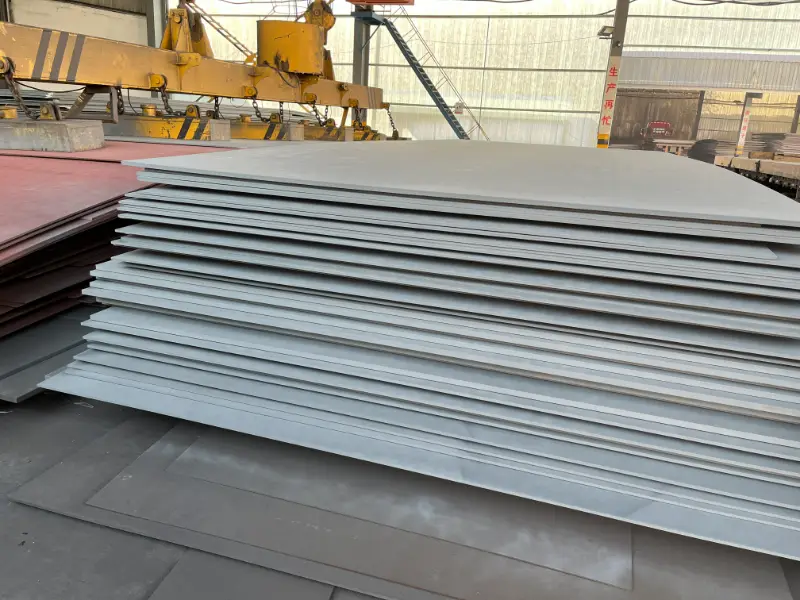
ABS Grade AQ47 Shipbuilding Steel Plate
ABS Grade AQ47 Shipbuilding Steel Plate - High-Strength Quenched & Tempered Marine Steel
Detailed properties, composition, and equivalents for ABS Grade AQ47 high-strength shipbuilding steel plate, used in hull structures and offshore applications.
Welding, hot/cold bending, flame/plasma cutting, machining, shot blasting and painting
- Phone : +8618037372205
- Email : [email protected]
- WhatsApp: Contact via Whtsapp
- WeChat: +8618037372205
ABS Grade AQ47 Shipbuilding Steel Plate Introduction
ABS Grade AQ47 is a high-strength quenched and tempered (Q+T) steel plate for shipbuilding, complying with the American Bureau of Shipping (ABS) rules. Its minimum yield strength of 460 MPa (47 kgf/mm²) provides excellent strength-to-weight ratio, allowing lighter hull designs without sacrificing structural integrity. The 'A' designation indicates a 0 °C impact test temperature, ensuring reliable toughness in moderate cold environments.
The steel is produced by electric arc furnace or basic oxygen process, fully killed, and fine‑grain treated with aluminum and optional microalloying elements (Nb, V, Ti). Low carbon content and controlled carbon equivalent (CEV ≤ 0.43) guarantee good weldability. Typical applications include main hull shell plating, strength decks, bottom structures, and rigid members of offshore platforms. Delivery condition is quenched and tempered; plates are normally supplied with ultrasonic testing per ABS requirements.
ABS Grade AQ47 Shipbuilding Steel Plate Chemical Composition
These limits apply to ladle analysis according to ABS Rules (Part 2, Ch. 1, Sec. 1, Table 2) for Grade AQ47. The steel is fully killed and fine‑grain treated. Carbon equivalent (CEV = C + Mn/6 + (Cr+Mo+V)/5 + (Ni+Cu)/15) is limited to 0.43 max to ensure weldability. Microalloying elements Nb, V, Ti may be added separately or in combination, but their total influence on strength must be controlled.
| Chemical Element | Standard Value (wt%) | Remarks |
|---|---|---|
| Carbon (C) | ≤ 0.18 | Maximum content |
| Manganese (Mn) | 0.90 – 1.60 | Range to ensure strength and toughness |
| Silicon (Si) | ≤ 0.50 | Deoxidiser; excess can reduce toughness |
| Phosphorus (P) | ≤ 0.030 | Harmful impurity, kept low for ductility |
| Sulfur (S) | ≤ 0.030 | Harmful impurity, low for through‑thickness properties |
| Aluminium (Al) (acid soluble) | ≥ 0.015 | Minimum for fine grain size |
| Niobium (Nb) | ≤ 0.05 | Optional microalloy, refines grain and precipitation strengthens |
| Vanadium (V) | ≤ 0.10 | Optional microalloy, controls grain growth during tempering |
| Titanium (Ti) | ≤ 0.02 | Optional microalloy, grain refinement and nitrogen fixation |
| Nickel (Ni) | ≤ 0.40 | Improves toughness; residual/added |
| Chromium (Cr) | ≤ 0.20 | Residual, limited to avoid adverse effect on weldability |
| Molybdenum (Mo) | ≤ 0.08 | Residual, minor effect on hardenability |
| Copper (Cu) | ≤ 0.35 | Residual; higher levels may cause hot shortness |
ABS Grade AQ47 Shipbuilding Steel Plate Thermal and Electrical Physical Properties
The following physical properties are typical for low‑alloy quenched and tempered steels and are not specified in the ABS material standard. Variations can occur depending on exact chemical composition, heat treatment, and temperature. These values are useful for design calculations, finite element analysis, and welding procedure development. Reported at room temperature unless otherwise noted.
| Property | Typical Value | Unit | Test Conditions / Remarks |
|---|---|---|---|
| Density (ρ) | 7 850 | kg/m³ | Room temperature |
| Modulus of elasticity (E) | 205 | GPa | Room temperature, static tensile test |
| Shear modulus (G) | 80 | GPa | Calculated from E and ν |
| Poisson's ratio (ν) | 0.3 | – | Within elastic range |
| Coefficient of thermal expansion (α) | 11.5 × 10⁻⁶ | K⁻¹ | Average between 20 °C and 100 °C |
| Thermal conductivity (λ) | 40 | W/(m·K) | At 20 °C |
| Specific heat capacity (cp) | 460 | J/(kg·K) | At 20 °C |
| Electrical resistivity (ρe) | 0.20 | µΩ·m | At 20 °C |
ABS Grade AQ47 Shipbuilding Steel Plate Mechanical Properties
Mechanical properties per ABS Rules (Part 2, Ch. 1, Sec. 1, Table 3) for Grade AQ47. Tests are performed on tensile specimens taken in the longitudinal direction (transverse if agreed). Yield strength (ReH) and tensile strength (Rm) are determined at room temperature. Impact energy is measured as Charpy‑V notch (KV) at the specified temperature. Bending test is required to prove formability. Properties apply to thicknesses up to 100 mm.
| Property | Standard Required Value | Unit | Test Conditions |
|---|---|---|---|
| Yield strength (ReH) | ≥ 460 | MPa | Room temperature; thickness ≤ 100 mm |
| Tensile strength (Rm) | 570 – 720 | MPa | Room temperature; thickness ≤ 100 mm |
| Elongation (A5) | ≥ 17 | % | Longitudinal test specimen; gauge length 5.65√So (L0=50 mm for round specimen); for thickness >50 mm the same value applies unless otherwise agreed |
| Impact energy (KV, 0 °C) | ≥ 34 (average) | J | Charpy‑V notch, longitudinal specimen, at 0 °C (A grade); individual minimum 24 J; transverse required values are 24 J average, 17 J individual |
| Bending test (180° bend) | No cracks | – | Mandrel diameter d = 3a (a = specimen thickness) for plates ≤ 25 mm; larger mandrel for thicker plates (e.g., d = 4a for t > 25 mm); test performed at room temperature |
ABS Grade AQ47 Shipbuilding Steel Plate Completely Equivalent Material Standards and Substitute Grades
| Country/Region | Standard | Grade | Remarks |
|---|---|---|---|
| International (IACS) | ABS Rules | AQ47 | Original grade; quenched and tempered, YS 460 MPa |
| France | BV Rules NR216 | A460 | Equivalent, Q+T condition |
| Norway/Germany | DNV Rules | A460 | Equivalent, often marked as NV A460 |
| United Kingdom | LR Rules | A460 | Equivalent, also as LR A460 |
| Japan | NK Rules | KA460 | Equivalent, Nippon Kaiji Kyokai |
| Italy | RINA Rules | A460 | Equivalent, Registro Italiano Navale |
| China | CCS Rules | A460 | Equivalent, China Classification Society |
| South Korea | KR Rules | RA460 | Equivalent, Korean Register |
ABS Grade AQ47 Shipbuilding Steel Plate Application Introduction
ABS Grade AQ47 is used extensively in marine and offshore construction where high strength and good toughness are required. Its excellent weldability and formability allow it to be integrated into modern shipyard fabrication processes. Recommendations:
- All welding procedures must be qualified in accordance with ABS Rules and IACS recommendations; preheating may be required for thicker sections according to the carbon equivalent.
- Bending radii should respect the supplied bending test data; cold forming of plates over 25 mm thick may require intermediate stress‑relieving.
- Ultrasonic testing (UT) of plates is typically performed per ABS requirements to guarantee internal soundness.
Product Applications: Main hull shell plating (side, bottom, bilge), Strength decks and stringer plates, Transverse and longitudinal frames, webs, and stiffeners, Hatch coamings and crane pedestal structures, Offshore platform topside structural members (legs, braces)
Processed into products: Shell plates (outboard strakes, sheer strake, keel plate), Bottom and inner bottom floors, girders, Beams, framings, brackets, and knees, Deck plates, deck girders, and longitudinal hatch side coamings, Bulkhead plates, stiffeners, and stools, Rudder horns, skegs, and other high‑stress cast/welded assemblies (when plate is cut and fabricated)
Application industries: Commercial shipbuilding (container ships, bulk carriers, tankers), Naval architecture and military vessels, Offshore oil & gas (jackets, decks, modules), Marine renewable energy (wind turbine foundations, tidal structures), Heavy lifting and transportation barges
ABS Grade AQ47 Shipbuilding Steel Plate Similar / Comparable Substitute Materials
| Country/Region | Standard | Grade | Remarks |
|---|---|---|---|
| Europe | EN 10025-6:2019 | S460Q | Quenched and tempered structural steel with YS 460 MPa; chemistry similar but may have higher carbon and microalloying; toughness at 0 °C (option) comparable; not certified for marine use but often accepted by class with additional testing |
| Japan | JIS G3106:2015 | SM570 | Weldable structural steel with TS 570‑720 MPa and YS ≥ 460 MPa for t ≤ 100 mm; typically supplied as normalized or TMCP, not Q+T; impact temperature 0 °C (optional) matches AQ47; used in bridges and general structures |
| USA | ASTM A514/A514M | Grade Q | Quenched and tempered alloy steel plate with YS ≥ 690 MPa; significantly higher strength than AQ47; suitable for heavy welded structures, but requires careful welding procedures; not directly a substitute but can be considered where weight saving is critical, with class approval |
Notes:
Delivery condition: Quenched and tempered (Q+T). Plates are normally supplied in the QT condition, but normalised delivery may be agreed between the purchaser and the manufacturer if additional testing confirms the required properties.
Certification: Each plate must be stamped with the ABS brand, heat number, grade, and a unique plate identifier. Mill test certificates according to EN 10204 3.1 (or equivalent) are provided with chemical analysis and mechanical test results.
Nondestructive testing: Ultrasonic inspection to ABS requirements is mandatory for plates ≥ 25 mm intended for critical structural members. Higher sensitivity class or full‑surface scanning may be specified.
Weldability: Low carbon content and CEV ≤ 0.43 ensure good carbon‑equivalent weldability; however, for thick sections, low‑hydrogen welding processes and controlled heat input are recommended to avoid cold cracking.
- Share



