
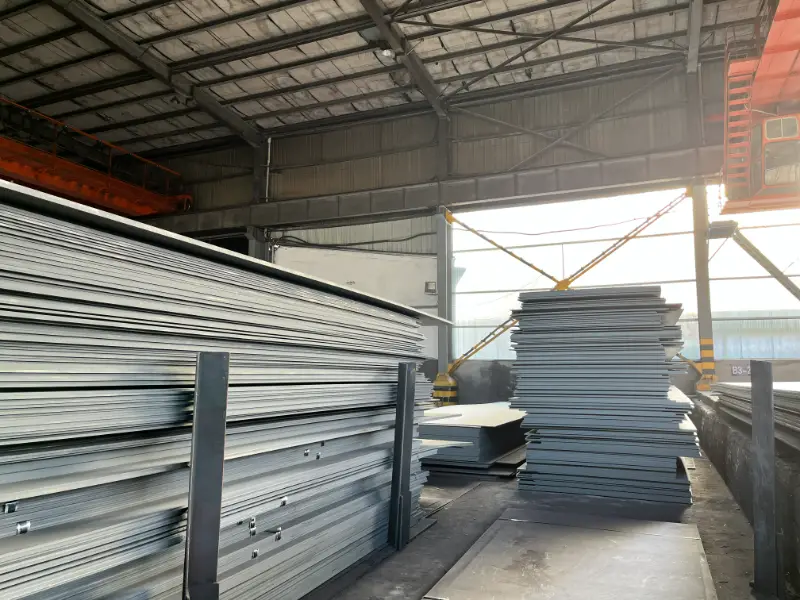
ABS Grade DQ47 Shipbuilding Steel Plate
ABS Grade DQ47 Shipbuilding Steel Plate - High Strength Quenched & Tempered Properties
Detailed material data for ABS Grade DQ47 shipbuilding steel plate, including chemical composition, mechanical properties, physical properties, and international equivalents. Ideal for offshore and marine structural applications.
Welding, gas cutting, plasma cutting, cold forming, hot forming, machining
- Phone : +8618037372205
- Email : [email protected]
- WhatsApp: Contact via Whtsapp
- WeChat: +8618037372205
ABS Grade DQ47 Shipbuilding Steel Plate Introduction
ABS Grade DQ47 is a high-strength quenched and tempered (Q&T) steel plate primarily used in shipbuilding and offshore structures. It offers a minimum yield strength of 460 MPa (47 kgf/mm²) and excellent toughness at low temperatures, making it suitable for critical structural components exposed to dynamic loads and harsh marine environments. This steel grade combines high strength with good weldability and formability, enabling efficient fabrication of complex hull sections and offshore modules. Its fine-grained microstructure, achieved through controlled rolling and heat treatment, ensures reliable performance in demanding service conditions.
ABS Grade DQ47 Shipbuilding Steel Plate Chemical Composition
The chemical composition of ABS Grade DQ47 steel is designed to ensure high strength, good weldability, and adequate toughness after quenching and tempering. Carbon content is limited to maintain weldability, while microalloying elements such as Nb, V, and Ti contribute to grain refinement and precipitation strengthening. The values below represent typical maximum limits as specified in ABS rules, unless otherwise noted.
| Element | Typical Value (max %) | Remarks |
|---|---|---|
| Carbon (C) | 0.20 | Ladle analysis; may be lower depending on thickness |
| Silicon (Si) | 0.55 | Deoxidizer and strength contributor |
| Manganese (Mn) | 0.70 - 1.60 | For strength and toughness |
| Phosphorus (P) | 0.035 | Maximum for improved ductility |
| Sulfur (S) | 0.035 | Maximum for improved toughness |
| Copper (Cu) | 0.35 | Residual element; may improve corrosion resistance |
| Chromium (Cr) | 0.20 | Optional alloying for hardenability |
| Nickel (Ni) | 0.40 | For toughness; may be increased for thick sections |
| Molybdenum (Mo) | 0.08 | Optional for hardenability |
| Niobium (Nb) | 0.05 | Grain refinement |
| Vanadium (V) | 0.10 | Precipitation strengthening |
| Titanium (Ti) | 0.02 | Grain refinement and nitrogen fixation |
| Aluminum (Al) | 0.015 min (acid soluble) | For deoxidation and grain refinement |
| Nitrogen (N) | 0.012 | Maximum to avoid strain aging |
| Boron (B) | 0.0005 - 0.005 | Optional for hardenability in thicker plates |
ABS Grade DQ47 Shipbuilding Steel Plate Thermal and Electrical Physical Properties
The physical properties listed are typical for quenched and tempered high-strength low-alloy steels of this class, valid at ambient temperature unless otherwise noted. These values may vary slightly with exact composition and heat treatment condition but serve as reliable engineering data for design and simulation.
| Property | Typical Value | Unit | Test Condition / Standard |
|---|---|---|---|
| Density (ρ) | 7850 | kg/m³ | At 20 °C |
| Elastic Modulus (E) | 200 - 210 | GPa | At 20 °C, static tensile test |
| Shear Modulus (G) | 80 - 85 | GPa | Calculated from E and Poisson's ratio |
| Poisson's Ratio (ν) | 0.27 - 0.30 | dimensionless | At 20 °C |
| Thermal Expansion Coefficient (α) | 11.5 - 12.5 | 10⁻⁶/K | Range 20 - 100 °C |
| Thermal Conductivity (λ) | 35 - 45 | W/(m·K) | At 20 °C |
| Specific Heat Capacity (cp) | 460 - 500 | J/(kg·K) | At 20 °C |
| Electrical Resistivity (ρe) | 0.20 - 0.30 | 10⁻⁶ Ω·m | At 20 °C |
ABS Grade DQ47 Shipbuilding Steel Plate Mechanical Properties
Mechanical properties are determined on test specimens taken from standard plate locations and prepared according to ABS requirements. The values below are for transverse specimens from quenched and tempered condition. Impact tests are required at -20°C for grade D. For thick plates or special applications, additional testing may apply. All values are minimum unless a range is specified.
| Property | Standard Requirement | Unit | Test Condition |
|---|---|---|---|
| Yield Strength (ReH) | 460 | MPa | Room temperature, 0.2% offset, transverse |
| Tensile Strength (Rm) | 570 - 720 | MPa | Room temperature, transverse |
| Elongation (A) | 17 | % | Gauge length 50 mm (2 in), transverse |
| Impact Energy (KV2) | 27 (longitudinal) / 20 (transverse) | J | -20 °C, Charpy V-notch |
| Bend Test (mandrel diameter) | 3a (a = specimen thickness) | - | 180° bend over mandrel, no cracks |
ABS Grade DQ47 Shipbuilding Steel Plate Fully Equivalent Material Standards and Replaceable Grades
| Country/Region | Standard | Grade | Remarks |
|---|---|---|---|
| International | ABS | DQ47 | Original grade, Quenched & Tempered |
| Norway/Germany | DNV | DQ47 | Identical chemical and mechanical requirements |
| France | BV | DQ47 | Same as ABS DQ47 |
| United Kingdom | LR | DQ47 | Equivalent classification society grade |
| China | CCS | DQ47 | Same specifications under China Classification Society |
| South Korea | KR | DQ47 | Korean Register equivalent |
| Japan | NK | DQ47 | Nippon Kaiji Kyokai equivalent |
| Italy | RINA | DQ47 | Registro Italiano Navale equivalent |
| Russia | RS | DQ47 | Russian Maritime Register equivalent |
ABS Grade DQ47 Shipbuilding Steel Plate Application Introduction
ABS DQ47 is widely used in critical ship and offshore structures where high strength-to-weight ratio and excellent low-temperature toughness are essential. The quenched and tempered condition provides uniform properties through thickness, making it suitable for thick plates in highly stressed areas. Fabrication requires careful control of preheat and heat input to avoid degradation of heat-affected zone properties. The material is typically delivered in the normalized or Q&T condition and can be further processed by cutting, forming, and welding.
Product Applications: Hull plates for container ships, tankers, bulk carriers, Deck plates and bottom shells, Longitudinals, stiffeners, and transverse webs, Jack-up rig leg components, Offshore module structural frames, Mooring components and fairleads
Processed into products: Keel plates, Bilge strakes, Sheer strakes, Hatch coamings, Bulkhead stiffeners, Crane pedestal and boom sections, Fatigue-critical nodes on offshore jackets
Application industries: Shipbuilding, Offshore oil & gas platforms, Marine engineering, Port and harbor infrastructure, Heavy-lift crane manufacturing, Pressure vessel (marine service)
ABS Grade DQ47 Shipbuilding Steel Plate Similar / Alternative Materials with Comparable Properties
| Country/Region | Standard | Grade | Remarks |
|---|---|---|---|
| Europe | EN 10025-6 | S460Q | Minimum yield 460 MPa, Q&T; may have different impact test temperatures |
| USA | ASTM A514/A514M | Type B, H, F, Q etc. | Yield 690 MPa range; some grades have similar carbon equivalent to DQ47 |
| Europe | EN 10225 | S460G2+M/Q | Offshore structural steel with improved toughness |
| International | IACS | EH46 | Thermo-mechanical rolled, yield 460 MPa; not Q&T but similar strength level |
Notes:
- All data presented in this document are typical values based on ABS Rules and common industry practice. They may vary within the permissible range of the standard.
- For specific thickness ranges and product forms, the manufacturer's mill certificate shall be considered the authoritative source.
- Preheat and interpass temperatures during welding must be controlled according to the carbon equivalent (CEV) and plate thickness to prevent hydrogen-induced cracking.
- Post-weld heat treatment (PWHT) is generally not required for this grade when proper welding procedures are followed, but may be specified for thick sections or service conditions involving stress corrosion cracking.
- This material is suitable for use in environments according to the IMO Polar Code with appropriate low-temperature toughness certification (e.g., FQ47 for -40 °C).
- Share



