
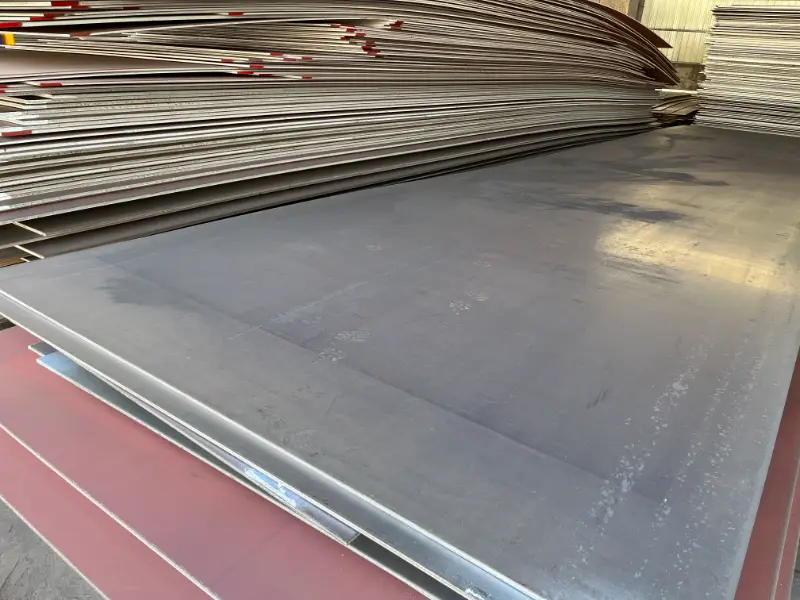
ABS Grade EQ47 High Strength Shipbuilding Steel Plate
ABS Grade EQ47 Shipbuilding Steel Plate: High-Strength Hull Structural Material
In-depth data sheet for ABS Grade EQ47 shipbuilding steel plate covering chemical composition, mechanical properties, thermal and electrical physical properties, international equivalents, and application guidelines.
Cutting, cold forming, hot forming, welding (preheat and post-weld heat treatment as required), machining
- Phone : +8618037372205
- Email : [email protected]
- WhatsApp: Contact via Whtsapp
- WeChat: +8618037372205
ABS Grade EQ47 High Strength Shipbuilding Steel Plate Introduction
ABS Grade EQ47 is a high-strength quenched and tempered shipbuilding steel plate classified under the American Bureau of Shipping (ABS) Rules for Materials and Welding. It offers a minimum yield strength of 460 MPa and is primarily used in the construction of hulls and offshore structures that require excellent toughness at low temperatures. The designation 'E' indicates fine-grain practice and low-temperature impact testing at -40°C, while 'Q' denotes quenched and tempered delivery condition. This grade provides a good balance of strength, ductility, and weldability, making it suitable for critical structural components in harsh marine environments.
ABS Grade EQ47 High Strength Shipbuilding Steel Plate Chemical Composition
The chemical composition of ABS Grade EQ47 is controlled to ensure high strength and low-temperature toughness. Elements such as niobium, vanadium, and titanium may be added singly or in combination for grain refinement. Ladle analysis limits are provided as per ABS Rules. The carbon equivalent (CEV) is typically limited to improve weldability:
- CEV = C + Mn/6 + (Cr+Mo+V)/5 + (Ni+Cu)/15 ≤ 0.53% for plates ≤ 50 mm thick
| Element | Standard Value (wt.%) | Remarks |
|---|---|---|
| Carbon (C) | ≤ 0.20 | For thicknesses ≤ 12.5 mm; higher thicknesses may have reduced limits |
| Manganese (Mn) | 0.70 - 1.70 | Higher Mn range provides strength and toughness |
| Silicon (Si) | ≤ 0.55 | Deoxidizer; excess may impair toughness |
| Phosphorus (P) | ≤ 0.025 | Maximum allowed; low P ensures cleanliness |
| Sulfur (S) | ≤ 0.025 | Maximum allowed; low S for improved toughness and HIC resistance |
| Aluminum (Al), acid soluble | ≥ 0.015 | Minimum required for fine-grain practice |
| Niobium (Nb) | ≤ 0.06 | Optional grain refiner; combined V+Nb+Ti ≤ 0.12% |
| Vanadium (V) | ≤ 0.10 | Optional; may be used for precipitation strengthening |
| Titanium (Ti) | ≤ 0.02 | Optional; for grain refinement and sulfide shape control |
| Nitrogen (N) | ≤ 0.015 | Typically limited to prevent strain aging |
| Copper (Cu) | ≤ 0.40 | May be present; not required |
| Nickel (Ni) | ≤ 0.40 | May be present; improves toughness |
| Chromium (Cr) | ≤ 0.30 | Optional; may be added for strength |
| Molybdenum (Mo) | ≤ 0.08 | Optional; enhances hardenability |
ABS Grade EQ47 High Strength Shipbuilding Steel Plate Thermal and Electrical Physical Properties
Physical property data are representative of carbon-manganese high-strength structural steels. Actual values may vary with composition and heat treatment.Density (ρ) and specific heat capacity are essential for welding heat input calculations. Thermal conductivity (λ) influences the cooling rate.
- Values are measured at room temperature unless noted otherwise.
| Property | Typical Value | Unit | Condition / Temperature |
|---|---|---|---|
| Density (ρ) | 7.85 | g/cm³ | 20°C |
| Elastic Modulus (E) | 210 | GPa | 20°C |
| Shear Modulus (G) | 80 | GPa | 20°C |
| Poisson's Ratio (ν) | 0.30 | - | 20°C |
| Thermal Expansion Coefficient (α) | 12.0 × 10&supminus;⁶ | 1/K | 20°C to 100°C |
| Thermal Conductivity (λ) | 50 | W/(m·K) | 20°C |
| Specific Heat Capacity | 460 | J/(kg·K) | 20°C |
| Electrical Resistivity (ρe) | 0.20 × 10&supminus;⁶ | Ω·m | 20°C |
ABS Grade EQ47 High Strength Shipbuilding Steel Plate Mechanical Properties
Mechanical properties are determined on transverse test pieces in accordance with ABS testing requirements. Impact tests are conducted at -40°C for Grade E. Yield strength (ReH) and tensile strength (Rm) values depend on plate thickness; below table covers the most common thickness range.
- For thicknesses over 50 mm, properties may be slightly adjusted per standard.
- ABS requires that the ratio ReH/Rm does not exceed 0.92 for quenched and tempered steels.
| Property | Required Value | Unit | Test Condition |
|---|---|---|---|
| Yield Strength (ReH) | ≥ 460 | MPa | Thickness ≤ 50 mm; transverse specimen |
| Tensile Strength (Rm) | 570 - 720 | MPa | Thickness ≤ 50 mm |
| Elongation after fracture (A) | ≥ 17 | % | Gauge length L0 = 5.65√S0 |
| Bend Test, 180° | d = 4t, no cracks | - | Diameter of former: 4 times plate thickness (t); for plates ≤ 25 mm |
| Bend Test, 180° | d = 5t, no cracks | - | For plates > 25 mm to ≤ 50 mm |
| Impact Energy (KV), longitudinal | ≥ 60 (average); 47 (individual) | J | At -40°C; Charpy V-notch; unless otherwise agreed, thickness ≥ 5 mm |
| Impact Energy (KV), transverse | ≥ 41 (average); 33 (individual) | J | At -40°C; Charpy V-notch, transverse samples |
ABS Grade EQ47 High Strength Shipbuilding Steel Plate Complete Material Equivalents and Substitutable Grades
| Country / Region | Standard | Grade | Remarks |
|---|---|---|---|
| International (IACS) | DNV Rules | E460 | DNV GL classification; same minimum yield strength 460 MPa |
| International (IACS) | LR Rules | EH47 | Lloyd's Register high-strength steel; impact at -40°C |
| International (IACS) | BV Rules | EH47 | Bureau Veritas equivalent grade |
| International (IACS) | GL Rules | E460 (now DNV GL) | Germanischer Lloyd, merged into DNV GL |
| International (IACS) | CCS Rules | EH47 | China Classification Society equivalent |
| International (IACS) | NK Rules | KE47 | Nippon Kaiji Kyokai (ClassNK) counterpart |
| International (IACS) | KR Rules | REH47 | Korean Register high-strength hull steel |
| International (IACS) | RINA Rules | E460 | Registro Italiano Navale equivalent |
| Europe | EN 10025-6 | S460QL / S460QL1 | Quenched and tempered structural steel; close mechanical match; check chemistry and delivery condition |
| USA | ASTM A514 / A517 | Grade Q / other grades | High-strength quenched and tempered alloy steel plate; grades with 690 MPa – check for equivalent strength |
ABS Grade EQ47 High Strength Shipbuilding Steel Plate Application Introduction
ABS Grade EQ47 is engineered for the most demanding structural applications in shipbuilding and offshore engineering. Its combination of high strength, excellent low-temperature toughness, and good weldability allows for lightweight design without compromising structural integrity. Key considerations for use include:
- Strict adherence to welding procedures, including preheat and interpass temperature control, to avoid cold cracking.
- Post-weld heat treatment (PWHT) may be required for thick sections.
- Plates are normally delivered in the quenched and tempered condition; hot forming should be minimized to preserve properties.
Product Applications: Hull plates for large container ships, bulk carriers, tankers, Deck and bottom longitudinals, Transverse web frames and girders, Hatch coamings and corner plates, Offshore module support structures, Jacket legs and nodes (subject to compliance with offshore standards), Crane pedestals and heavy lift beams on vessels
Processed into products: Shell plating (side, bottom, sheer strake), Strength deck plating, Bilge keel elements, Rudder horn and rudder stock support, Hatch corner reinforcement pads, Transition pieces in offshore wind substructures, Lifting padeyes and strongpoints
Application industries: Commercial Shipbuilding, Naval Shipbuilding, Offshore Oil and Gas, Renewable Energy (Offshore Wind), Floating Production Storage and Offloading (FPSO) Units, Ship Repair and Conversion, Marine Heavy Lifting and Transportation
ABS Grade EQ47 High Strength Shipbuilding Steel Plate Similar or Alternative Material Recommendations
| Country / Region | Standard | Grade | Remarks |
|---|---|---|---|
| International (IACS) | ABS Rules | EQ43 | Next lower strength level (yield ≥ 420 MPa); similar toughness but reduced load capacity; possible alternative if design allows |
| International (IACS) | ABS Rules | EQ51 | Next higher strength level (yield ≥ 500 MPa); higher strength but may require more stringent welding controls |
| International (IACS) | ABS Rules | DQ47 | D-grade equivalent with impact test at -20°C; not suitable for extreme low-temperature applications unless verified |
| Europe | EN 10025-6 | S460QL | Q&T steel with similar yield; verify chemical and impact requirements to match EQ47's -40°C toughness |
| USA | ASTM A709 | Grade 50CR (HPS 50W) | High-performance steel used in bridges; yield 345 MPa, not a direct replacement but offers improved weather resistance; requires strength upgrade |
| Japan | JIS G 3128 | SHY 685 | High yield strength steel for welded structures (yield 685 MPa); over-matching strength but may need re-qualification for marine applications |
Notes:
- All properties are based on ABS Rules for Materials and Welding (2023) and typical industrial data. Actual certification values must be obtained from mill test certificates.
- The carbon equivalent (CEV) shall be reported by the manufacturer for each heat and should not exceed the agreed maximum to ensure weldability.
- Ultrasonic testing is normally required in accordance with the applicable class rules.
- For offshore structures, supplementary requirements such as through-thickness properties (Z35) or increased impact testing may be invoked.
- This grade is not intended for high-temperature service above approximately 250°C without special consideration due to potential temper embrittlement.
- Share



